Essay 3: Chess has Baggage
Designing with and around "baggage"

This essay is the third and final essay in a series about repurposing board games for RPGs. I wrote it as part of the design process for Violent Delights: A chess-based RPG about Shakespeare’s Romeo & Juliet.

An Epic Task
I am working on a game called Violent Delights, which is a chess-based RPG about Shakespeare’s Romeo & Juliet.
Yes, I know what you are thinking. That is an epic task! I am seeking to invoke — nay, to challenge — one of the all-time greats!
A goliath of the West stands before me, and his name is… Shakespeare? No. Well, him too.
But I’m talking about chess, one of the most widespread and influential games in the world.
You’ve Got Baggage
To be blunt, the central challenge that I’ve faced in writing this game is baggage — of Shakespeare, chess, the Firebrands mini-games that I adapt. All games have baggage, these intangible things that they carry into the designs. And that baggage is especially clear when you’re trying to adapt existing art, like the plot from Romeo & Juliet, the mechanics of chess, or public domain illustrations, pre-1929. Oh, a blackjack mechanic? You’ve got baggage. Firebrands mini-games? That’s Baker baggage (positive). One of the most popular games in the world? It has Baggage.
Baggage affects play. It’s something that your game text can try to account for but can’t always control. It creates expectations: X system is meant for genre emulation. They can do Z in Lord of the Rings, so why can’t we do it in this game? The pre-1929 illustrations that you’re using only depict men; does that imply this character should be a man?
That baggage can also be political or ethical, and you position your design in relation to that baggage, sometimes implicitly. In my game SPINE, I considered using the hangman’s game as a creepy clock mechanism. When I learned about the baggage of this children's game — its history with white cap parties and connection to lynching in the U.S. — I decided that I was not going to use it at all.
And now while writing Violent Delights, I have wondered, “Is my game just another layer of paint on Shakespeare’s pedestal or am I inviting critical engagement with Romeo & Juliet?” And good lord, um. What about chess?
Chess Has Baggage
I do not wonder if I am engaging with chess’s baggage. That is my intention. What I have been wondering is how to handle all of the baggage.
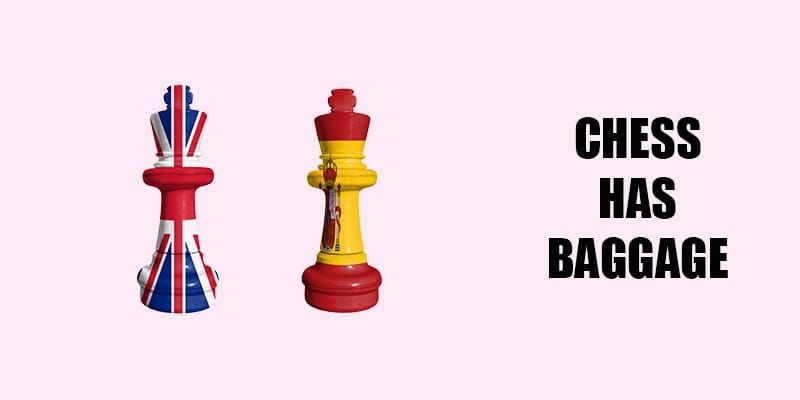
Chess is not an innocuous game, at least it hasn't been historically. I am not saying that you are actively causing harm by playing it, but I think we should be mindful of its past. Chess is not the oldest game in the world, not remotely close. It’s existed since at least the seventh century, possibly originating in northwest India. The modern version that most people are familiar with (as opposed to say xiangqi, which is also in the chess family) was appropriated in 13th-century Spain and spread through Italy and France.
The pieces were changed to reflect a western European idea of monarchy, and the popularity of "Western" chess since then is owed largely to European colonialism. The game, which may represent a battlefield or court politics, is abstract, and in its abstraction it may not explicitly endorse imperialism. And yet it reproduces some of these values in its “ludic logics,” as Mary Flanagan and Mikael Jakobsson suggest in Playing Oppression (pg 21).¹ And I expect you can find historical examples in which an imperialist interpretation is made explicit, is implied in the design and materials of pieces for unique chess sets, or in which chess is used for colonial interests, like practicing strategy.
And so as I was formulating ideas for Violent Delights (or whatever shapeless thing it was at that time), I thought to myself, it could be fun to turn chess on its head.
In chess, the two kings may never be in adjacent squares, which would make the king vulnerable and undermine the purpose of the game. And I said to myself, “Wait. Has this been a game of forbidden love all along? In chess, the kings may never kiss.”
What if chess is not a game of war or nations? What if chess is really about love and vulnerability?
Handling Baggage.
The next question I asked myself was, “If the real goal of the game is for kings to kiss, what are the other pieces doing? What do the rules do?” Are they trapping the kings in social or political obligation? They have prevented the kings from being vulnerable for centuries. Is chess’s conflict a symptom of the rules that forbid its underlying goal?
Chess encourages players to make moves that protect and trap the kings; this is the system at play, a social order and game system preventing the kings from acting on their desire. In Violent Delights, every move that enables the kings to approach one another is an act of defiance. Moving in this way creates dissonance, but it’s a desirable dissonance that raises awareness of real systems.
I expected that chess’s rules and strategies were so standardized and well-known that diverging from the rules would create dissonance for players — this is baggage as well when designing with chess. But this baggage is very heavy, so there had to be a structure that pushed players out of chess habits, that encouraged them to think about their chess pieces differently, to ask: “This might be the best chess move, but is this what my bishop would really do in this situation?”
I also reframed the game. Chess has a prelusory goal: trap the opponent’s king. Tabletop RPGs rarely have prelusory goals. I had to clarify. This game has two possible endings: either the kings kiss or they are trapped. You may feel drawn to one of these endings, but neither is your goal. Your goal is to play your characters and craft a compelling story. In playtesting, I found out that this is the key rule for this game and changed the game text so that it would be in “flashing lights,” so to speak.
And yet, chess’s baggage is so heavy that this isn’t enough. I remarked to Alex Rinehart, who helped playtest the game in its earliest stage, “if this were a grid of a ballroom with character tokens and no chess rules, we could probably just inhabit our characters and see whether Romeo and Juliet kiss or if society succeeds at keeping them apart. No baggage. But the baggage is also what makes it interesting to me.” I wanted that friction or dissonance between the desires of a character and the systems that govern them.
Alex helped me realize that if I wanted players to feel dissonance without feeling as if the game was misfiring, then I needed an effective “relief valve” to balance it out.
Checked Baggage.
Some people may push back against the claim that chess is an abstract board game. It isn’t as abstract as checkers or mancala, for example. Its pieces are characters of a sort, although the character of these pieces are abstract enough as to have little impact on why we move them.
It should be quite easy to impose a new character over them, except that the pieces are gendered.
I debated whether I should stick with a story of two kings who want to kiss. I understand if some are disappointed that this is only latent now. But I didn’t want kings or a battlefield or court politics. I wanted a tale of forbidden love, of bedrooms and ballrooms, of family and friends. Romeo and Juliet is the classic that brings this baggage, and I saw a compelling parallel with chess in the Capulet’s masquerade scene, where Romeo and Juliet first meet and kiss. I also saw in it a compelling parallel in gender dynamics of the early modern stage, in that latency.
There is a sorcery in taking chess’s king and telling the players he is a woman. It is reminiscent of Shakespeare’s stage in which you present a young male actor and tell the audience he is now a woman. The audience knows she was a man, if only because women were not allowed on stage, but because she is a woman, she and Romeo may kiss without repercussion.
And what of the queen in chess, whom I have made an antagonist? I hesitated to make the antagonists feminine-coded, and yet I wondered, What desires are implied in a queen’s pursuit of the enemy king, in Paris's pursuit of Juliet? In Tybalt’s pursuit of Romeo? These, I thought, may be fruitful relationships to let the players unpack their baggage and experiment. Love and violence are two sides of the same coin. Whichever side the coin lands on will invite high emotional stakes.
There’s more baggage besides. These pieces are stratified by social class, which has always been a rich avenue to narrativize in chess, in the pawn’s value, in the possibility that these pieces transform or promote into something else. Chess creaks beneath its immense baggage. It’s hard to understand how people can ignore it whenever they play the game “properly.”
Conclusion
It may be clear at this point that baggage is not simply something to acknowledge or design around but to harness. In games, we are always making sense of rules within our cultural contexts, just as much as we make sense of the books we read and media we consume. But one unique thing about games is that this process can be inverted, more so than with other media. Players can also use a game to make sense of their own culture and context. To some extent, I am doing that with chess.
More than that, whereas most media is good at making statements, RPGs are good at asking questions and extending invitations. I see myself as repackaging chess’s baggage and sending it to players as an invitation in Violent Delights.
And finally, I want to acknowledge that baggage may not be the best term. Baggage has baggage. Not everything that I have called baggage is necessarily a burden or impediment. And I could have framed this essay in terms of adaptation studies or reception studies. That may have made me sound well-informed. But I suppose I didn’t want the baggage that comes with it. Everything has baggage, really. It’s what you do with it that matters.
Other Essays and Interviews in This Series
- Essay: Chess Supports Roleplay
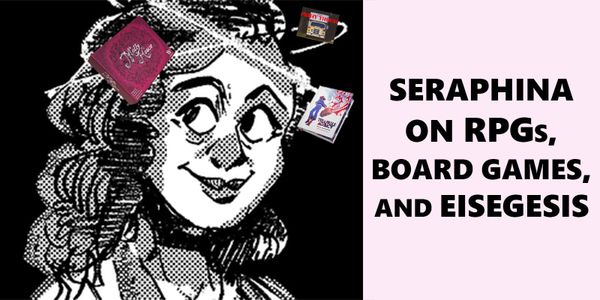
- Interview: Seraphina Garcia Ramirez on RPGs, Board Games and Eisegesis
- Essay: Chess is a Boxed RPG
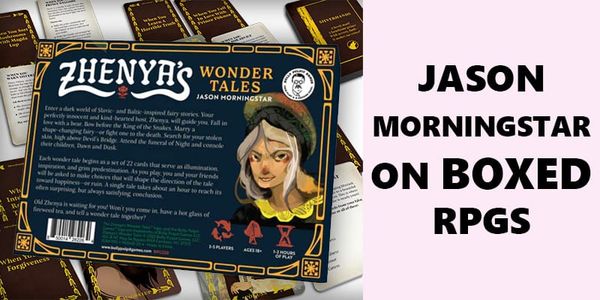
- Interview: Jason Morningstar on Boxed RPGs
- Interview: David Harris on Adaptation and the Public Domain Game Jam
References
Flanagan, M., & Jakobsson, M. (2024). Playing Oppression: The legacy of conquest and empire in colonialist board games. The MIT Press.
¹ From Chapter 2: Establishing Mindsets: Politics and Ideology in Early Board Games, "Chess was played in medieval courts, as it was considered quality entertainment as well as strategic practice. The design of chess prioritizes strategy and assigns different classes of characters specific abilities, mimicking the kinds of roles one might have in a hierarchical society. The game privileges 'noble' conditions of conflict by its formal turn taking, assignment of power to the titled pieces, and goal of protecting the king. Social structures and class stratification from a thousand years ago are reflected by the strict division between pawns and nobles. Chess also teaches that certain people (the pawns) are expendable for larger initiatives or lives deemed more important (the royals). In fact, violent conflict itself is a value that goes unquestioned in gameplay. For example, nowhere in the standard game do we find opportunities for negotiation. ... These time-tested classic games tell stories through their physical properties, such as their materials of construction—but they also communicate through the rules, objectives, mechanics, and overall ludic logics under which players operate."