The Problem with Production Value
A Retrospective on SPINE and Production Value


This post is indebted to the Explorers Design and Dice Exploder discords. Thank you to everyone who let me pick their brain on what production value means and its relationship to production quality.
High Production Value Isn’t Always Good
Production value is a term that is used in a few different creative industries and hobbies, from film and board games to digital media and streaming. I have seen it discussed occasionally in tabletop RPGs, and it is a category in the ENNIEs. Generally, it can mean the perceived expense or worth of a product based on material, features & accessories, and technical criteria. Sometimes it can be the deciding factor in whether someone might buy a print copy instead of the PDF or whether they might “spring for shipping.”
Good production value in tabletop RPGs is high production value, typically. It might be a premium book — a hardcover with luxurious features, like generous art, a foil-stamped or embossed cover, painted page edges, or ribbon bookmarks. Consider Koriko, silver in production value for the 2024 ENNIEs, or Warhammer’s Enemy Within Collector’s Edition, silver winner in 2023. Or it might be a boxed set with exciting, toylike play materials, like the Mothership Deluxe Set or the Land of Eem Deluxe Box (gold and silver 2025).
 Mousehole Press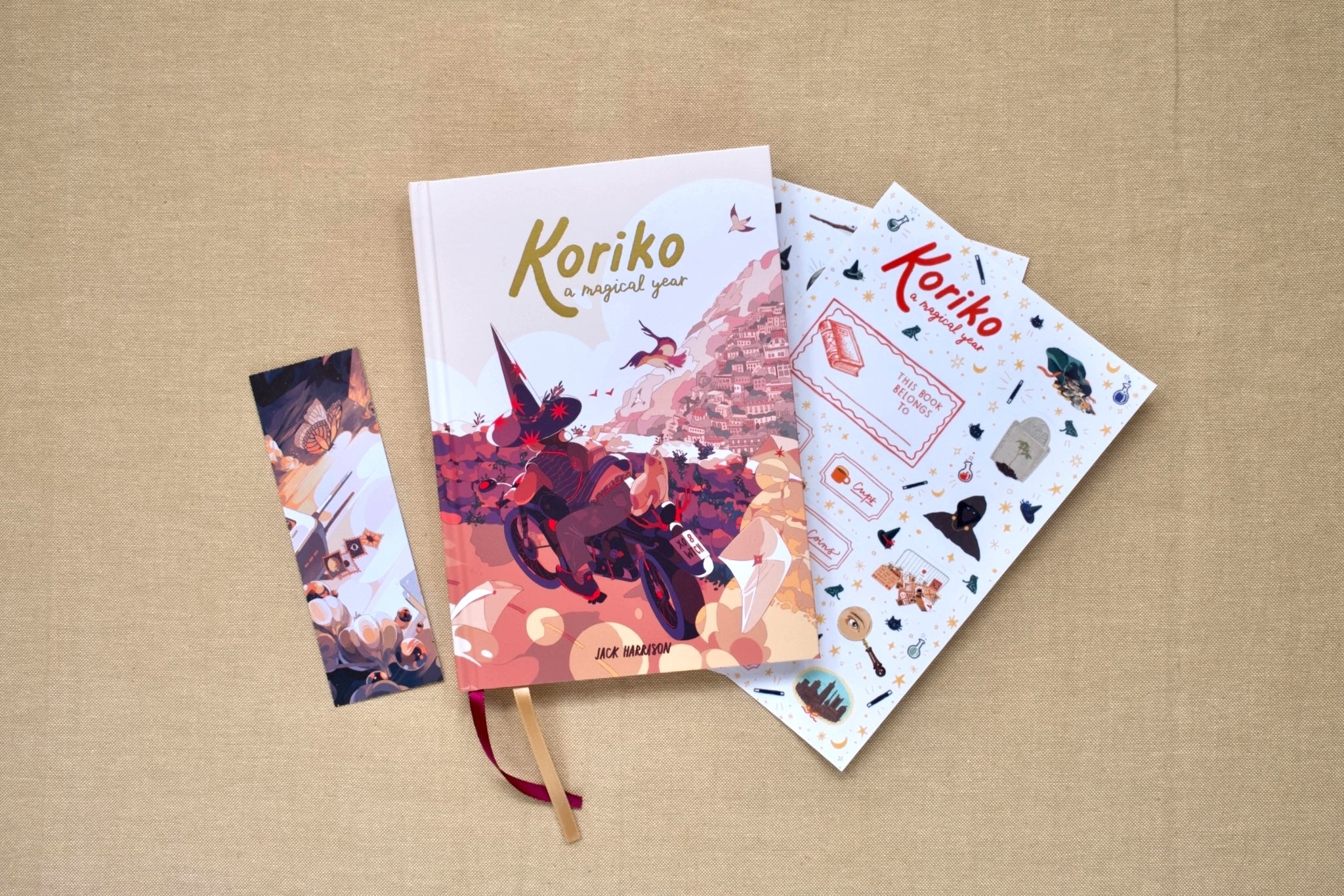
High production value is often a good thing for a game, and I display these games admiringly on my shelves. Yet, I think one of the best things about my game SPINE is its lack of production value. In other words, I don't think that high-production value is a good thing for every game.
One factor is the expense. Unlike film or digital content (in my amateur assessment), tabletop RPGs often need to pass on the expense of premium features to the consumer. Some products can become exorbitantly expensive for certain audiences, particularly boxed sets when they are shipped internationally and taxed differently than a tabletop RPG book.
But personally, really, I care more about production quality than I do about production value. Conventionally, production quality is well-executed, consistent manufacturing and the durability of materials — their ability to withstand the stress of their function and use. To me, it also means that the final product is well-designed and that its form coheres with the content and function of a game book.
Production quality factors into production value, and I think that production value is often conflated with quality as a result. However, value does not confer quality. And sometimes the aim for high production value can run contrary to a game’s interests.
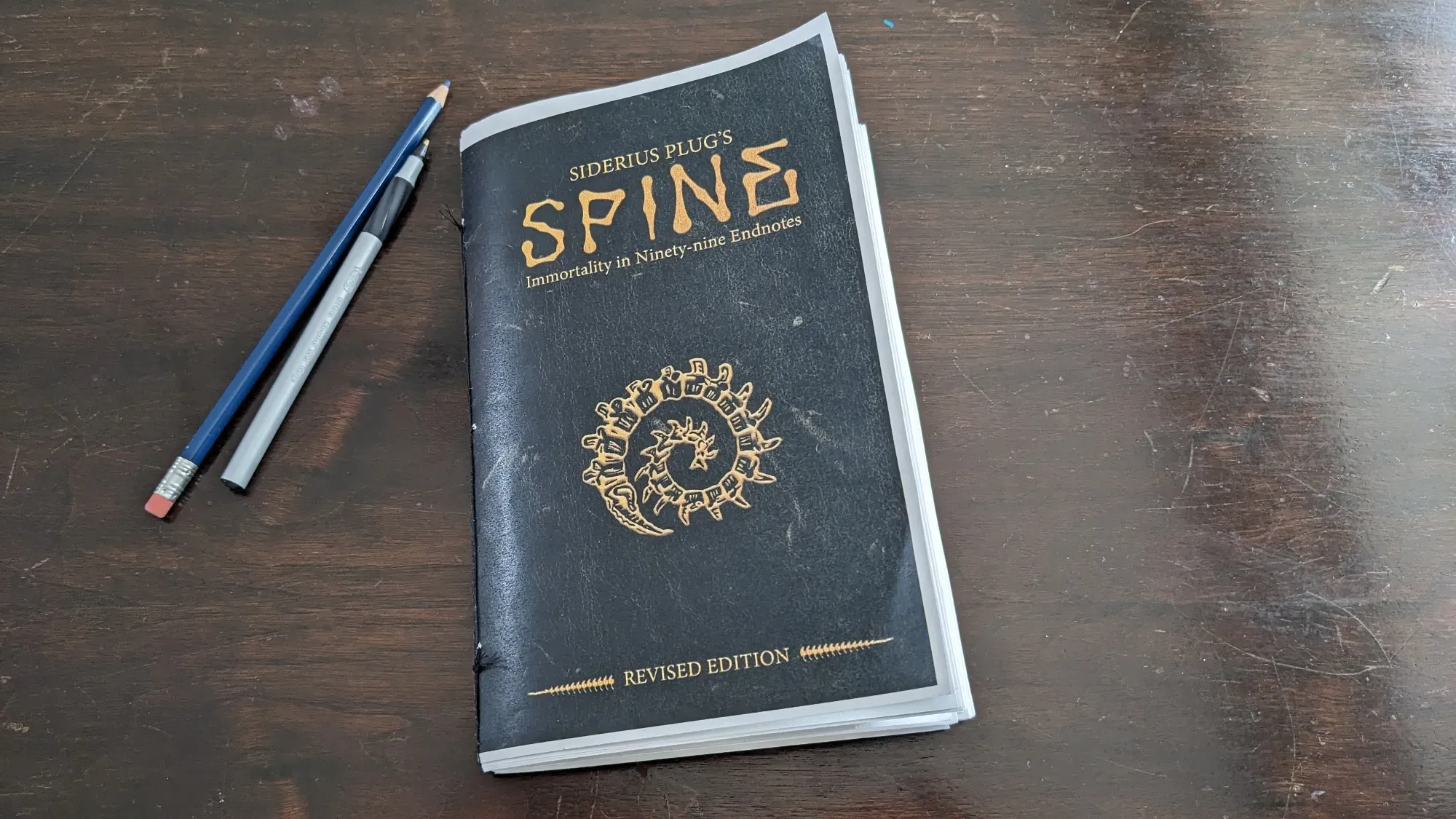
I have thought about this a lot recently because I had to make choices around production value for SPINE, particularly about what form the game would take. I landed on a PDF booklet for print-and-play and an affordable print-on-demand option — a perfect-bound paperback. Neither of the options that I chose qualify as high production value, but they cohered with the content and function of the book object.
Reflecting on this decision six months later, I would say that it has been in the game’s best interest.
Form and Function
Many RPG books are meant to function as play aids at the table, referenced occasionally. Others — like solo RPGs and some GMless games — are meant to facilitate play in a role analogous to a game master. SPINE is of the second category. But it is also meant to be transformed and treated as an artwork, an object whose meanings you create and re-create through play, similar to a “keepsake” game. You will sign the book. You will throw it. Pages will be torn. Margins will be written in. During the design process, I had to ask, “How can the book’s form facilitate its function, especially when many people are hesitant to “damage” a book?”
In SPINE, I wanted a book that players didn’t need to be precious with. This is an obvious example where high production value would hinder the book’s function.
Who would want to modify a gorgeous book with premium features, especially when you paid well for it?
Early on in the project, I understood that SPINE would need a print-and-play version, not only to keep it affordable and make it broadly available but also to make it easier for people to modify: you’re most likely using cheap paper and standard print quality to create it. Also, a print-and-play booklet is (in some ways) an object that you have created, and you have a very different relationship to that object than something you have purchased. There’s no need to be precious with this booklet.
As for the print edition, SPINE could not have premium features, although I admit that a ribbon bookmark would be very functional. Beauty and luxury would be obstacles for a book that you modify. Premium features would also make it less affordable, but SPINE needs to be affordable. The higher its perceived monetary value, the less likely some will be to modify it. In fact, I cut my margins on the print version significantly to keep it affordable. I make $3 on every print copy sold.
That’s a low margin.
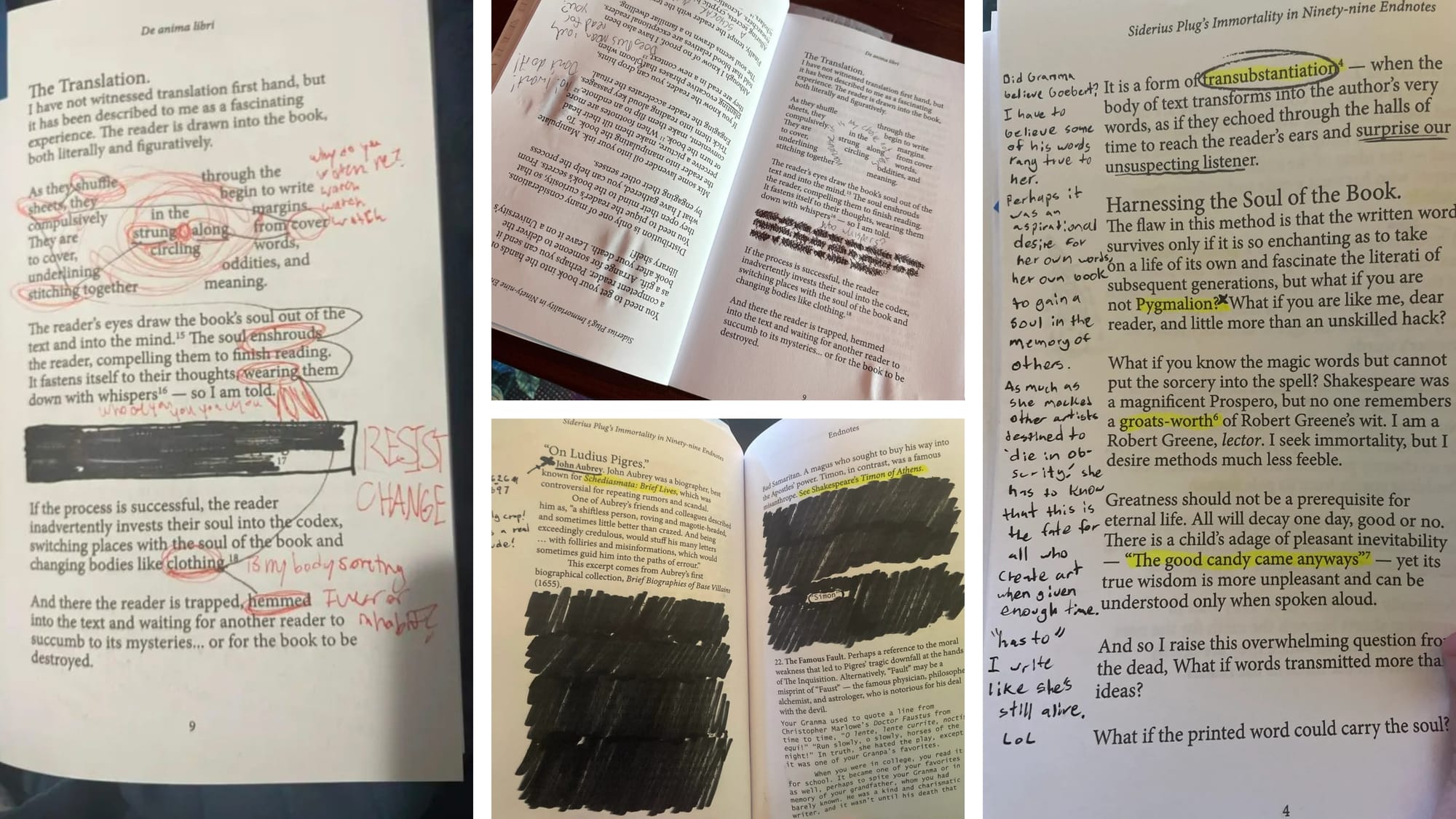
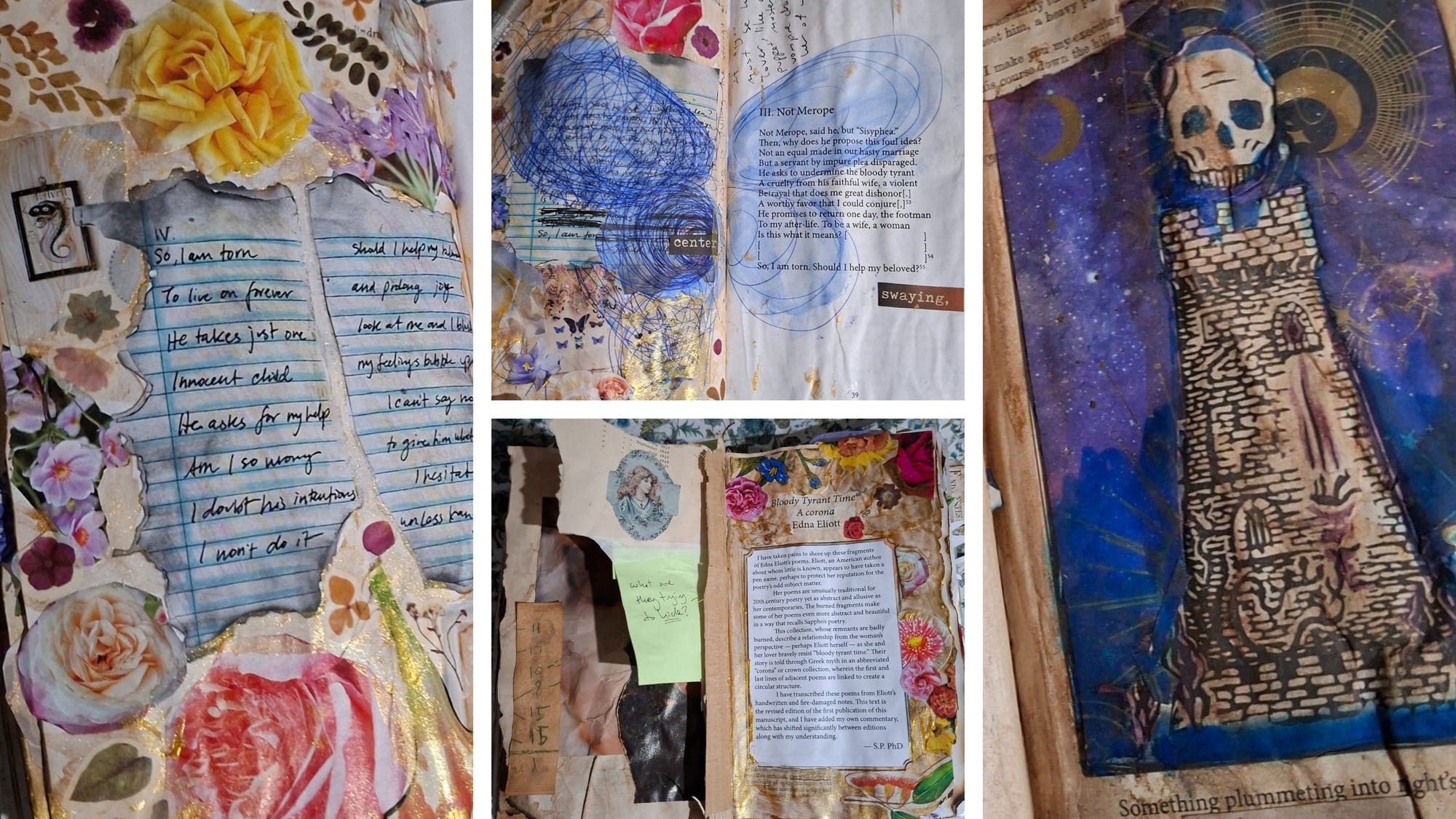
In my eyes, these forms have been successful at getting people to modify their books. They still whisper, “This is so wrong” as they drip water on the pages, but this is the right amount of wrong, and I have loved how many players have shared photos of their books. The beauty in these books is not in its manufacturing as much as it’s in the way that the player transforms them — in the book that the player is producing.
Form and Content
SPINE is meant to resemble a book that you inherited from a relative. It is implied that this book was amateurly printed and bound. The layout and visual design leans into this with linocut prints and printing errors. They are convincing enough to have confused Mixam, the printing company, who suggested that I correct some of these errors while reviewing my first proof. Later, they accidentally printed a copy with its covers upside-down, and I suspect it was for similar reasons.
Premium features would detract from the amateur aesthetic. The book is also supposed to seem “academic." Its visual design is traditional and simple. It is also "cursed," if not a little ugly.
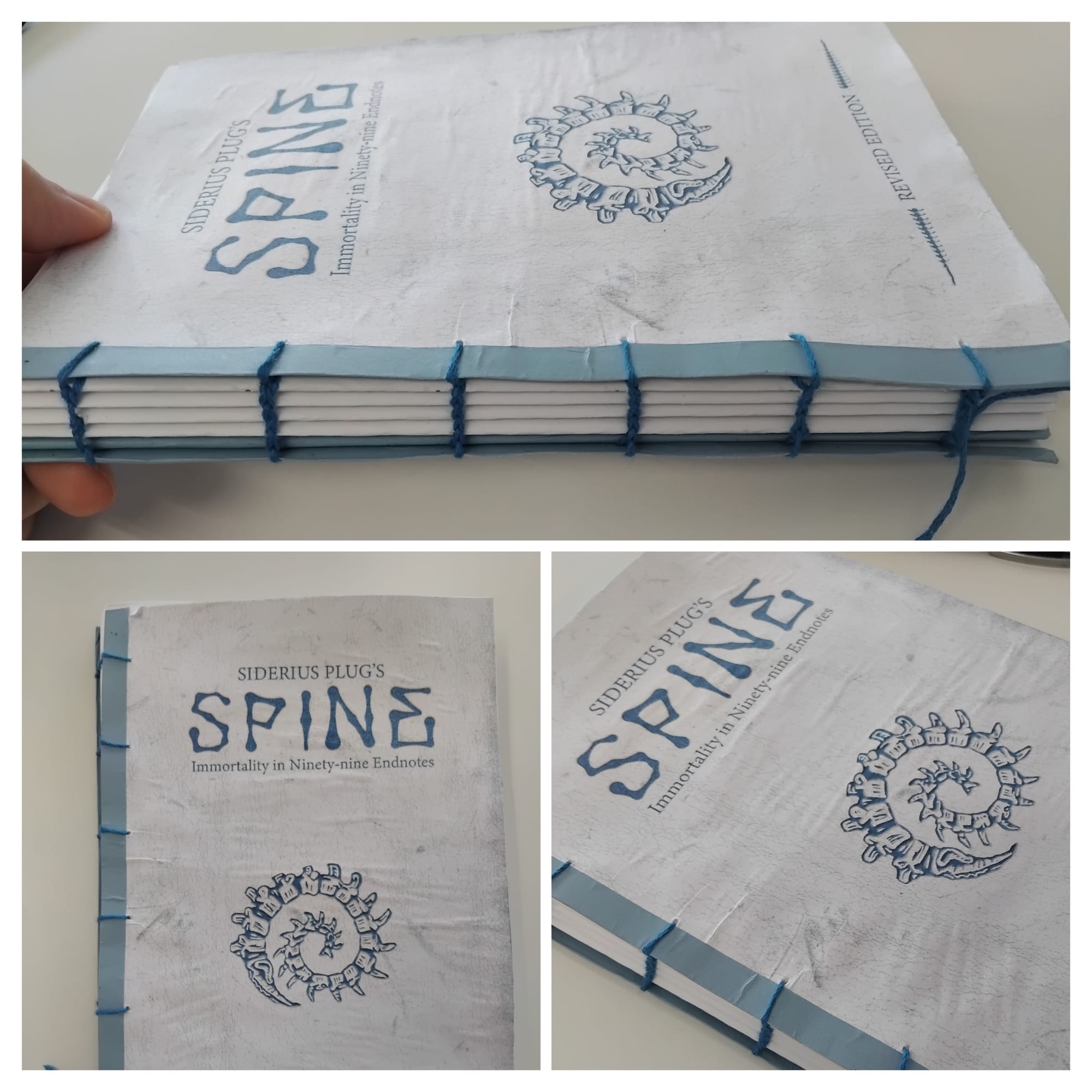
This context is especially relevant for the print-and-play version. To my surprise, the amateur aesthetic of the fictional book has encouraged players to bind their own books and to share their photos.
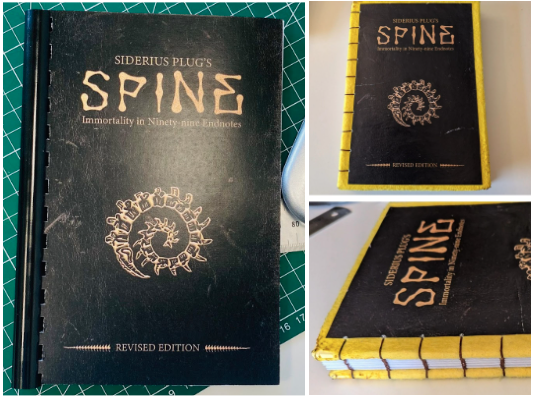
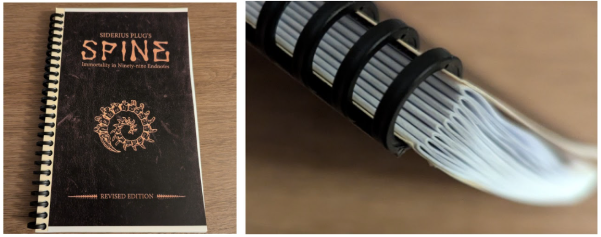
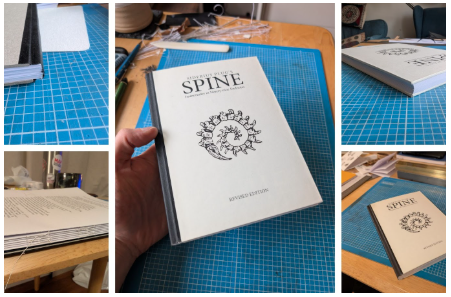
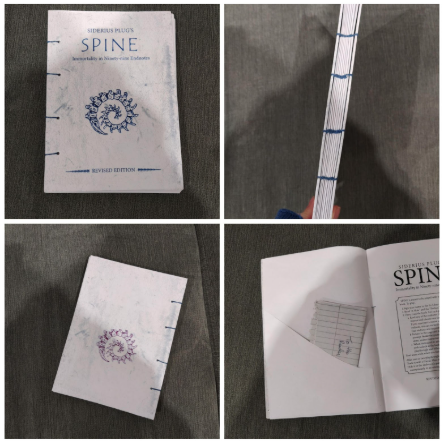
In order: A coilbound copy of SPINE by brettrolfe; Coptic binding with six signatures by rspbrykat; A bound copy of SPINE with 9x4 page signatures and printed cover by tenpenjenn; A binding of SPINE by @stampyourfoot: “It's a stiffened board binding with 9 signatures, stitched and then boards glued to the endpapers. I was surprised at how relatively easy the whole process was!”; A coptic binding of SPINE by Kincajou. Modifications include cover title and colors, plus a pocket for the “To the Reader” note.
In SPINE the book also functions as a prop. Players who have bound their own copies lean into the book as a prop. There is space here, I think, for a high-production value print version — foil-stamped leather cover, ribbon bookmark, stitched binding — but it would conflict with the function of the book. And I wonder, if this were the standard option, would it discourage people from binding their print-and-play books? I don’t know.
Maybe I will offer a premium version of SPINE to decorate shelves one day, but if I do it will be a limited run, and I suspect it wouldn't be played as I would like.
Conclusion
I recognize that these decisions are unique because SPINE leans into the book as a prop and as artwork. Yet, it’s important that our RPG books are functional. I think there is also an aesthetic or artistic value in how the book object reinforces the content and themes of a game — one that may be more important than production value, although not necessarily as lucrative.
Maybe what I have done for SPINE is an example of a good low-value production. I can also acknowledge that my definition of production value may be too restrictive or my definition of production quality too broad.
In any case, I will say that I don’t think people see the cover of SPINE and think, “I have got to decorate my shelves with that book!” But I do think that they may read what SPINE is about, see the book, and think, “I’m going to give this a try.”
That’s what I am hoping for.