Monthly Mecha: Reverse Battleship w/ John Mulligan of Exeunt Press
Mecha TTRPGs Monthly

This is Asa Donald with your monthly mecha rpg for May. This newsletter is 100% free. To support it, me, or my games, sign up for my upcoming Kickstarter Violent Delights: a chess-based RPG about Romeo & Juliet. If you’d like to hear more from me, you can follow me on bluesky.
In this month's newsletter, you'll find:
- Community content, including a solo actual play of HOME, plus
- A guest post by John Mulligan of Exeunt Press and Skeleton Code Machine: "Reverse Battleship with Celestial Bodies."
Community Content
John Mulligan writes "Neighborhood Robots: Turning a card game into a solo journaling TTRPG." This month's guest writer delivers twice in the robot world, writing about the card game mechanics in Navaar Seik-Jackson's Neighborhood Robots and its basis in Clear the Dungeon.
 Skeleton Code Machine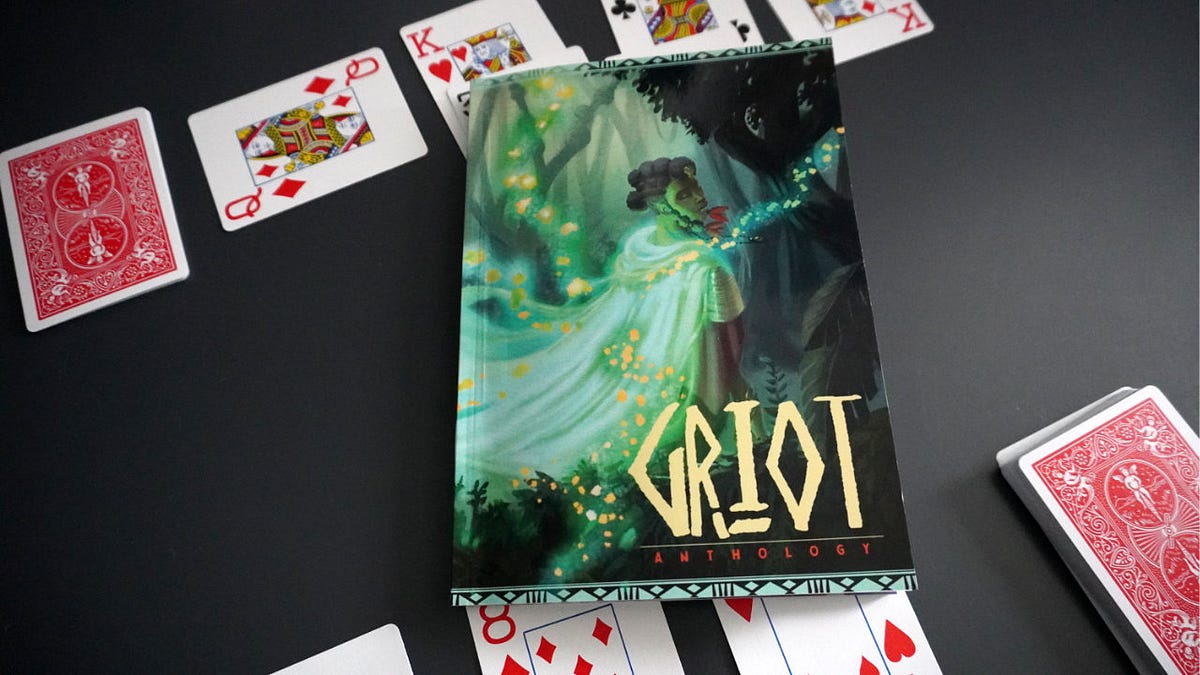
Check out Griot Anthology. I enjoyed reading it and am a fan of the cover artist too!
Lin Codega reviews Dragon Reactor on Rascal News in "Mythopoetic mecha game Dragon Reactor gives me everything I want and I want more."
Lin Codega
Maia's Solo Room creates high quality actual play content for solo games. Earlier this month, she covered HOME:
Maia makes really great videos!
A recent Reddit post asks about New Mecha TTRPGs (games released within the last two years). It highlights some games that I've shared or am actively following: Girl Frame, Dragon Reactor, Ion Heart, and Screaming Metal. But it also has a few deep dives and smaller games.
New Mecha TTRPGs?
by u/AppropriatelyHare-78 in rpg
Maybe you have a few to recommend?
Community Releases
SUITS (free) has been released by tinkin: a Mech vs Bugs hack of the Breathless system. Swarms of alien creatures pour through inter-dimensional portals to attack human worlds, slaughtering billions. On the worlds of the Colony Corporations, the only thing holding them back are scratch-build combat Suits and their pilots.
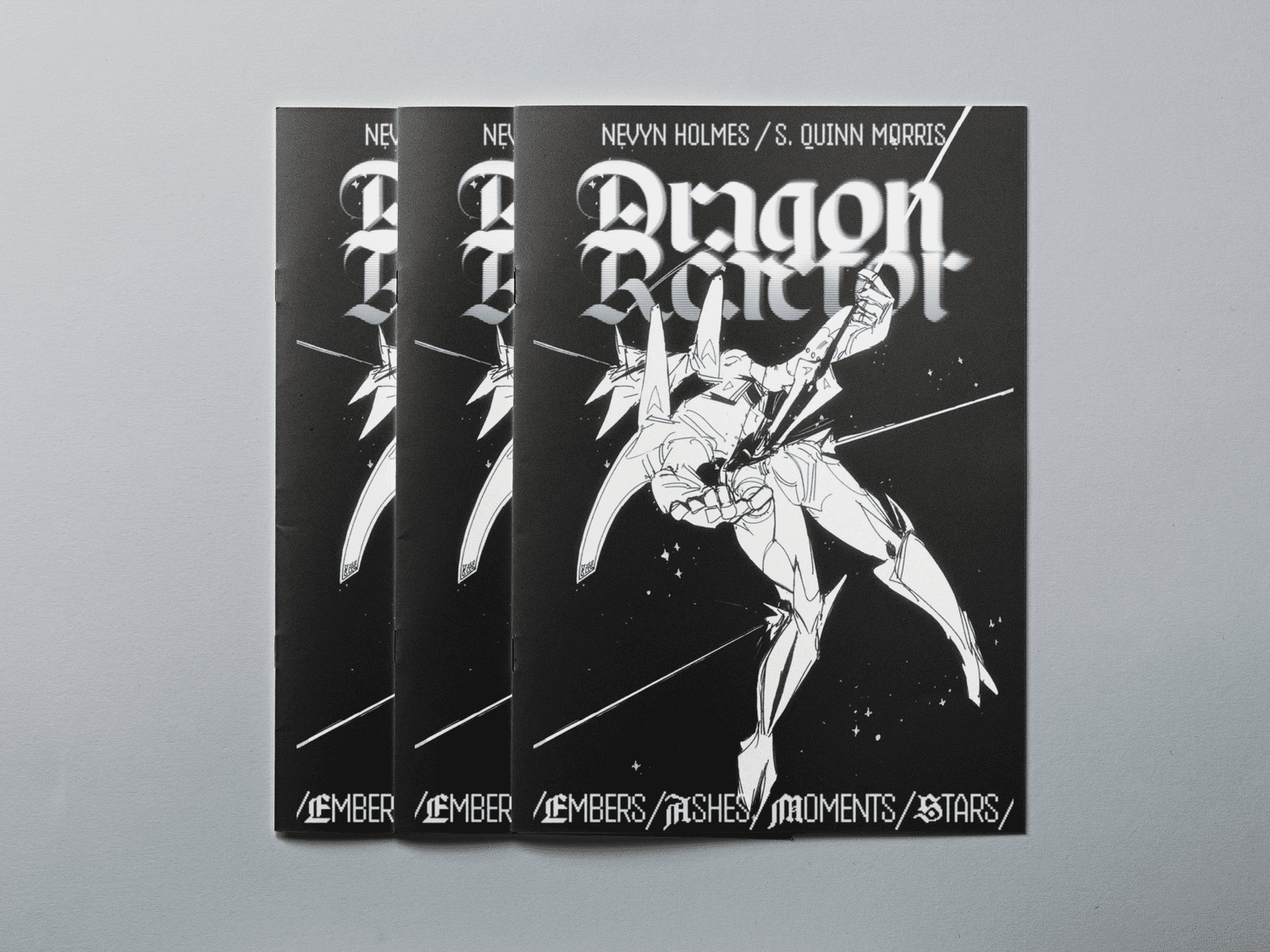
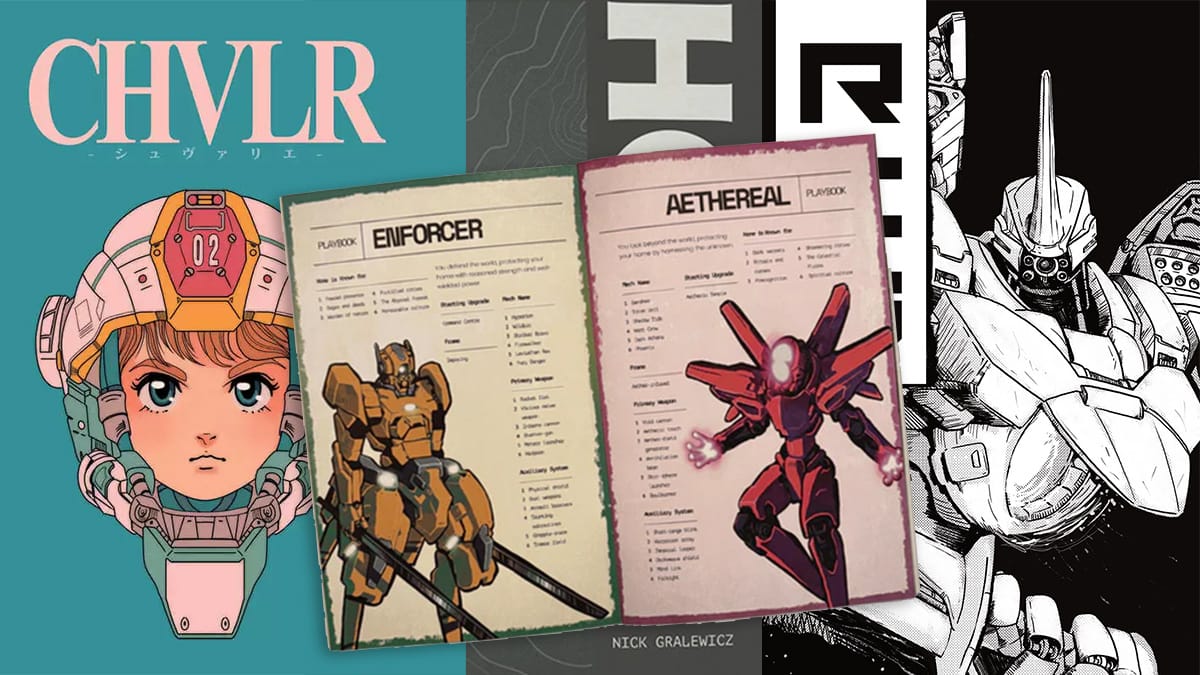
Physical copies of Dragon Reactor, the mythopoetic game of mechs, tragedy, and war across the stars, are now available at Dinoberry Press. Clash with Rivals, sing your Refrains, and meet your Doom using this jam-packed 60-page black and white zine.
Personal Releases
Later this year, I'll be crowdfunding Violent Delights: A chess-based RPG about Romeo and Juliet. Firebrands mini-games meet chess in this RPG, which depicts the Capulet’s masquerade when Romeo and Juliet first meet. The chess board represents the Capulet’s great chamber, and the game ends when either your protagonists meet (kissing kings) or they are prevented by those around them (checkmate).
Community Content
You can submit your own community content for this newsletter. It's 100% free. Share your new releases, blogs, reviews, etc. as long as it's related to mecha ttrpgs.
Featured Guest Post
John Mulligan of Exeunt Press and Skeleton Code Machine.
If you're interested in indie RPGs, you've probably seen or played one of John's games before: Eleventh Beast, Caveat Emptor, and You Are a Muffin are some of his popular games. Exclusion Zone Botanist may be his most popular: an Ennie-nominated solo drawing and exploration game inspired by Lovecraft's The Colour Out of Space and Jeff VanderMeer's Annihilation.
In fact, John is reworking it, and it's currently in prelaunch on Kickstarter.

Exclusion Zone Botanist: Epsilon (Prelaunch)
A solo adventure game about exploring a dark and corrupting forest. Get in. Discover and document. Get out.
John also publishes the award-winning Skeleton Code Machine each week, a newsletter exploring tabletop game mechanisms. It's very good. I have featured several of his newsletters here, including:
And this month I've added his recent piece on Neighborhood Robots.
My favorite is probably the piece that he wrote for this newsletter, alongside "Playing the Chaplain's Game." And without further adieu, here is John's post on "The Reverse Battleship of Celestial Bodies":
"The reverse Battleship of Celestial Bodies"
John Mulligan, Exeunt Press / Skeleton Code Machine
Damage locations in mech games
Mech games almost always contain some elements familiar to the genre: giant robot frame with legs, systems to dissipate heat, and a human pilot in the cockpit making the decisions.
These elements show up in varying degrees in BattleTech, Lancer, Apocalypse Frame, Auctoratus, and many others. There’s another element of mech games, however, that has more variety across systems: damage locations. Hit location might be random or it could be a called shot. Either way, the damage is applied to that specific part of the mech.
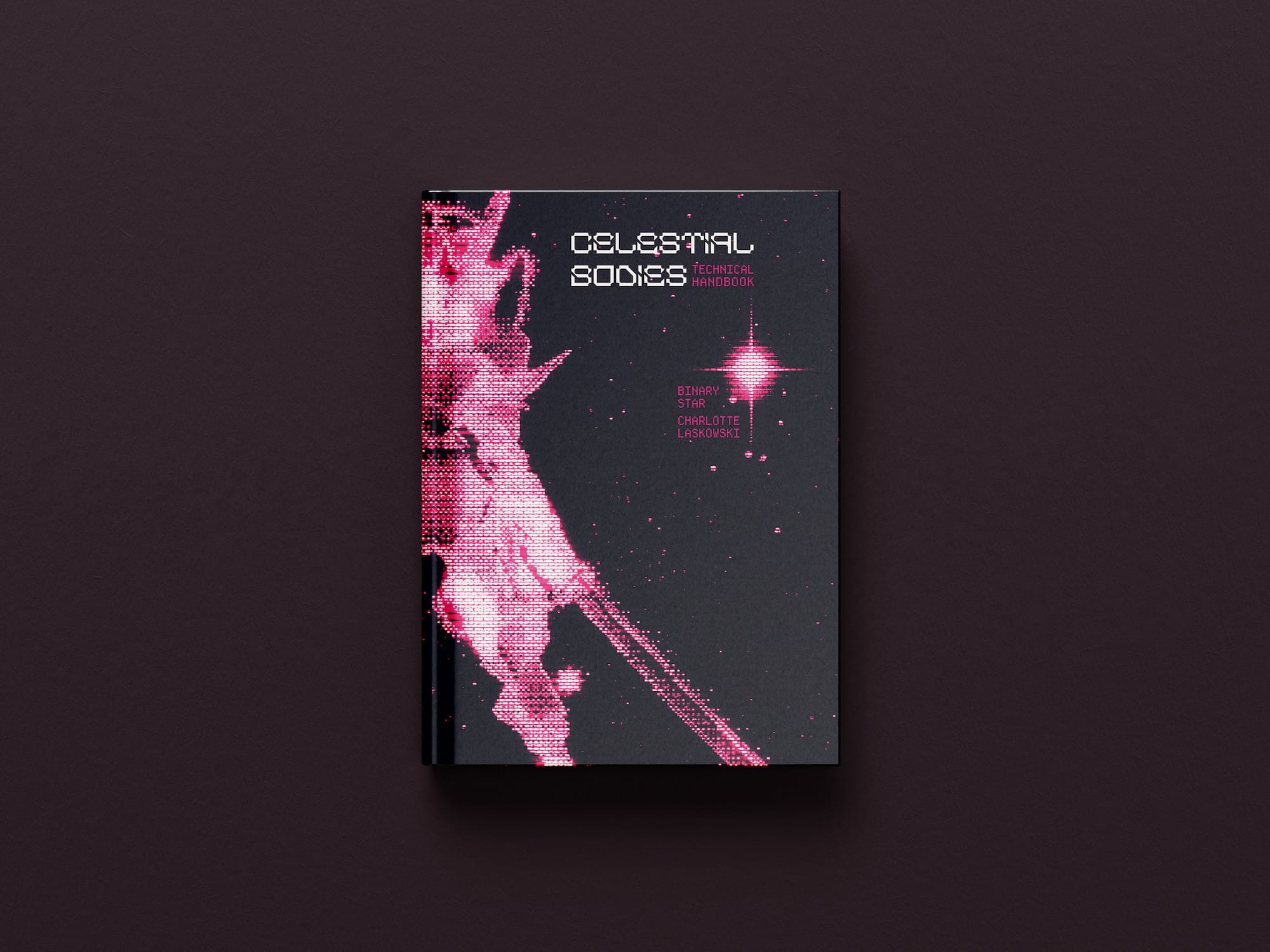
Celestial Bodies by Charlotte Laskowski and Binary Star is a mech TTRPG funded on Kickstarter in April 2025. Set in a post-calamity future where humanity builds mechs from bones of dead gods, you are a “lamplighter” pilot protecting your home-ship. The game has one of the most interesting damage location systems I’ve seen in the genre. To understand its elegance, we need to look at how BattleTech handles damage.
BattleTech’s armor and internal structure pips
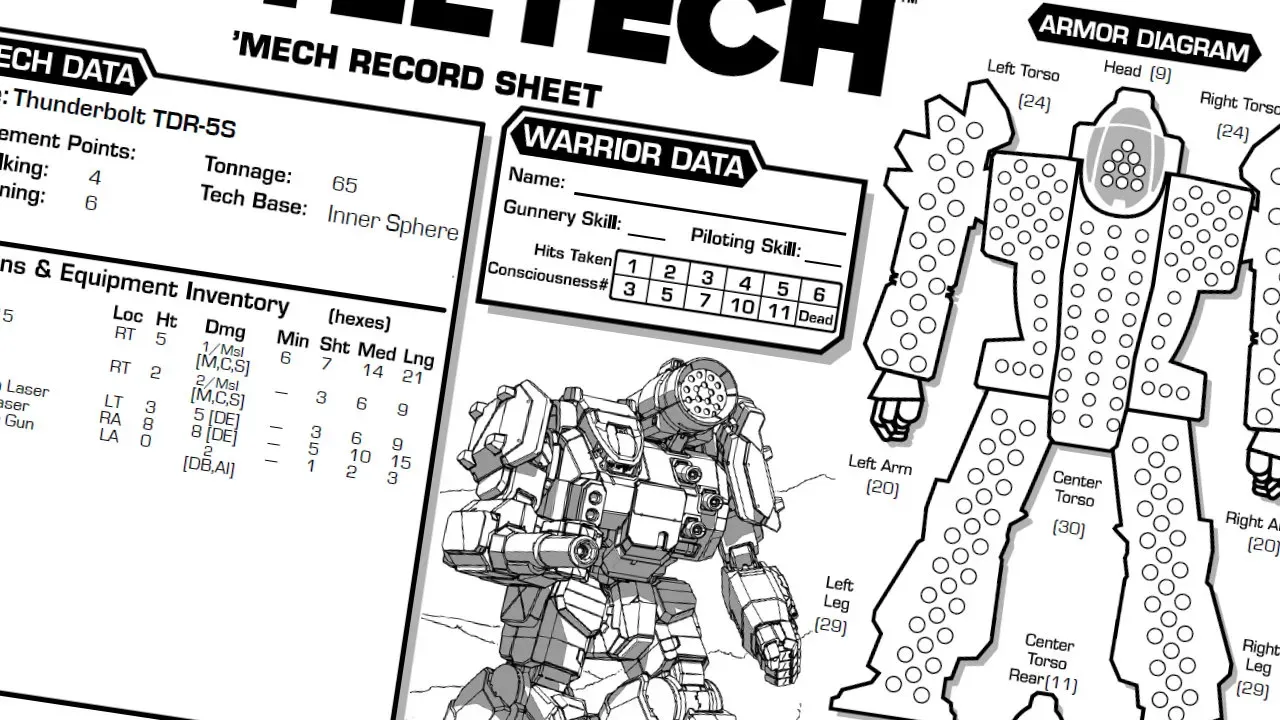
In classic BattleTech, each player maintains a silhouette of their mech divided into key locations: head, left/right/center torso (front and rear), left/right arm, and left/right leg. Each location has pips that are filled in to track damage. More pips means more damage capacity. The Locust LCT-1E can only take 12 left arm points of damage before it’s disabled while the Thunderbolt TDR-5S can take 30 before it’s gone.
This type of hit location system creates a level of granularity and simulation that many players appreciate. It comes at a cost, however, in the form of additional rules and recordkeeping. A BattleMaster BLR-1G has over 225 damage pips to track!
Inverting Battleship to create the grid
Battleship is one of those classic tabletop games that almost everyone knows. Two players take turns calling out random locations on hidden 10x10 grids hoping to hit their opponent’s ships. The game ends when one player sinks their opponent’s fleet.
The game relies on hidden information and random location guesses, with no distinction between the types of ships other than size.
Celestial Bodies also uses a grid damage system, but with some important twists.
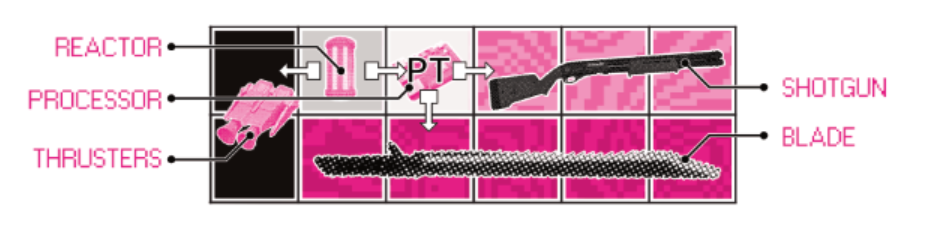
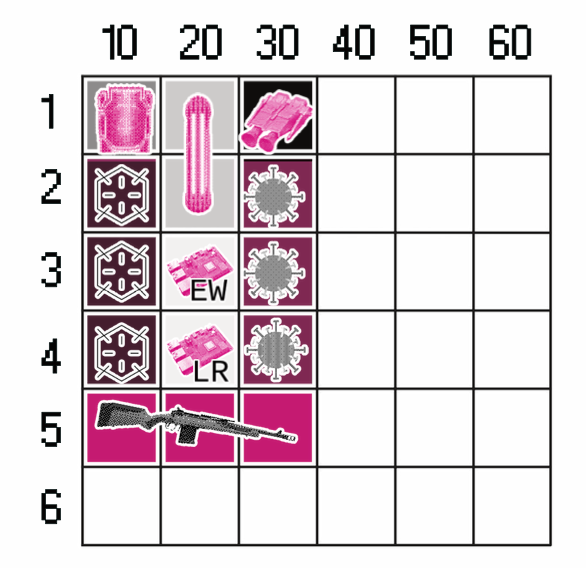
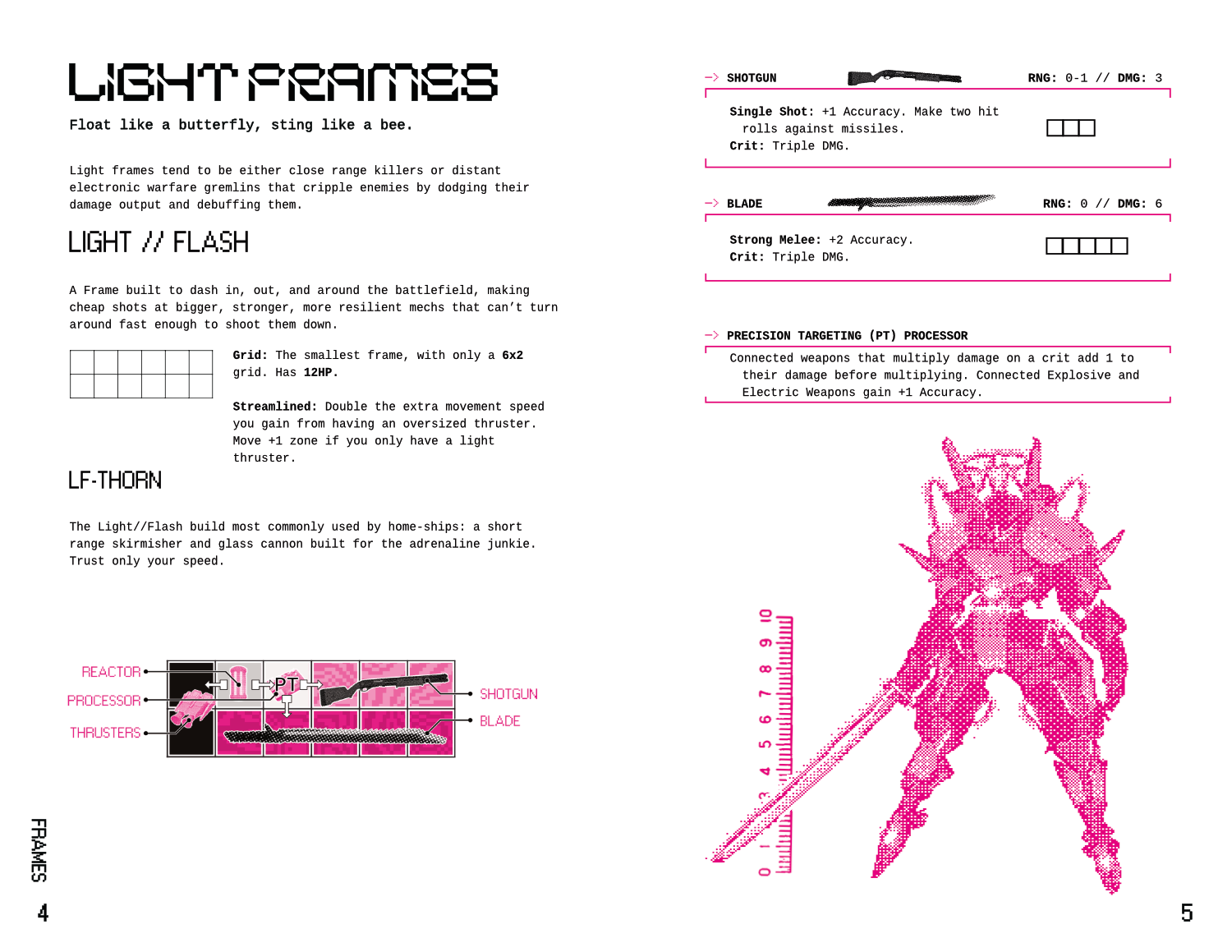
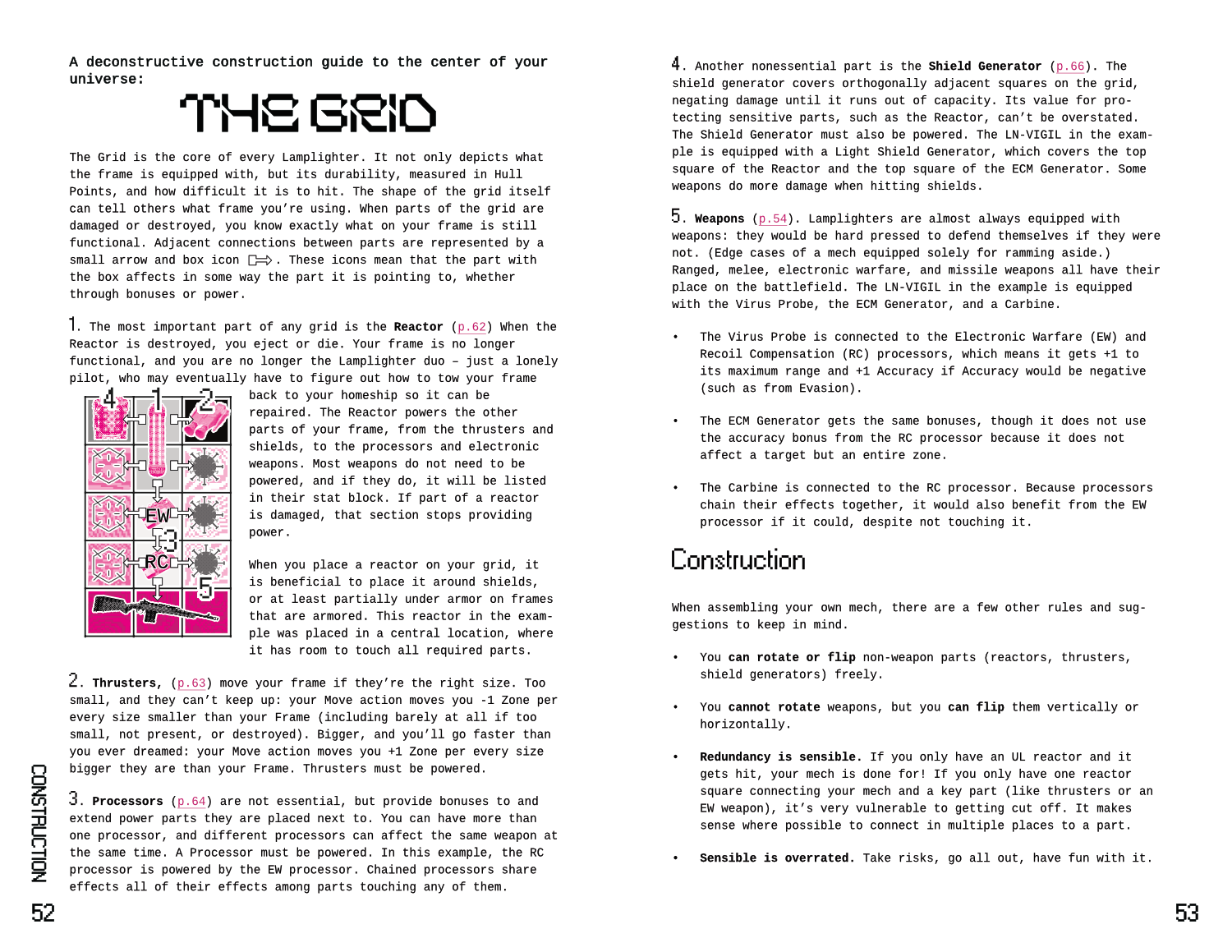
Each Celestial Bodies mech type has a frame size expressed as a differently sized grid: 6x2 light, 5x4 medium, 6x4 heavy, or 6x5 ultra frame. This grid combines durability, customization, and evasion into a single visual. Small grids are harder to hit but allow less room for systems like reactors, thrusters, processors, and weapons. Large grids are easier to hit but have more room for systems.
Every attack roll is with two six-sided dice (2d6) that correspond to a location on a 6x6 grid. Light frames are naturally harder to hit because they only use 12 of the possible 36 results (33%). An Ultra frame, however, uses 30 of the 36 (83%), making it easier to hit.
This might seem like Battleship on the surface, but it actually inverts every aspect:
- Fixed grid → variable grid: Grid sizes vary by mech frame size which is selected by the player when creating their mech. It’s a conscious decision to pick one that matches your play style: big and tanky or fast and fragile.
- Hidden information → open information: Where Battleship relies on hidden information, Celestial Bodies grids are all open information. You can see where systems are located and how much damage has been done, then use that information to decide what to do next.
- Random location → luck mitigation: Rather than a blind guess or a random dice roll, Celestial Bodies uses Accuracy as a way to mitigate luck. High accuracy allows the attacker to modify the dice values to shift a hit toward a specific location. Conversely low accuracy (high evasion) allows the defender to modify the dice and nudge the shots away from critical systems.
- Generic targets → critical systems: Whether you hit a carrier or a patrol boat in Battleship doesn’t matter as they are all the same. Mechs won’t operate without a reactor and the reactor can only power adjacent equipment. Knock that out and it’s a kill shot. Targeting specific systems is critical in Celestial Bodies. Weapons, thrusters, processors, and shield generators (all slotted in like Tetris pieces) can all be targeted in this way.
All of these changes significantly increase the player agency of the grid damage system. Players are presented with tough choices, they have the ability to act upon the choices, and what they choose impacts the world of the game. Even the dice roll mechanism isn’t purely random — accuracy mitigates that luck (good or bad).
Every game teaches a lesson
Battleship, although it’s been around since 1931, is not highly regarded by modern gamers. It scores a rather poor 4.8 out of 10 (”not so good”) rating on BGG. And yet analyzing it can inspire much better game designs. Not to copy the mechanisms, but to subvert them.
Celestial Bodies, while drawing more inspiration from Faster Than Light than from Battleship, is a good example of how inverting ideas creates a new and interesting design. The 6x6 grid is an elegant damage location mechanism that does so much more than just track damage.
That said, when my reactor is destroyed, I might still yell, “You sank my mech!”
Check out John's work on Skeleton Code Machine or the company site for Exeunt Press: