Playing Alone Together
My essay in The Soloist, plus the social dyanamics of solo RPGs.

"Playing Alone Together" was originally published in the March 30th issue of The Soloist. I am reposting it with permission, as well as a short preface.
 Patrick Buechner
My short piece "Play Along Together" was featured in the March 30th issue of The Soloist.
Preface
"Playing Alone Together" is a piece I wrote about running solo rpgs for groups at Breakout Con. When I pitched it to Patrick of The Soloist, I imagined it as one piece of something bigger: a speculation about the social dynamics of solo games. But I had only 450 words, and I like how the piece turned out.
My "nutshell" take is that solo games are never truly solo. Communities form around solo games and their creators. Some solo games have artifacts of play that are meant to be shared. VOID 1680 AM is an example of a social solo game in both of these ways.
Players may feel a parasocial connection with the designer(s) of solo games; in fact, I think the author (or the authorial character or the implied author) of solo RPGs "haunts" the gameplay in a way that's less common in multiplayer RPGs. There is a unique relationship between the player and the authority that the designer(s) invest into their solo game texts.
Or, players may find a real connection with fictional characters (player and non-player). As Rita Felski wrote:
We all seek in various ways to have our particularity recognized, to find echoes of ourselves in the world around us. The patent asymmetry and unevenness of structures of recognition ensure that books will often function as lifelines for those deprived of other forms of public acknowledgment.
She is talking about identification with characters in literature. But it is true in tabletop RPGs as well. Maybe more so when we roleplay as those characters. We develop real relationships with fictional characters.
I think you can see some of these social dynamics shine through in "Playing Alone Together." The desire to discuss a movie after watching it, to discuss a solo rpg after playing it, is there. I think that's part of play, which doesn't end with the game. You "play" around with ideas as you process the game's meaning and your experience.
Although "Playing Alone Together" is more about the social dynamics of parallel play and independent coworking or body doubling, we are always making sense of our experiences within "interpretive communities," even as we consider them alone. Group solo sessions facilitate conversation with a community that has been constructed for this purpose. And it turns out — maybe unsurprisingly — it's an enjoyable experience.
Without further adieu, here's the original piece:
Playing Alone Together
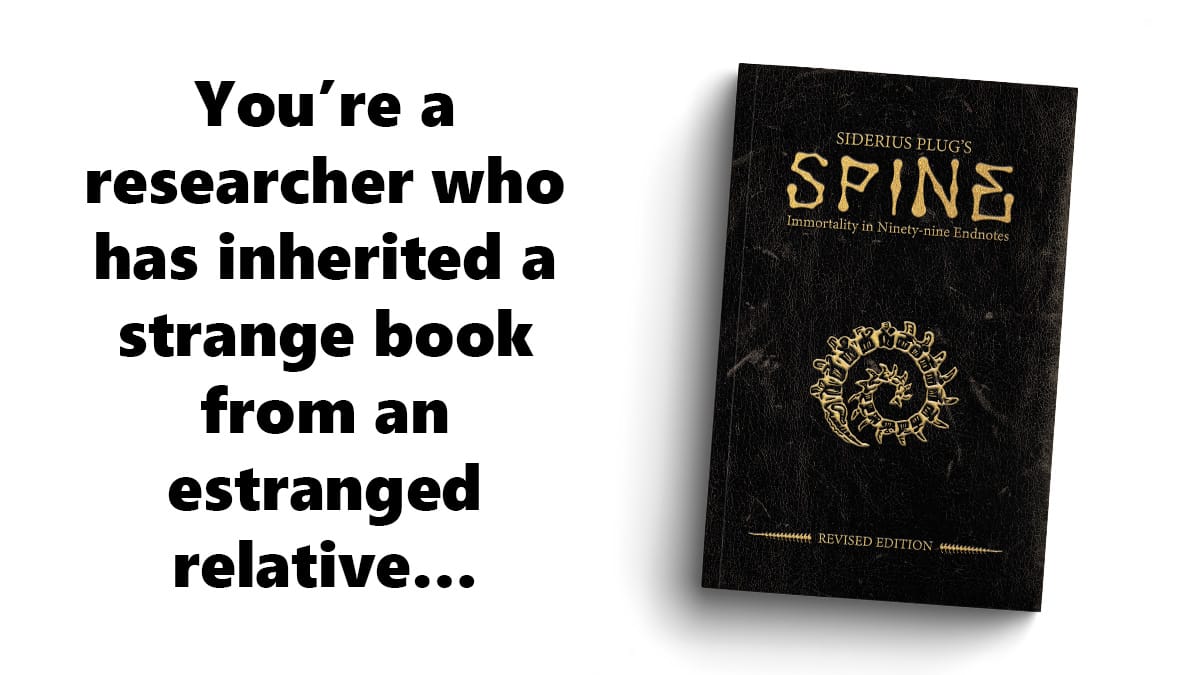
In December, I was invited to be a special guest at the 2026 Breakout Con and to run at least one of my games there. It was an honor. And I was also surprised, because I was invited to run SPINE in particular — my dark solo rpg about losing yourself in a book. I wondered, how do I run a solo game for a group? I’m glad I tried.
As Breakout’s RPG manager Christian Malleck told me, solo RPGs “had never been intentionally added to Breakout Con” but part of his role is “paying attention to what is popular in the TTRPG community and figuring out how to bring that to the convention.” He suggested that players learn the game together, play alone in company, and discuss their experiences afterward. I ran five sessions with SPINE, and they were incredible.
Many of the participants remarked that they buy solo RPGs and then have a hard time playing them on their own. One said that our collective play was like a study session at university. It created a positive sense of accountability. They felt less inclined to check their phone. Another said that it just “felt good.” They observed each other’s reactions, caught glimpses of what others were doing, and enjoyed the curiosity they felt.
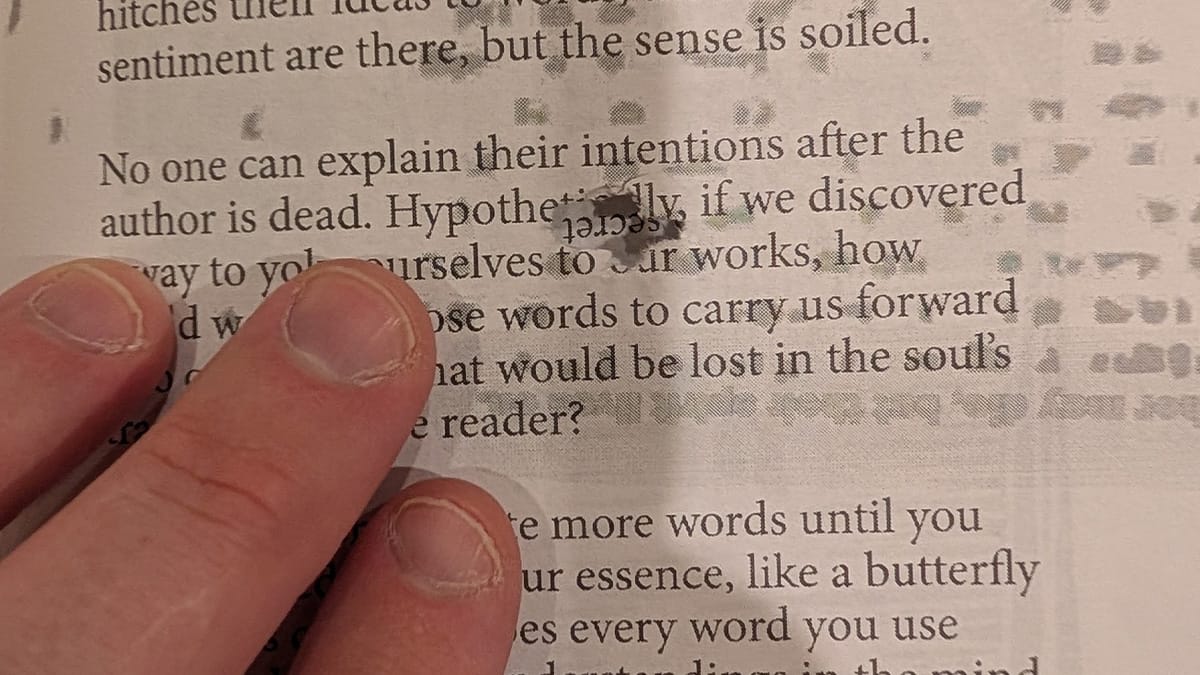
SPINE encouraged that curiosity, I think. In my first session, we looked up from the table at an attendee who held a cup of water in her hand. “This is so wrong,” she whispered, letting the water drip on to her booklet. We laughed together. Earlier in the same session, we watched another participant stab her book with a pencil.
Participants enjoyed the conversation afterward too. It was a chance to compare how their stories diverged, to debrief, to socialize over a shared experience. One said, “When I go to a movie, I like to talk about it afterward.” This created a similar experience. More than one said they “want to do more” solo sessions like this. It was a way to meet people with similar interests, be “alone in company,” and connect with each other.
I was not alone in running solo games at the con. In fact, Ian Howard of Leafy Dragon Games ran several of his solo RPGs by having the attendees collaboratively play one character. This provided a boisterous experience closer to group-oriented RPGs. “I'm glad that I chose to run the solo sessions collaboratively," he told me, "and I don't think I'd do it any other way in the future!”

Breakout Con is on to something, and I hope to see more of it. Heck, I’d like to see it at game stores and cafes too. Or for solo RPG clubs. Join me. Maybe we can play alone together.
Postscript: How did I run SPINE for groups?
Materials.
SPINE is a game that is played with a physical book object. But I couldn't afford to give away print copies. Instead, I printed 20 booklets, flattened them, stapled them, and gave away those for free. I also brought a half dozen pencils.
Group size.
I had groups of all sizes. On the final day of the con, I had groups with only one person, and I played along side them. On the first day, I had larger groups. For SPINE, the larger groups were best for both parallel play and discussion. SPINE invites people to do odd things with their books, and in large numbers you have interesting collective moments when you can observe what others are doing.
Agenda.
The sessions were two hours in length, total, with some buffer time.
- Introduction, Set the Tone, Content Warnings, Safety, Instructions, Questions (10 minutes)
- Play (75 minutes+)
- Discussion (20-30 minutes)
My group solo sessions of SPINE were designer-led, of course. And I think there is some extra appeal in that, but it can really change the discussion afterwards.
Discussion.
I came with four questions about their experience while playing. After we re-introduced ourselves, I asked...
- How did you modify your book during play?
- Was it hard to write in the book? How did you feel?
- What was it like "playing alone together"?
- How was your reading experience playful or frustrating?
I didn't ask much about plot, because SPINE comes with spoilers and people play at different paces. But this would be obviously fruitful for other games.
Most of the quotes in "Playing Along Together" come from comments made during play or afterward in the discussion.