Solo RPGs: An open or shut case?
On open-ended and close-ended solo rpgs and what group play can learn from them

On Open-Ended and Close-Ended Solo RPGs and what group play can learn from them. This essay was originally posted on The Lone Toad newsletter.
But first... I live in Minnesota.
I live in one of the neighborhoods that ICE has been targeting in Minneapolis/Saint Paul. Many of my neighbors live in fear. Regardless of whether they are U.S. citizens, they carry their documentation wherever they go. Regardless of whether they are U.S. citizens, some feel unsafe to leave their homes. It is not because ICE is "broken." This is by design. This "surge" is a fear campaign. That is why it has been so publicly brutal and illegal.
Why am I telling you this? There are plenty of good reasons. But last week one of my friends told me that he and his wife do not feel comfortable speaking out or protesting because they are afraid that they will be targeted. I promised to be twice as loud.
Speak out about injustice. Speak out to acquaintances, on social media, in your newsletters. If you're in the U.S., say something and maybe someone else will say something too.
All around the U.S., you will find Constitutional Observer trainings, like these online versions by the Minnesota DFL. If you are a U.S. citizen, I encourage you to attend to learn how to legally observe and document immigration agents for violations of constitutional rights. Be prepared for when ICE shows up in your city and state.
I have an acquaintance who works at the Immigrant Law Center of Minnesota. They are good people. The link above takes you to their donation page. Help them help others.
Solo RPGs: An open or shut case?
In the October 2025 episode of the Yes Indie’d podcast, I sat down with Thomas Manuel to discuss my solo RPG SPINE. Thomas, who has a knack for productive questions, asked how I resolved two of the game’s competing interests, which he characterized as open-ended journaling and close-ended puzzles.
I promise you, this is not an essay about my own game. But this question came about because SPINE is an intentionally gamebook-adjacent solo RPG, and the gamebook is a relatively close-ended form of RPG. Thomas’s remarks cut directly to the heart of the matter, which is that most tabletop RPGs are open-ended and that this quality is an important part of what makes them replayable:
A journaling game you can play multiple times because you can choose to feel different things or make different choices. But a puzzle, once solved, it remains solved. Usually, that's our common understanding of the word puzzle. This is what I assume of gamebooks, the Choose Your Own Adventure kind of stuff, like Fighting Fantasy.
I’m writing this guest post because I cannot stop thinking about how these terms — open-ended and close-ended — might apply to solo RPGs.
By my definition, many solo RPGs are open-ended, but not all. Does it matter? Should they be one or the other?
Open-Ended and Close-Ended Games
In his interview, Thomas proposes that replayability is the fundamental difference between open-ended and close-ended games. In particular, he is thinking of puzzles, which have only one solution and one way of achieving that solution:
The Rubik’s cube, that’s an open-ended puzzle. Chess is an open-ended puzzle. But a certain chess position where it’s like “What’s the next move?” That’s a chess puzzle, and once you figure that out, you can’t really do it again. The pleasure of it was trying to figure it out once. You can’t ever have that experience again... Unless you forget.
Thomas acknowledges that gamebooks don’t suffer from having a correct answer, and truly "close-ended" (e.g. close-ended questions) merely denotes "a defined set of solutions," not necessarily any one "correct" answer. But his point is a valid one, because there are varieties of solo RPGs that have limited replayability. And so, I want to think about how solo RPGs may fit into this dichotomy of open-ended and close-ended. They are not precise categories of games, by any means. They inevitably unravel, especially when applied to group RPGs, yet I am convinced they may be useful frameworks for thinking about how solo RPGs function.
In my definition, close-ended games are those in which the plot and/or the choices that the player makes are well-defined. Many solo RPGs are open-ended. They are often like skeletons, which is to say they provide one or more fundamental structures — their bones! —, and we flesh out those bones, often with the help of oracles. We determine or contribute to the final shape of our creation: the story. As players, we are a sort of necromancer who magically adds flesh to their bones to bring these stories to life. The power that we use for this is the “authority” granted to us by the game, by which I mean “the power of the author” to shape the fiction.
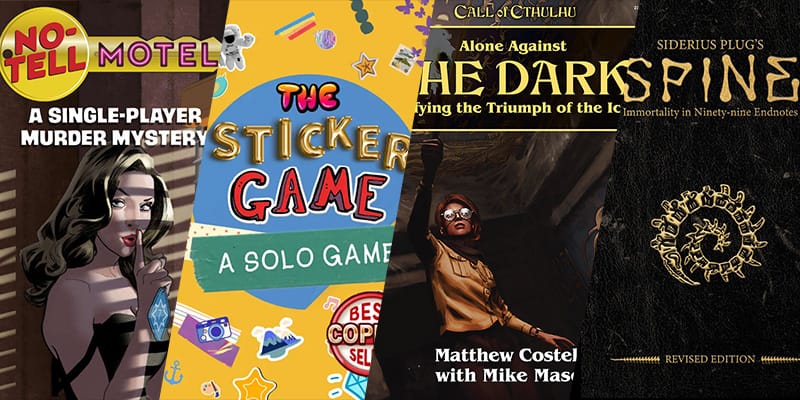
No-Tell Motel, for example, is a solo murder mystery RPG by Ken Lowery, in which you play as an overnight clerk at a motel where a murder has occurred. Your goal is to gather anecdotal evidence and present your suspicions to a detective. The bones of your story are:
- The Night in Question: When guests check in and the murder occurs.
- Working the Overnight: What you observe during each shift.
- The Moment of Truth: When a slack-jawed gumshoe interrogates your main suspect.
The game provides the bones. Yes, you draw cards to determine general details around the characters and events, but you flesh everything out yourself in your reports until you can build a case against one of your suspects. Ken gives his players clean structures to build on with intricate yet smooth machinery to help them author the fiction. It’s a great game with a tight, smooth design.
But solo RPGs are close-ended as well. If open-ended games are like skeletons that we flesh out, close-ended RPGs are undead monsters that we stitch together. The parts are already fleshed out, and we choose which limb to stitch on next. We’re their Dr. Frankenstein, and the limbs that we choose determine or affect the final shape of our monstrosity. These games are close-ended in that they grant players agency but limit their authority. Often, when we have authority, it is limited to the identity or backstory of the character(s) we are playing.
A unique and innovative game in this style is Cassi Mothwin’s The Sticker Game. This game is a linear, close-ended RPG in which you play as a volunteer for a multi-dimensional research project. Essentially, you are prompted by audio files to place certain types of stickers in a notebook, which affect a version of you from an Alternate Universe (AU) who is in danger. The game’s audio files deliver the plot, which is well-defined, and your character chooses which stickers to deploy within that plot to help your AU self. It sounds simple, but your sheet of stickers becomes both an oracle and a pick list, and the choices that you make defamiliarize your stickers or affix new significance to them in relation to the plot.
Some existing genres lend themselves to being close-ended more than others. Detective fiction often presents a puzzle, a clear, desirable outcome, such as discovering the culprit of a crime. They invite (or require) you to use your ingenuity to achieve that outcome. Whereas open-ended mysteries like No-Tell Motel ask you to invent a plausible solution, a close-ended game asks you to deduce the logical solution, as you would in much of the Golden-age style of detective fiction. Some people feel very strongly about which style is more appropriate, but we aren't obligated to reproduce a literary genre as a tabletop RPG, which is its own distinct form. Open-ended games and close-ended games ask different things of their players and help us produce different experiences as a result.
Consider Alone Against The Dark (2017), a close-ended solitaire game by Matthew Costello with Mike Mason. This game is a branching, close-ended RPG in which you search for answers about a recently deceased friend and eventually try to forestall a calamity. This game, which some may call a “scripted solo RPG,” resembles a Choose Your Own Adventure gamebook in its form and function. Much of this game is defined for you, down to the clues, and your ingenuity leads you deeper into the plot.
I use this example because Alone Against the Dark is extremely defined. While tracking every hour of every day, you must ensure your characters eat, sleep, and even entertain themselves daily on a 10-day sea journey. And yet, despite being so close-ended, it’s a great example of how open-ended games and close-ended components are not necessarily incompatible. Some close-ended games operate on open-ended systems.
Open-ended games tend to operate more like machinery. The terminology of machines is embedded in the genre: systems, engines, mechanics, and hacks. But they are not often “story machines,” they are “storytelling machines,” which is to say that they do not produce a story, they facilitate your storytelling. Their procedures may create structures (the bones!), and the machine may come with a toolbox of bells and whistles for fleshing out the story. But the machine does not produce the story. You do.
If open-ended games are machines, then close-ended games are analogous to programs, which are designed to produce a specific story or a very specific experience. Some programs have their own system built-in. Others are built to run on open-ended machines, as Alone against the Dark is intended to run on Call of Cthulhu. There can be competing interests between these otherwise compatible games, but often the scripted game overrides these interests through its own unique rules.
Replayability
When speaking with Thomas on Yes Indie’d, I rambled about the nature of close-ended puzzles and whether they are “replayable” instead of answering his question. I still think that the question of replayability is the most important point in this framework, and the question is not whether they are replayable but how.
Often when we talk about replayability in games, we think of a game’s novelty. Games create an experience like any other type of art form, but the beauty of games is that we get to participate in those experiences. One of the attractions with RPGs is that you can build a machine that creates novel experiences each time you turn it on, mixing the randomness of its engine (tarot, dice, etc.) with the unique mind that powers the game through interpretation and creativity.
Of course, close-ended games can generate novelty too. Although the general plot may be the same, we may make a different choice, follow a different path, or play a different character. It’s also helpful to think of these games as scripts for drama, which you perform by playing. Even when the overarching plot is the same, your performance will differ not only from someone else’s but even your own at a different stage of your life. As with rereading a novel or poem, your experience differs each time, although the novelty is not in the text. It is in you.
I acknowledge that open-ended games create a greater degree of novelty and that the novelty in close-ended games can be less exciting. Perhaps it is more about appreciation. I’m more likely to replay an open-ended game regardless of its quality. With close-ended games, I’m most likely to replay a well-written game.
That brings me to my next point, which is that novelty is only one factor in replayability. Another factor is artistry. One of the defining qualities of art is that it cannot be consumed. Art invites you to re-engage. Every engagement invites a more complex understanding of the game, wherein our attention shifts from the drama to the craft, composition, quality, and significance.
Replayability is a measure of quality, especially for close-ended games. It is a measure of quality for open-ended games too, albeit less so. And the quality measured can differ between them in the same way that we would assess a well-wrought urn differently from a well-engineered machine.
Should RPGs Be Open-Ended or Close-Ended?
I want to answer my opening question: Should RPGs be open-ended? No, nor are we obligated to make them close-ended.
I encourage designers to consider when and how we as designers incorporate both open-ended and close-ended elements into our games. As I mentioned at the beginning of this article, these categories unravel easily, as both are necessary elements in RPGs. We must ask: When do we want to empower players with authority and when do we limit them to agency? When do we rely solely on the machine and when do we run the program? It may not be obvious but the statement that you make through a machine will differ from the statement you make through a program. Designers can combine these strategies productively in concord or discord.
I have been talking about solo RPGs. I do not think open-ended or close-ended are productive categories for thinking about group RPGs in the way that they are for solo RPGs; however, I do think that parts of this discussion can be applied to group RPGs.
Maybe you have already been thinking about this in terms of how adventure modules are “programs” for their game systems or machines. Or how Brindlewood Bay handles mysteries as a system as opposed to mystery modules that rely on close-ended plotting.
I think that RPGs with group play tend to be more open-ended, and games with a game master are able to be less structured than open-ended solo games. A group game with close-ended elements tends to be less limited than a close-ended solo RPG; most commonly, these games function as modules for games that are open-ended by default and close-ended only when desired.
Group games tend to be so predominantly open-ended that it's more useful to think about their close-ended elements and how they work together or against the open-ended elements than to pretend that you can categorize them. I’d like to see more of this combination — in the most general sense, a defined plot or critical plot point built into the machine.
Recently, some of the most impressive games have done just this. I would argue that Triangle Agency does this in a very unique way, as key plot elements invite you to work against its system. But, you know… spoilers.
Yazeba’s Bed & Breakfast may be the best example of how close-ended elements can be brought into one of these games. In fact, Yazeba’s has many close-ended elements — its characters, chapters, arc, and ending are defined. And Yazeba’s uses these elements to frame your opportunities for authority — to connect with specific characters and tell their stories. These close-ended elements guide the meaning that you make along the way.
This too is what I tried to do in SPINE, although a vastly different game, and these experiences are what I crave. I crave games with endings, games that produce well-wrought experiences with just enough authority to create personal, unique experiences. What I’m looking for is not a program or a storytelling machine but something in between.
Give me your story machines.