Feature: Cyberrats in Space
June's Mid-month Feature: Cyberrats in Space, crowdfunding on Kickstarter.

This is Asa Donald with a mid-month mecha ttrpg feature! If you’d like to hear more from me, you can check me out on bluesky. As a reminder, this newsletter is free. To support it, me, or my games, sign up for my upcoming Kickstarter Violent Delights: a chess-based RPG about Romeo & Juliet.
This is my second mid-month feature, and I hope to do a couple of mid-month features every year, each of which are a short newsletter dedicated to an upcoming mecha ttrpg crowdfunder. Feel free to reach out, if you have one coming up.
In this feature, I’m excited to share that Alex Rinehart is bringing his newest game Cyberrats in Space to Kickstarter. In fact, it launched today! Cyberrats In Space is the sequel to the original Cyberrats game, illuminated by Spencer Campbell’s LUMEN system, and the third game in the series after the expansion, Cyberrats: Rise of the Briny Bastards.
I was fortunate enough to get my hands on an early draft over a year ago, and I’m excited to hear how it’s changed. Even in its early stages, Space was a game that excited me and which I had fun flipping through, reading over clever premises for its special missions and enjoying Alex’s incredible writing. And finally, I'm looking forward to sharing a sneak peak of its art!
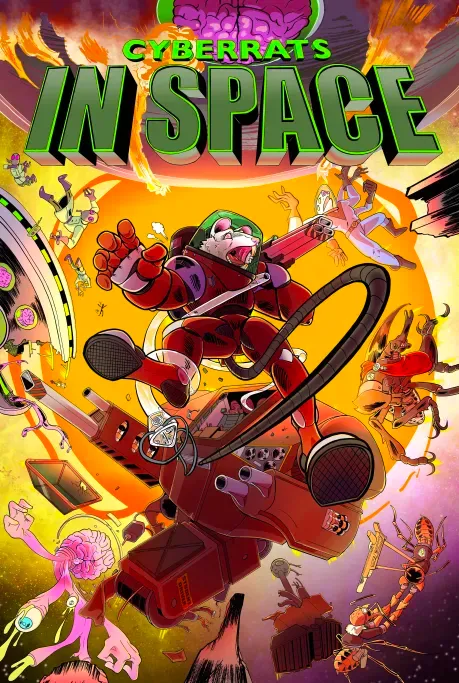
Cyberrats In Space
Take to the stars to get Earth's revenge in a new campaign meant to be won (or lost!) in 12 two-hour sessions!
Build and customize your mech, including the ability to link up with others to share powers.
An interview with Alex Rinehart, Designer
What has changed between the original game and your new standalone game?
Asa: Cyberrats in Space takes the fun premise and the LUMEN-based system of the original Cyberrats and ejects it into outer space with a bucket full of bolts. What has changed between the original game and your new standalone game?
Alex: The biggest thing is that you have a mech now. In the original Cyberrats game, you start as an intern and you build your weapons by taking on debt. After your first mission, you pick a career. Here, we start you with a handgun and a wish of luck. That's free. And after the first mission, you get your very own mech to customize.
More broadly, we shied away from lore in the first game. I think there's 2, maybe 3 pages of 'canon' lore, and most of that was collaborative with backers. This is our sendoff, and in order to make that meaningful, we had to establish some things from the previous games. You've lost. Earth is over. This is a game about revenge, and revenge needs stakes. So there's a bit of background lore here everyone needs to internalize. Your planet was taken from you. It's also a little more overtly political than the previous games. People missed that the first game was anti-war, that it poked fun at corporations. I think everyone understood the second game's themes around pollution and the environment, but people missed the themes of the first game! There's no avoiding them here. I took the subtext, unearthed it, raised it up a few more times, and then shone a floodlight at it. It's pretty clear what I'm trying to say here, because I flat out just say it: no matter how justified your war feels, it's wrong. You are wrong for killing people, irrespective of what they did to 'start' it. This war you're re-igniting in this game has been over for generations. You are in the wrong here, and that's the text of the game!
But really, aside from the mechs, everything in this game is just the previous two games but bigger. More items, more mission types, more locations. We streamlined a lot of the pain points from the first game, made things easier to run and easier to play. But if you ever get out of your mech (either because you choose to dismount, or because an enemy makes that choice for you), you just fall back on the core game's rules.
A lot of mech games struggle with the interplay between in and out of the mech. We already had the mechless bones in place. It's not two separate systems strapped together, we built on the bones of what we had, and we built on top of them with steel and paint.
What are some of your favorite, most flavorful mechs in this project?
Asa: I admire you as a writer because you create a distinct voice for your games. And in an era where designers are trying to make their instructional game manuals more enjoyable to read, the Cyberrats series stands out as having an incredibly playful voice, which pairs so well with Patrick “Boog” Sinnott’s lively comic-style illustrations. It’s been exciting to see these come together in the mechs that the two of you have designed. What are some of your favorite, most flavorful mechs in this project?
Alex: That's very kind of you to say. One of the last steps of making these books is a flavor pass, where we punch every joke up, change out placeholder names, and just make things fun. There's a lot of jokes and flavor text snippets that get cut from the playtest docs to the final. In this game, there's a really juvenile visual gag that I put in some placeholder art, certain it would get cut. It's a cutout of the ship, with a medbay and an engine room and all that. At the front of the ship there's a cockpit, as you'd expect. And right behind it is a ballpit. It's such a dumb joke, but it makes me laugh. I thought there's no way this makes it in. But if you look at the final artwork Patrick did, it's still there. There's a few jokes like that, where I put it in expecting it to be cut, but we've kept it. I remember Boog sat me down when I talked about cutting one of them (Bondage Gear, which of course improves your relationships. It helps you bond). He looked at me and said, "Alex, we have an ability in Briny Bastards called 'The Blowhole Special.' It stays."
But asking about the mechs specifically, I mean I have a softspot for the Frog. Some of these mechs, you have to explain them a little. "Okay, the Beatbox is a karaoke machine you can ride. The Leftovers is a biomech made of interns who, well, didn't make it. The Hotbox is a 5-in-one kitchen appliance. It slices, it dices, and it cleans its own dishes." But the frog, it's just... it's a big metal frog! It's a hopper with a hopper! It jumps around and eats people. That's the whole pitch!
What sort of cool new things do mechs bring to the gameplay and tactical side of Cyberrats?
Asa: Mechs are new in the Cyberrats series. What sort of cool new things do they bring to the gameplay and tactical side of Cyberrats?
Alex: Oh boy. The mechs have two kinds of abilities, armaments and munitions. Munitions work just like powers in the base game: they don’t take up an action; as long as you’ve got diesel to spend, you can keep using them, and they are just as likely to deal Harm as they are to provide movement or support to your teammates. Armaments are more like weapons. They mostly do damage (and some effects, like pushing foes), they have a chance of failing, and they have fuses that can blow, rendering the armaments inoperable until you spend an action fixing them. One mech (the boomwagon)’s whole schtick is that it can choose to blow its own fuses to power up all of its other weapons. It has one ability called Full Reboot that basically says use every armament you have as if you rolled max dice, then blow every fuse you have.
More generally, all mechs can link up, Voltron style, and form Supermechs, enabling them to use each other’s fuel, defenses, and abilities. So you can build a mech that does no damage, but just goes REALLY FAST. And someone else can build a big gun. Or just a walking damage suck. And when you combine, you can zoom to a good position and everyone takes turns using the best weapon available. It adds an entirely new tactical layer, and also allows for quicker positioning, since you can all move as a single action once joined.
Can players still adapt material from Cyberrats: Rise of the Briny Bastards?
Asa: After the original Cyberrats game you published an expansion, Cyberrats: Rise of the Briny Bastards, which had a lot of new features. Can players still adapt material from Cyberrats: Rise of the Briny Bastards?
Alex: 100% yes! From the word jump, I wanted to ensure that this game was compatible with the previous Cyberrats books (Cyberrats and Cyberrats: Rise of the Briny Bastards) In fact, even while developing Briny Bastards, the team (Rachel, Boog and I) were having conversations about forward compatibility. There were a few points in the edit of that expansion where we said "This mechanic is only used once or twice, but I'm thinking of giving it a keyword to make the next game even easier to key into. The biggest example of this is the Cycle keyword, where events happen at the beginning of the ENEMY PHASE. The first book is full of "At the start of the ENEMY PHASE..." The second book uses "Cycle: ..." There are 7 of those abilities in Briny Bastards, and that's all there to lay the groundwork for Cyberrats in Space, which is full of it.
What inspirations or touchstones does Cyberrats in Space draw from?
Asa: What inspirations or touchstones does Cyberrats in Space draw from?
Alex: In terms of mech touchstones, the three biggest inspirations are 13 Sentinels: Aegis Rim, Titanfall 2, and Ultramechatron Team Go!. 13 Sentinels is a video game that is equal parts soap opera as it is a mech strategy game, which is also how I think of Cyberrats. Ultramechatron is an old College Humor show that’s basically a parody of Voltron / Power Rangers, that also just works on its own.
I looked Ratchet and Clank, Risk of Rain, and Atlas Reactor for power design. I want things that feel powerful and distinct, and those all do it well.
But the most unexpected inspirations are probably Chuck E. Cheese (Did I mention one of the mechs is an outdated animatronic entertainment device?), the dance level from Dishonored (one of the missions is a heist at a masquerade ball where you have to steal a mech), and an interview I read about mission design in Citizen Sleeper 2 a full year before that game released. My impressions of the game I was building in my head became side hustles, which might be my favorite innovation in Space. Side Hustles are optional side missions where I break the rules of the game, just a little bit at a time. There’s one that’s inspired by the intro to Saints Row IV, where the mission starts right after you place a bomb, and you have to get back to your spaceship before an LCD Soundsystem song ends. This is a song that physically plays at the table. Everyone has to take their turns and move while this song is actively counting down. That’s the kind of thing we do in side hustles, and there’s ten of them.
Who should try Cyberrats in Space?
Asa: Who should try out Cyberrats in Space?
Alex: Mysteriously wealthy benefactors, for one. In all seriousness, Cyberrats is a game for people who like a little bit of crunch in their games. This isn’t the kind of game that requires you to do homework, or to optimize builds. Ultimately, we limit each mech to 3 slots of munitions and 3 slots of armaments, so you’ll spend more time upgrading what you have than poring over endless choices.
Cyberrats started as my love letter to XCOM, and there’s a lot of XCOM still in it. But there’s also relationships, and ‘fastball special’ type combos. It’s a game meant to be played in 2-hour stints, and to tell a complete story in about 12 sessions. There’s collaborative resource management (both in the ‘lets pool up and buy a bowling alley for our base!’ and in the ‘hey, if we can scrounge up some Scrap, we can lower the Threat of the faction we’re about to fight’) kinds of ways. It’s a balancing act, as you have two factions that both have victory meters, and there’s never enough time to complete every mission in front of you. At the end of the day, Cyberrats is for people who want to stomp around in a big, customizable robot with their friends, while they parade through space and complete goal-focused missions for a few hours at a time.
What other games do you recommend?
Asa: What other games do you recommend?
Alex: There are two games I want to shout out. The first is A Complicated Profession by Jason Price, because it absolutely rules. You play retired bounty hunters who work on a cruise ship, and Jason is so smart. Your character sheet is actually two halves. One half is your bounty hunter half, and the other half is your cruise ship half. I used to be a notorious hacker, but now I’m the janitor. As you play, you lose your hunter abilities as you walk away from that life. Your goal is just to make sure the people on this space cruise have a great time.
The other game is HEDGE, made by Navi and Shawn Drake, two of the kindest people making games. HEDGE is a tactical game, similar to Cyberrats, where you play as Wardens defending what remains of the earth from invading fey creatures. All of the classes ooze with flavor, and it’s the kind of game that can be played with no prep for a one-shot, or for a longer campaign. In fact, I think I stole some of my downtime mechanics from them.
Sneak Peak Gallery
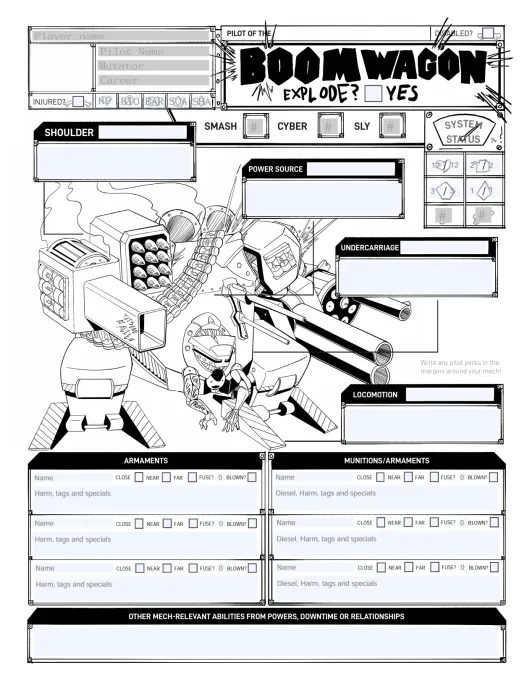
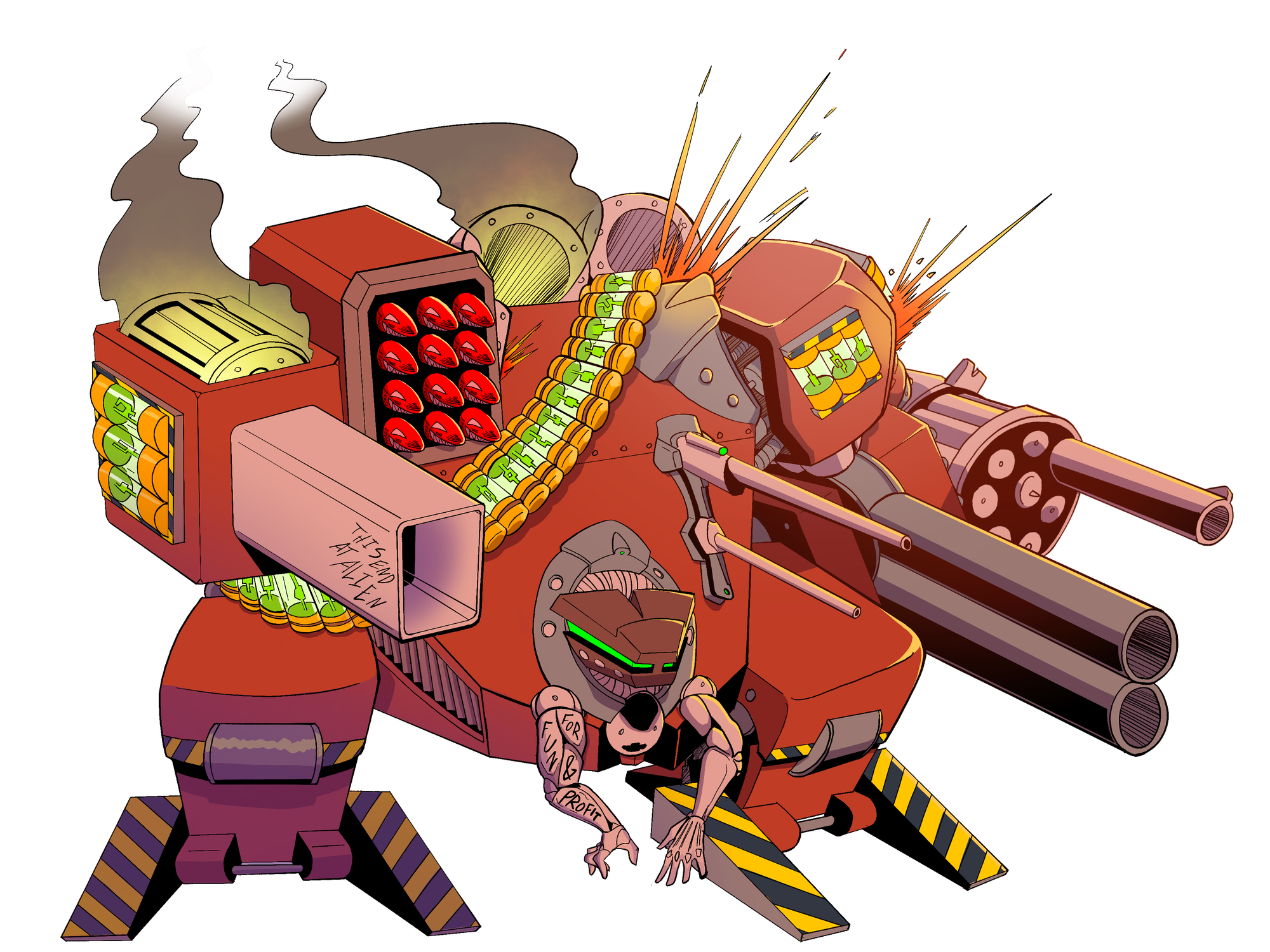
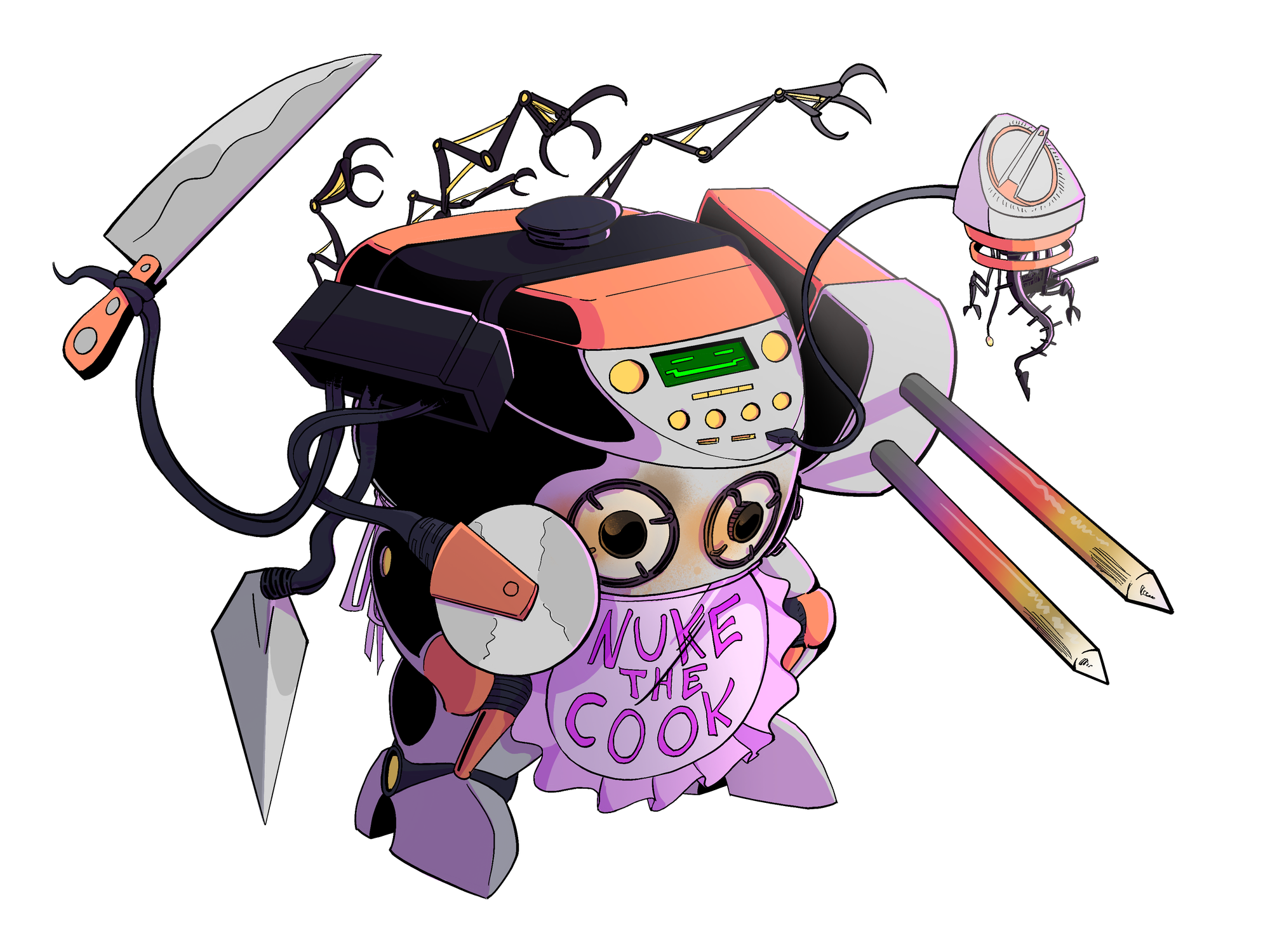
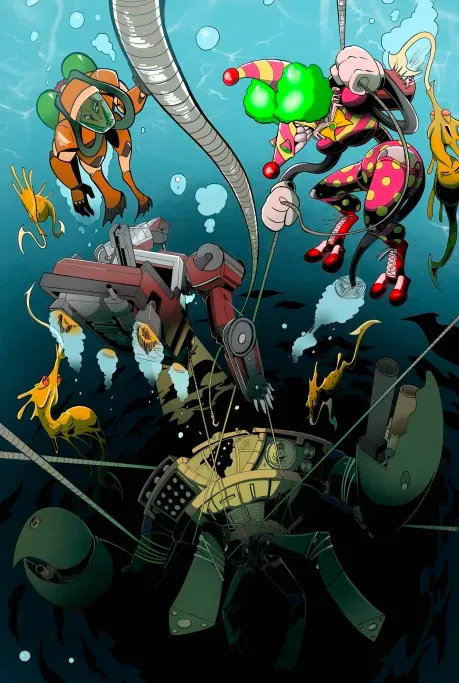
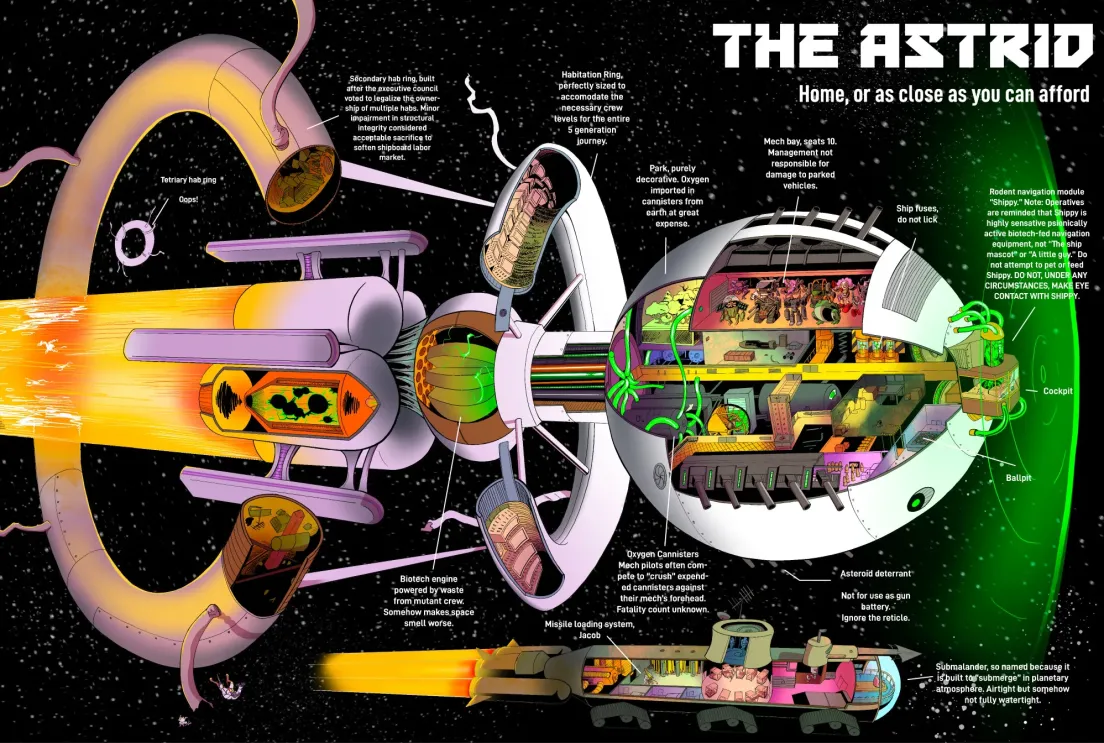
Art by Patrick "Boog" Sinnott. Left to right: Boomwagon character sheet, The Boomwagon, The Hotbox, Salvage art, The Astrid cutaway diagram.