🎤 David Harris on Adaptation and the Public Domain Game Jam
Six-time winner of the Public Domain game jam

This interview is the third in a series of essays and interviews about repurposing board games in RPGs. This interview is about the Public Domain game jam and how David Harris views adaptation in his design process. I wrote it as part of the design process for Violent Delights: A chess-based RPG about Shakespeare’s Romeo & Juliet.

An Interview with David Harris
David Harris (he/him) is a six-time winner of the Public Domain game jam, a game jam that requires you to incorporate at least one work that has entered the public domain within the last year. He has a background as a research physicist, journalist, artist (interactive, mechatronic, public art, science art, bioart), and designer. He has worked in the university system or adjacent institutions both in Australia and the US, including tenured positions in art and design. His PhD thesis built a framework for how artists and scientists collaborate, based on the first broad accounting of the field and including a large body of creative practice-led research. He is an honorary lecturer in Physics with the role of artist-in-residence at the University of Queensland Department of Physics. He works mostly in the product design space but is primarily a parent. Games continue to be one of his passions.
As David is a six-time winner of a game jam that is fundamentally about adaptation, I wanted to interview him as a way to share some of his innovative projects, learn about his design process, and get his perspective on adaptation.
David, your submissions to the public domain game jam have incorporated everything from visual art pieces, a yearbook, sketches, and diagrams to fonts and wire sculptures for analog games. Can you share one of your favorite adaptations? What work did you adapt and what role does it play in this game?
Which of your projects is your favorite adaptation?
David: Well, my favourite child is...
Starting with an aside, this is a really interesting question for me because it makes me think back over this set of games. And I realise again that I didn't always understand my own games at the time. I know this feeling from my art practice as well, as I'm sure many artists would. Sometimes you make something and it comes from something in you that you hadn't consciously realised, or hadn't realised how it might connect with other people. You might only discover years later! I once had a "throwaway" algorithmic generative video online in my portfolio. Visually it was a mix of op-art and glitch art. But it had an underlying important mathematical physics problem driving it that isn't obvious at all except for giving what I think is a "naturalness" to the flow of the animation. I liked it but mainly as a curiosity. I was going to take it out of my portfolio but was contacted out of the blue by a curator who wanted to include it in an international exhibition. It's been included in a few other exhibitions since. I'm not saying the public domain jam games are worthy of significant exhibitions but I have come to realise that there is often more in them than I first appreciated. And that means my favourites change also.
I am still very fond of my first game in the series The 24th Kandinsky. I think it fundamentally gets at what the game jam is about - a consideration of copyright law and its role in creative expression. Without going into that topic in detail, I think that the Kandinsky game really leans into the idea of how creative works can inspire other creative works and how the corporate-driven extension of copyright deadlines has worked against what it was designed for originally.
The game jumps on a little numerological accident for 1924, the year in focus for that game jam. Kandinsky painted 23 significant known works as far as I can tell in that year, so the game is to create a "missing" 24th. You literally remix elements of Kandinsky's abstracts from that year as a group to create your group's own work, by cutting and pasting geometric elements from the known 23.
We've all heard the comment about modern art, "my kid could have done that" to the point of cliche. But modern art doesn't really work like that, of course. And this game explores the way in which these minimalist geometric works are absolutely not random. Players propose elements to add to the canvas in specific locations and then the group by vote determines which "feels" most right. And those are often pretty easy votes because so often something does feel right to everybody. How is that possible with just coloured circles, squares, and triangles on a canvas? There can be a deeply felt aesthetic sense that is ineffable. Ironically, I think that kids play this maybe better than adults because they don't overthink it - they go with the vibe and what feels right. So maybe your kid could have done that, at least better than you.
But I am also partial to Calder's Circus (with an underlying theme of how close observation can lead to rich stories), Solar Storm 1928 (how the human act of manual recording plays against unpredictable but deterministic natural law and how visions of the future can emerge in that environment), and Tower Tree Stories (about uncovering the secret yearnings of emerging adults in a socially restrictive environment). So I like them for very, very different specific reasons. Yet, as a set, I do see some recurring concepts that probably reflect my underlying philosophy of game design, and probably creativity.
What does your design process look like?
Asa: In your last answer, you mentioned Calder's Circus, which is a game in which players sculpt a circus scene using wires and narrate the performance. In your design commentary for Calder’s Circus, you write, "I want to create games that deeply engage with past creative work. … My approach is then to find source material that is really interesting and let all the game design flow from that material. Embed my mind in the work and mindsets of the time and reimagine it in playful ways." What does your design process look like? And what type of research do you do for these projects?
David: There are a few parts to this but, for this jam in particular, I have a whole process for coming up with a general direction and then another process for developing it. I don’t let myself look at anything until January 1 because that constraint makes it more fun for me and I work better with constraints.
I start with a deep dive into various archives, sometimes based on stuff I know about, but pushing beyond what I am familiar with. I look for things that just seem really interesting, without worrying whether it is suitable for adaptation as a game.
In this jam I’ve typically spent maybe 20 hours in the archives just identifying cool source material, and I love that part. Sometimes there’s a fascinating idea and I have to run it down harder to see if there’s enough material to lead me to a deeper understanding. That’s probably my journalism background kicking in.
For example, one year I found some stuff about how the idea of gravitational slingshotting, used in interplanetary travel for space missions, was first published in a Russian scientific journal prior to NASA implementing the ideas. I managed to find some really interesting stuff including the original paper but I don’t read Russian and I just ran short of information that I could find online.
I feel like I need to get deeply into the source material to be able to give it an authentic representation in a game, not just a surface gloss. So my first phase is coming up with lots of candidate sets of information. I might end up with 20 or 30 sets on wildly different topics.
Then I step back and look at what I’ve got and see what is really sticking in my mind. The ideas I just can’t escape. The first phase happened over a few days so there’s been time for ideas to get their hooks in me. In the Calder’s Circus case, I just couldn’t get beyond him saying “I think best in wire”. Isn’t that an amazing idea?!
So once I have something that won’t let go, I dig deeper. I was a little familiar with Calder’s work through my fine art background but only really in terms of his later mobiles. I hadn’t known anything about his wire stuff, which was an important precursor for him.
So I read biographies of Calder, looked for exhibition catalogues, exhibition reviews, documentation of his work, critical analysis, and just spent a long time looking closely at his work from that year. Now, I’ve never seen his wire work in person, only a bunch of his sculptures, so it’s a limited view. Like any archival process, you make do with what you can. But it’s important for me to try to get as close to the source material as possible.
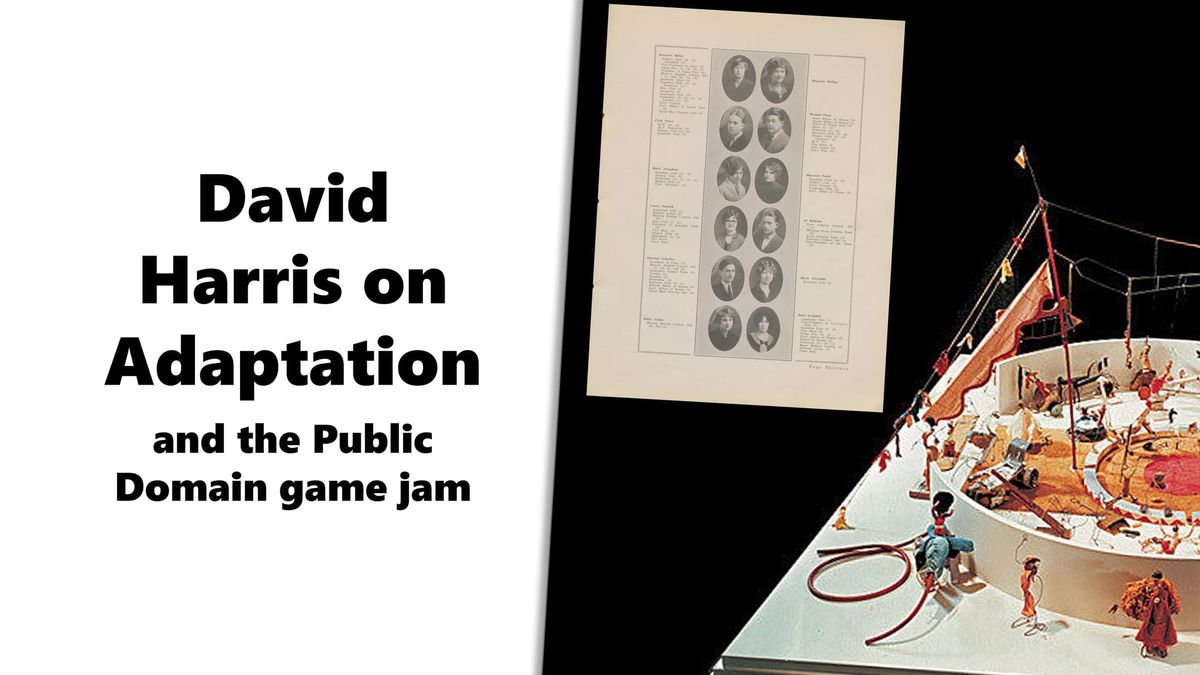
Calder’s wire portraits led to his sculpture/performance piece, Cirque Calder, first in Paris then the US, in which he play-acted a circus performance with his wire and wood sculptures on a circus tent set he made. He did these in living rooms for small, intimate audiences. That must have been quite a thing to experience!
So my question was really: how can a game format help us re-create that experience as closely as possible given the constraints of our contemporary lives?
But think about how many games are just reskins of another game (and not just interminable D&D reskins). They exist because somebody found the theme appealing but weren’t necessarily in a good position to do anything beyond a reskin. Often those games feel shallow, discordant, or consciously derivative because there’s no deep connection between the game mechanisms and the theme. And this is true of RPGs, boardgames, storygames, all kinds of things. I personally need to find a way to find game mechanisms that actively support the work I'm exploring.
This generally means that I try to come up with mechanisms driven by the source material, like making wire sculptures for Calder's Circus. Of course, there are few original mechanisms and I have a library of them sitting in my head from decades of playing games so there will always be similarities with others. And familiarity makes games easier for players so it should never be thrown aside on principle. As long as it all fits with trying to have an experience that connects with the source material, I'll explore it. Sometimes the result might not look much like a "game", but if I can create a game-shaped experience, I'm happy.
Then of course there's playtesting, with my home table first, but also sending to some other people who I don't play with.
Finally, I like to connect the layout and graphic design to the source material so I like to use typefaces that were also created in the year of the material, use photographic, illustrated, or archival elements.
So overall, it's still a pretty rapid process in that I just have 31 days start to finish, but in January I typically have a fair bit of flexible time I can devote to this jam.
How do you invite players to engage with works and their context?
Asa: You describe the research that you do on the source material and how the source material drives your selection of mechanisms that support your audience's experience. When we adapt source material like this, we are necessarily recontextualizing it for our audience. And when we recontextualize it, we predispose (intentionally or unintentionally) our audience to engage with the work, its context, or its meanings in new ways.
Your game Dreaming the Cave may be my favorite interesting example of this — a game in which two people explore a surrealistic dream connection between two artistic partners, Jindřich Štyrský and Toyen, after Štyrský’s death. Can you say a little bit about how this game is played? How does this game invite players to engage with Štyrský’s and Toyen’s works and their context?
David: I hope this game works in a couple of ways. At the surface, it introduces the work of Štyrský and Toyen, which is not particularly well known. But they were influential artists with complicated lives in a challenging artistic environment. Their careers moved from Cubism to Surrealism and, formally, the game itself is played on a very boardgame-like more Cubist-style painting, on which players overlay their later Surrealist works, mimicking a life progression in art. But with each painting placed, the players create a loosely shared dream-world inspired by the painting and the coincidences of the order they appear in.
Really, the game is about making a connection with these minds through an imagined surreal dream-world. Touching another's dream-world can't be done with any accuracy, as we have all experienced, but that's also beside the point. Our dreams are driven by very internal states but are typically prompted and influenced by external events. Surrealist paintings provide a window into the artists' dream-worlds, not a description. But we can use those prompts to enter our own, despite being in a different time and place. Surrealist art has a certain timelessness that creates some of its appeal, and it's something we can play with. In the game we find overlap between our dream-worlds and the artists', then between our own and another player's, almost as a proxy for a shared dream-world between Štyrský and Toyen. We can't say that our dreams are like theirs, but we also can't say they're not.
We can't try too hard to access dream-worlds–it just doesn't work!–but we can feel for the edges and see what emerges, influenced by the external world. In this game, we dream dreams that we couldn't have done without access to Štyrský and Toyen's work.
How do you handle fraught histories in your creative process and games?
Asa: Some of the works that we adapt may depict or reinforce biases from their time. Some have fraught histories, and you note as much as part of your research into circuses for Calder’s Circus. How do you handle these fraught histories in your creative process and games?
David: When we take things out of time or place, we can only ever play in a simulacrum. Given that, I like the Deleuzian idea that simulacra are actually a way we can challenge a previously accepted ideal. So in this case, engaging with the idea of the early-20th-century circus means we can hew closely to its format, structure, and rituals but also challenge the parts of it that we now have a different view of. In particular, the exploitation of animals.
For this game we can consider Umberto Eco's framework of "sport cubed" for circuses, which shares the aspects of performance, ritual, audience, cultural embeddings with sport. The first level is the circus itself being performed. Then there are the descriptions of the performances (circus squared), and then the discussion around those performances and the circus (circus cubed), each step further removed from the actual circus. In Calder's Circus, the archival record sits mostly at circus squared, and then the game itself is more like circus cubed but the rules ask us to re-inhabit a simulacrum of the original circus through construction and performance of acts. Hopefully we intervene in the typically linear degradation from the original act all the way to gossip that Eco describes. We can never get back to circus ourselves (in a tabletop game) but we can create a simulacrum.
So overall we can engage with these histories, but can challenge the fraught aspects through a game experience. In the end we are playing in the hyperreal (perhaps inevitably), but that is the only reality we can actually create so let's make the choices we want to make.
How do you see your games as “transformative” in their adaptation of these works?
Asa: And finally, adaptation can be transformative, and in many of your games, you not only reimagine the art work in playful ways but use the art as a spark of inspiration or a framework to imagine new possibilities. How do you see your games as “transformative” in their adaptation of these works? Or if not transformative, how do you view these games?
David: I think that aspects of my games are transformative in the sense that they build on and modify what came before, the original conception of what copyright law was dealing with. But I think I'm trying to do something a little different in that that idea of "transformative" is quite functional. It is using the prior work to do something new, but I want to use games to engage with the earlier work as more than just inspiration or source material. Being in the public domain means this transformative work is legal, but in what ways can it be ethical in the sense of being true to the work? We can't impose litmus tests on that question but we can explore it.
A theme I think I probably have going through my games is revealing the unknown through engagement with these past works. In some cases this is about just bringing to light aspects of these histories that are little known (such as the Solar Storm game). Other times it's about imagining and playing in the gaps of what is known. Perhaps the best example of the latter is Tower Tree Stories, where you can read the old yearbook closely, and think about what it was like to be at high school. You can really feel there is so much in those teen minds going unsaid, a palpable yearning for a fully developed life, much of it likely butting up against the rules and norms of the educational system, especially in that time period. So that game is exploring what else could have been said.
Our archival record is necessarily incomplete, even for contemporary work. Can we explore the gaps in that record through games in a way that is authentic to the original work and its circumstances? I don't know if I can claim these games succeed at the goal, but they are experiments in the attempt.
What else do you want to say about adaptation in your games or creative process?
Asa: Is there anything else that you’d like to say about adaptation in your games or your creative process?
David: Overall, my games tend to be about creating experiences, which has always been a factor in both my art and design practices. It's not just about making objects (although I very much like objects) and it's not just about creating processes in the form of rulesets that can be executed even with great creativity (though I do love processes as well).
For me, a key to creating rich experiences is physicality. I think all of the games in this series would be difficult to play only digitally, or at least lose something fundamental about them. These games try to create experiences that capture something fundamental in the work I'm engaging with. But it's a more general focus in my creative work.
Thank you for taking the time to share your thoughts, David! I really appreciate the opportunity to chat with you about the Public Domain game jam and adaptation in your design process.
I’ll link to your public domain games below, and I am excited to see what you come up with next!
- Calder’s Circus: Best Adaptation for "Gaming Like It's 1929"
- Solar Storm 1928: Best Deep Cut for "Gaming Like It's 1928"
- Tower Tree Stories: Best Analog for "Gaming Like It's 1927"
- Dreaming the Cave: Best Remix for "Gaming Like It's 1926"
- Fish Magic: Best Analog for "Gaming Like It's 1925"
- The 24th Kandinsky: Best Analog for "Gaming Like It's 1924"