🎤 Seraphina on RPGs, Board Games, and Eisegesis
The author of "What do we mean when we say a game supports play?"

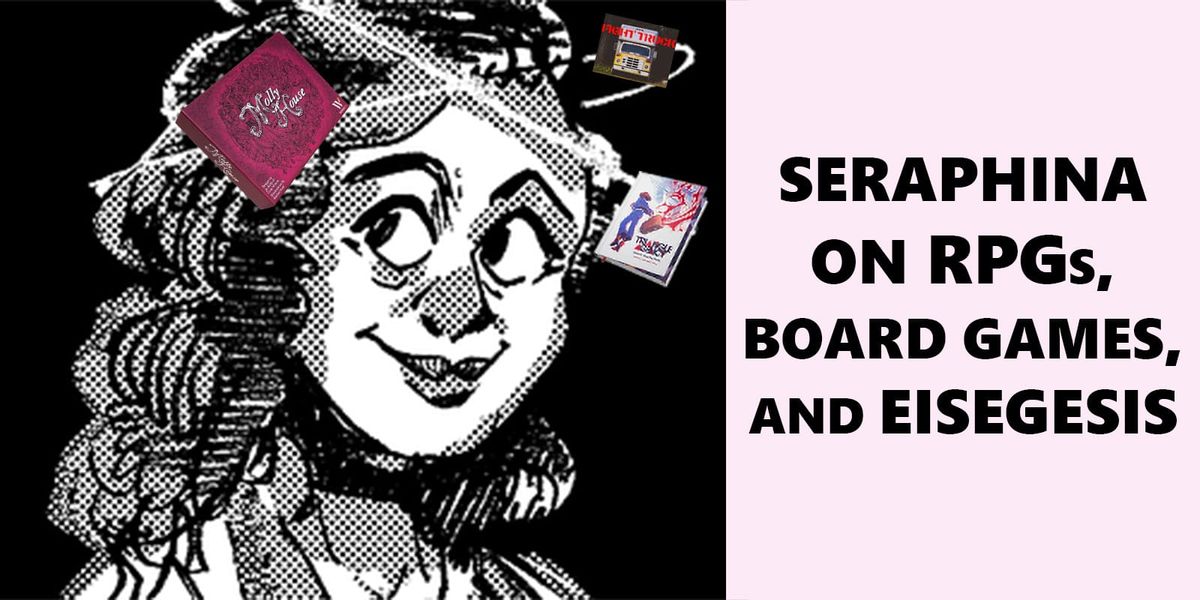
This interview is the first in a series of essays and interviews about repurposing board games in RPGs. I wrote it as part of the design process for Violent Delights: A chess-based RPG about Shakespeare’s Romeo & Juliet.

An Interview with Seraphina Garcia Ramirez
Seraphina Garcia Ramirez is the author of the excellent “I want to fight my friends in the back of a moving truck” (Rascal News) and “Expressionism in Practice: A Case Study of Triangle Agency.” Sera is whip-smart consultant for analog RPGs and a beloved moderator for the Dice Exploder discord. Anyone who consults her on their game and anyone who has playtested something with her inevitably wonders, “Is Sera the best kept secret in tabletop RPGs?”
I am not exaggerating!
Earlier this year, Sera stirred up some age-old discourse when she asked a question in her blog, “What do we mean when we say a game ‘supports’ play?” In this piece, she argues that the game text is insufficient to explain certain acts of play. What caught my eye is that she intentionally talks about games and not just RPGs. I invited Sera to talk about how this applies to board games and how players use games to make sense of the world around them.
Sera, your post “What do we mean when we say a game supports play?” reexamines discourse around Dungeons & Dragons and what it “supports.” You essentially argue that a game text is insufficient to explain certain acts of play, and that the word “support” brushes past "the complexity and nuance involved in how a text turns into a dynamic play experience through the interpretation and context of the readers in players.” Can you give an example of one of these acts of play — in which players bring something into the game that isn’t supported by its text?
What is an example of how players may bring something into a tabletop RPG that isn’t supported by its text?
Sera: My argument is in part that "isn't supported by the text" is a challenging framing to engage with, but I think it's useful to consider the example I used in the essay of coffeeshop play in Dungeons & Dragons to explain why.
If a table decides their party is going to take the gold earned from their latest excursion and use it to open a restaurant in the local urban metropolis, they will have to engage in a process of shared negotiation of that endeavor. Purchasing a property, getting approval from the city to run a business, developing a menu, renovating and decorating the space, sourcing ingredients — these are all details the players might want to engage with which exist outside the scope the book describes, barring liberal application of certain core mechanics, before they even get to the day to day complexities and encounters involved in such an endeavor. In some discourse, this might be referred to as a focus of play which is "unsupported" by the text, particularly as it might naturally evolve into new interpersonal and social dynamics.
I'd more precisely say that these are areas of the play which the formal rules of the game do not address, at least not in the way Stewpot. But this kind of play will still occur! Commonly, games will push out into these scenarios that the text itself does not directly address. But players will bring an understanding of what these processes look like, and apply that understanding to the game. They'll have a shared sense of social norms which govern how decisions are made. They'll bring their understanding of the tropes of fantasy media to bear when outlining what their particular tavern looks like.
But even if the formal rules don't specifically address running a tavern, they will still shape this play! The character creation process will paint a picture of a character with skills and failings, who comes from an ethnic culture and background, and it'll leave a void that invites players to consider who their character is beyond those statistics and labels. The combat rules will have presented these characters with life threatening scenarios, danger and risk, which will present players opportunities to demonstrate what they are fighting for, and what they want their life to mean. The social and exploration rules will present the players with a world full of other characters, who have lives beyond dungeon crawling or adventuring, and who have basic needs they want to meet. Even the core mechanic of rolling a d20 vs a target number will define the world as full of risk that can be mitigated through talent and training, but never fully overcome.
As I'm alluding to, the voids the game creates are just as influential on play as the ones it doesn't. By not having more formal social rules, the game will indicate a perspective on interacting with other people — that it lives in a space of more open complexity, until resolved in a very brief mechanical manner. By not presenting rules for how running a business works, it becomes an empty cup for whatever assumptions the players make, and whatever details they decide to elide. By treating all granular actions as represented by a single d20 roll, it leaves room for GMs and players to do whatever additional work they like filling in those gaps, or room for them to fall back on that single roll of a die.
I'm not making any claims here about how intentional this influence is, or how effective a play experience it may be for any given table, or whether another game with different formal rules might not accomplish all this with less effort from a table. But I think it serves as an effective example of how the relationship between a game text and the play that a table engages in while centering that game text is not as simple as asking what using the rules as written, exactly as written, looks like. Players will bring their own preferences and context to the table, and the game will shape their perspective even when they aren't directly following any given formal rule.
How does this type of play emerge in board games as well?
Asa: In your blog post, you’re careful to talk about “games” and not tabletop RPGs exclusively. Besides D&D, you briefly mention Monopoly, which I take as an invitation to think about how this works more broadly. How does this apply to board games?
Sera: Board games, like role playing games, consist of formal rules which are interpreted by players at the table. Since players can bring their own social and internal rules to play as well, these formal rules are not the only factors shaping play.
Take Monopoly, one of the most popular commercial board games of all time. Monopoly has a set of formal rules which ask you to win the game by accumulating wealth. Since it wants to allow multiple avenues for that engagement, there are multiple strategies that someone might implement to do so, and the choice of which strategy to undertake is shaped by many factors. How experienced is the player with the rules of Monopoly? Are they sharing the table with strangers, friends, or family? Have they played the game with this group before? What kind of dynamic does the group have? All of these factors will determine how the player attempts to win, how much they rely on negotiation, or even how interested they are in winning.
This sets aside an abundance of factors still, outside of strategic play. Perhaps when I was young, I was the banker when my family played Monopoly, responsible for tracking the paper bills that players earn and spend. Is that a fond memory for me? Perhaps that brings an additional layer of enjoyment to when I play Monopoly even today. Or perhaps we just watched a movie that featured businessmen of the type that Monopoly has us play as, and we decide to start roleplaying as our own cartoonish industrialists, conjuring up backgrounds and relationships that then shape the decisions we make in the game. When Paula reneges on a deal we had, I'm no longer taking it as a game action only, but as a slight from her family of posh aristocrats against my clan of new money investors, and my game becomes about spiting her.
Another example that comes to mind is Molly House, a semi-cooperative game where players take on the perspective of queer people in 18th century Britain, throwing parties and accumulating joy while avoiding the eye of the law. The game's primary victory condition is having the most joy individually, while collaboratively ensuring the community in the city reaches a certain minimum of joy. But when a player is caught out in the open and indicted by the authorities, they are offered an alternate path to victory — secretly informing upon the rest of the community, saving your own skin at the expense of the group.
To be clear, if play was solely informed by the text, then there are situations where it is objectively a better path to victory to inform on your fellow mollies rather than staying loyal, especially if their festivities and celebrations are the reason you have been put in this position to start with. But if we examine the reality above the table, perhaps a table full of queer players has a complicated relationship with this fiction the game conjures up. Even though the game does not call for roleplaying or embodiment, it is all too easy to see myself in the cards and pawns of Molly House. Even when it would be the clearest path to victory, I have seen players reject that option, choosing to model the ideals they value rather than treat the game as a simple exercise in optimizing towards victory.
Games are social constructs, and as such they are subservient to and shaped by our social dynamics. When I play chess with a friend who is vastly more skilled than I, and they choose to offer me do-overs of my blunder exposing my queen, or I choose to explain my thought process and seek advice from my opponent, we are bringing a dynamic that is not explicitly supported by the text of the game, but those experiences are as much playing the game as any tournament match. Games are more than just their texts, they are the people that play them as well.
Are there parts of a game or its text where we are more disposed to bring our cultures and contexts into play?
Asa: At the heart of your argument is the point that reading and play is always interpretive. Whether you’re reading poetry or a technical manual, your subjectivity forms the building blocks from which you build your understanding and enact play. Like you just said, games are also the people that play them. And yet, I wonder, are there parts of a game or its text where we are more disposed to bring ourselves into play? To perform eisegesis and read into the text?
Sera: Absolutely. As much as engaging with a text is always interpretive, the audience for that text can be prompted towards more conscious or varied interpretation in different forms. As much as I've come to understand I'm very comfortable with being bold about bringing myself into how I interpret the text without needing permission, nearly all people playing games are conditioned on a societal level to uphold the rules of those games (as they understand them). Therefore, games taking deliberate steps towards inviting or permitting players to make choices about how they engage with their understanding of the text serves to make that kind of interpretation more permissible and therefore more common. There's one game in particular I'll bring in as a very well rounded case study of where games can invite eisegesis.
Xoe Allred's game Conviction is a two player card game where you take on the role of a stalwart and an idealist in a relationship with each other they've committed themselves to. The game begins with establishing a change the idealist longs for and the reason the stalwart is opposed to that change, but it explicitly allows for that fiction to be completely set aside in favor of a sole focus on cardplay, to be played out in narration and scenes, or somewhere in between. Over the course of the game, these players will take turns playing cards in different ways and passing cards back and forth, as they attempt to find a resolution to this conflict. These cards are given minimal context in play — they have names like "Listen", "Embrace, "Sabotage", and "Publicize", and they have mechanical effects that are associated with either one player or another, but neither the rules nor the text on the cards themselves are explicit about what playing them means within the fiction. The only direct connection is drawn when we are told that taking cards of your partner's suit is how you listen to them, and filling their deck with cards of your suit is how you change their mind.
When the game ends, there are three possible outcomes based on the comparative proportion of your own cards and your partners cards in each of your decks when the game ends. Either one of the partners has Dominated and so gets their way, neither of the players have changed their mind at all and so they Separate, or if they manage to have both come around to the others perspective an equal amount they Cooperate. But the game takes great care to not assign value or priority to any of these outcomes — an author's note at the top makes this clear:
"Conviction deliberately does not explain how to win. Relationships are complicated, messy, contextual, and intimate. While many couples generally cooperate, there are times when one partner is clearly in the right and they should stand firm and dominate the subject. Occasionally, it’s clear from your partner’s behavior that what’s best for you is to leave the relationship, in which case you’d plan and hope for a safe separation. When introducing the game to others, be careful with your language. Do not say “this is how you win,” for example. You may unintentionally dominate their story and designate their play path for them."
This game is remarkable for the multifaceted approach it takes towards inviting players to interpret their experience. When you decide which player plays the Stalwart and which plays the Idealist, a pair might decide to pick roles that reflect or contradict their own history with interpersonal relationships above the table, and as such put their own experiences in conversation with the text. Deciding what change the Idealist longs for allows space to frame a goal that is admirable or reckless, and deciding why the Stalwart opposes this change allows them to be framed as a voice of reason or a restrictive partner. Cards being vague about what fiction causes the mechanical game state to change and how much detail the players might add to those plays means the personal perspectives of the players are allowed room to fill gaps, or perhaps be elided and thus paint the experience as a colder, more abstracted engagement. When the game refuses to label one of the outcomes as a win condition for either participant, it permits the players to more freely decide what their goals are and how those goals might shift, for the game to flow between a cooperative and competitive experience. But it also requires the players to do so, to bring in some degree of internality or else simply be a passive agent in the game.
Conviction is a very strong example of how and when games can make players more disposed to perform eisegesis. It leaves gaps that players are either permitted to explore if they choose, explicitly required to fill as part of play, or implicitly forced to navigate as the game pushes them along. When a ruleset claims to explain itself thoroughly or to bound the experience of play clearly, players may not choose to push those boundaries or question those explanations. But in the moments when it declines to tell you what is or should be true, when it leaves gaps where your decision making is not provided clear or direct motivation by the formal rules, it illuminates the endless opportunities to add your own meaning to play, even in the other parts of the text that aren't quite as permissive.
Do you see the fruitful void as inviting eisegesis?
Asa: You talk about gaps in this answer and voids previously, but it seems like you're tiptoeing around the term "fruitful void." Do you see the fruitful void as inviting eisegesis? And if I can speculate, are you avoiding the term because there are other voids (perhaps less evident or unintentional) that also invite us to bring ourselves into play?
Sera: The fruitful void as originally outlined certainly can — the concept gestures towards this idea that there are themes which might be central to a game but which would suffer from being mechanized. That kind of design will always invite eisegesis because players will inevitably bring in their own ideas for how that element of the game should work and what it might look like, but I do believe it's only one way to describe gaps in the text.
In my previous example, the central theme of Conviction is arguably how people who are engaged in a relationship resolve fundamental conflicts of perspective. A traditional understanding of fruitful voids might argue that mechanizing such an argument is intruding into that space, so a TTRPG that wanted to be about these kinds of arguments might decide to avoid mechanizing conversation in this way. And that could be productive! But clearly Conviction is interested in exploring the same themes (successfully, I would argue) while still mechanizing these elements. The void shifts from "How do we resolve this action without mechanics to determine the outcome?" to "What choices do we make about how we engage in these mechanics?"
That isn't to say a work that takes this kind of "board-gamey" approach to systems might not still have fruitful voids. I could see an argument for the absence of a mechanical win condition being an example in Conviction. I think role playing games are historically often predominantly concerned with creating mechanical simulations of fictional scenarios, and so recognizing that some designs benefit from decisions being made by players filling the gaps rather than texts dictating procedures is still a useful lesson. But that does not mean anywhere mechanics exist intensely cannot also include gaps and voids! There are so many choices and meanings that can be found within a mechanical system, and how we choose to interpret and engage with those mechanics can also introduce elements of ourselves into a space that may otherwise seem very crowded by rules and instructions.
That being said, the fruitful void is a fairly flexible idea that I know has been interpreted by some to include what I'm describing here, so perhaps it's fair to say these are all different ways to incorporate that principle into design!
How do we use games to understand our culture, our situations?
Asa: I've asked about bringing our contexts and cultures into playing a game, but we also use play (and games) to understand our contexts and cultures. This is an idea that folks like Friedrich Froebel, the inventor of kindergarten, and to some extent Jean Piaget have discussed around child development. But we do this in adulthood as well. From your perspective, how do we use games to understand our culture, our situations?
Sera: This is a really interesting space that you see very different answers around depending on the kind of game design and criticism you inhabit. Quintin Smith and Jacob Geller had a conversation recently on Nebula where they discussed games about historical atrocities, and the idea that different kinds of game are better at different lenses on history came up. I think there's some truth to this — a board game can capture systems and structures, how they produce behavior or push trends, through the cultural tendency in that space towards very bounded decision spaces. Role playing games, in contrast, might spend more time on interpersonal relationships, on how people within a cultural context make choices and experience their environment, because of their tendency to connect players to individual characters. But I think both of these arguments (which I have heard in a variety of spaces) don't necessarily account for how interconnected people are with systems, and how games might push past prior design tendencies.
Seven Part Pact, the upcoming wizard TTRPG by Jay Dragon, is concerned with power and masculinity on a societal scale. It looks at powerful men through how they wield that power through larger cultural systems and institutions by mechanizing those systems in a very board-gamey way. But it's deeply concerned with the people inside these systems — how they grapple with gender, how they justify these decisions and turn them towards their own benefit, how these rules are in many ways both entirely constructed and arbitrary while also being irresistible and powerful.
Mechs Into Plowshares, by Anomalous Entertainment, is a much lighter solo game about a mech pilot who has been sent home from the war, and is attempting to repurpose their weapon of war into a tool for running a farm under the pressure of financial obligations and the looming threat that war will come find them again. With an economy of words and rules, it creates a space for considering anxiety and trauma, how we exist inside a world that we feel we know is coming to take away everything we love. I'll avoid going into detail, but it mechanizes paranoia in a way that feels very real and present.
I've recently been preoccupied with how culture shifts power and responsibility away from individuals to systems and cultures. Games, as constructs preoccupied with naming and recognizing what rules we are agreeing to operate within, and how they connect to our broader situation, feel powerful as tools for testing those assumptions. It's harder to dismiss something as nobody's fault when you come to understand that every rule must be enforced and abided by to exert power over people. It's easier to recognize what is a rule that was created by people when you deconstruct a play experience that entrusted you with deciding on the rules that shape your engagement with the people around you.
This starts young, of course. Children use games to understand how lies work, how their bodies and their spaces function. Play is a teaching tool that shapes social awareness and illuminates how we share our time and space with each other, and how we see a world that at this young stage we are just beginning to see the shape of. That learning doesn't have to end, and it doesn't have to come from these heavy or serious games. Every game and every instance of play, no matter how casual or how lighthearted, is an opportunity to decide what we prioritize as we choose to spend time with others and ourselves, and how we can choose how we engage with rules in service of our true goals for that time.
Other Essays and Interviews in This Series
- Essay: Chess Supports Roleplay
- Essay: Chess is a Boxed RPG
- Interview: Jason Morningstar on Boxed RPGs
- Essay: Chess Has Baggage
- Interview: David Harris on Adaptation and the Public Domain Game Jam