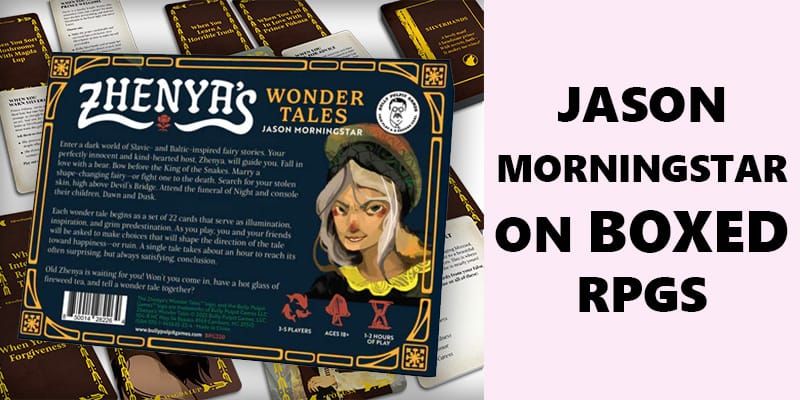
🎤 Jason Morningstar on Boxed RPGs
The designer of Fiasco, Desperation, and Zhenya's Wonder Tales.

This interview is the second in a series of essays and interviews about repurposing board games in RPGs. This interview is about Bully Pulpit's boxed RPGs and what designers should know about their design. It was conducted as part of the design process for Violent Delights: A chess-based RPG about Shakespeare’s Romeo & Juliet.

An Interview with Jason Morningstar
Jason Morningstar is one of the most notable game designers in analog RPGs. He is co-owner and creative director at Bully Pulpit Games, and he has designed or been a designer on numerous award-winning games, like Fiasco, Desperation, Grey Ranks, and Night Witches. He is a winner of multiple ENnies, the Diana Jones Award for Game Excellence, and an Indiecade “Best Analog Game.”
As the designer and publisher of various boxed RPGs, I’ve invited Jason to share his perspective on these games. I ask him, what should other designers know about the opportunities, challenges, and alternatives for boxed RPGs?
Jason, among Bully Pulpit’s titles are many, many boxed RPGs, including the second edition of Fiasco, Desperation, and most recently Zhenya’s Wonder Tales. Bully Pulpit Games is also the publisher of Star Crossed by Alex Roberts. As a designer, what is the appeal of boxed RPGs, including card-based games?
As a designer, what is the appeal of boxed RPGs, including card-based games?
Jason: I believe that games tell you what they want to be if you listen, and some games want to be in boxes. Desperation and Zhenya's Wonder Tales share a form factor, which is basically a bunch of cards. Containing these in a functional box just makes sense. The second edition of Fiasco is also card-driven, and wanted to have a more board-game-like affect, so again, a box made sense. Beyond listening to the game, there are really good reasons for putting a tabletop roleplaying game in a box — from a marketing perspective it elevates the perception of quality and value, and from a merchandizing perspective it makes a game stand out on a shelf. There are significant downsides, of course — expense being one, and we can wrap shipping into that category. Another is that many gamers are not familiar with form factors other than books for TTRPGs.
Asa: Can you expand on what you appealed to you about using cards for these games?
Jason: Cards are great! I find that a lot of my game ideas want to use cards and I have to be actively talked out of it or find ways around it, because printing and shipping card games is not currently affordable for us. I like the affordances of cards, the simplicity, the tactility. Each project is a little different but you can use sequences in interesting ways, you can tune decks, you can get satisfying randomness, you can combine disparate elements easily. The amount of information you can put on a card is both self-limiting but also sort of the right upper bound anyway.
What are some of the biggest challenges that you have encountered for boxed RPGs?
Asa: You already mentioned some downsides to boxed RPGs, and with the recent release of Zhenya, you have likely navigated some of the recent practical challenges for this sort of game. What are some of the biggest challenges that you have encountered for boxed RPGs?
Jason: Idiotic fluctuating tariffs, damage in shipping and warehousing, higher overall expenses for both production and distribution when compared with a book, in some cases regulatory issues related to product safety (If it is considered a toy rather than a book, for example). The value equation for the customer can be a challenge.
Asa: It sounds like there are challenges normally, but those are being exacerbated by Trump's chaotic trade "diplomacy" and tariffs. In your opinion, what might the path forward look like for these sort of games, whether for hobbyists or people who rely on these games for income?
Jason: My hope is that domestic (US) manufacturers see the opportunity and we can source set-up boxes, cards, and other components locally with a similar quality. Right now that's barely possible but cost prohibitive, but it is an opportunity for printers. The way forward for us, for now, is to pivot away from anything that doesn't want to be a perfect-bound book. That's the internal rubric — "can this be a book? No? Shelve it for now."
The other potential way forward is a more dramatic rethinking of what a "product" looks like. In Italy they are much more creative about game packaging; Narrativa put the Italian language edition of Montsegur 1244 in a corrugated cardboard cosmetics case, for example. The QUiet Year comes in an aluminum soda can.
The risk here is with the market rejecting something in a form they don't really understand.
The other potential pivot is to print-and-play (PNP) or print on demand (POD). PNP adds an arts and crafts burden a lot of people don't want to deal with, and POD is hard to make a profit with, although for cards it is very accessible and easy to use. For more complex boxed components the costs escalate quickly.
Asa: You've anticipated my next question!
Why do you provide a print-and-play option for Desperation and other games?
Asa: I’d love to give a shout to Desperation, which is such an accessible game for new players. I also really appreciate that although it is card-based, it is also available as a print-and-play. Of course, the physical cards are a more appealing and functional product. Why do you provide a print-and-play option for Desperation and other games? What about PNP is important to you as a designer and publisher?
Jason: One of our (Bully Pulpit Games) goals it to make our products accessible to a wide audience, and a print-and-play version is both an added value for the purchaser of the physical product (through the Bits and Mortar initiative) and a way to reach folks for whom price is very sensitive. Plus I love the arts-and-crafts aspect of making your own cards, personally. We are occasionally restricted in markets (Zhenya's is only shipping to North America, for example) so a PNP version is a benefit to our fairly large and definitely enthusiastic non-North American audience.
As the publisher of Star Crossed by Alex Roberts, what were some of the practical considerations for the wood block tower?
Asa: Bully Pulpit Games also published Star Crossed by Alex Roberts, which is an awesome card-based game that uses a Jenga or wood block tower. It’s not the first game to use block towers, of course, but the block tower is an interesting alternative to, say, assorted boxes, who have game components that are sold with the box. The tower is sold separately.
As the publisher of this game, what did you think about its use of a block tower? This game was written by Alex Roberts, but to the extent that you were involved in the design process, what were some of the practical considerations around the wood block tower that your team discussed?
Jason: Well, the first edition of the game included a tumblin' block tower, so we've explored a lot of possibilities. There are loads of games that ask you to supply components — any tarot-based TTRPG, any playing card-based TTRPG expects you to supply cards. Few games ship with dice. With the wooden block tower, there were many, many discussions about how to package it, how to produce it, how to ship it. It's a complicated thing for sure.
Asa: Was that availability part of the decision making? And if I can ask, what was the main reasoning behind shifting to cards-only?
Jason: You can spec out any product through Chinese vertically integrated manufacturers and intermediaries. So availability was not a concern. We adjusted based on customer feedback and we're inspired by the tower-less Italian edition.
Asa: Thank you for taking the time to share your thoughts, Jason! I really appreciate the opportunity to chat with you about Bully Pulpit and boxed RPGs.
I'll link to some of your games below, and I look forward to hearing about the next game in your queue!
Check out some of Bully Pulpit's games, like
Other Essays and Interviews in This Series
- Essay: Chess Supports Roleplay
- Interview: Seraphina Garcia Ramirez on RPGs, Board Games and Eisegesis
- Essay: Chess is a Boxed RPG
- Essay: Chess Has Baggage
- Interview: David Harris on Adaptation and the Public Domain Game Jam