Let the Metagames Begin
Games about games

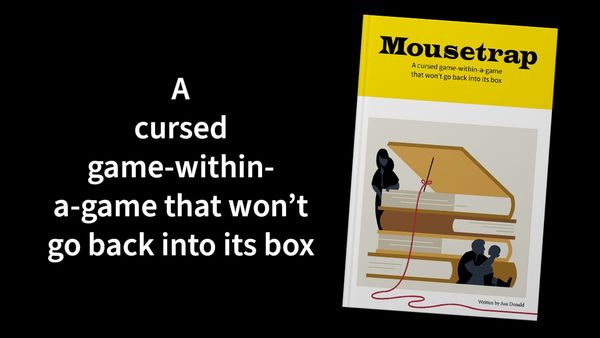
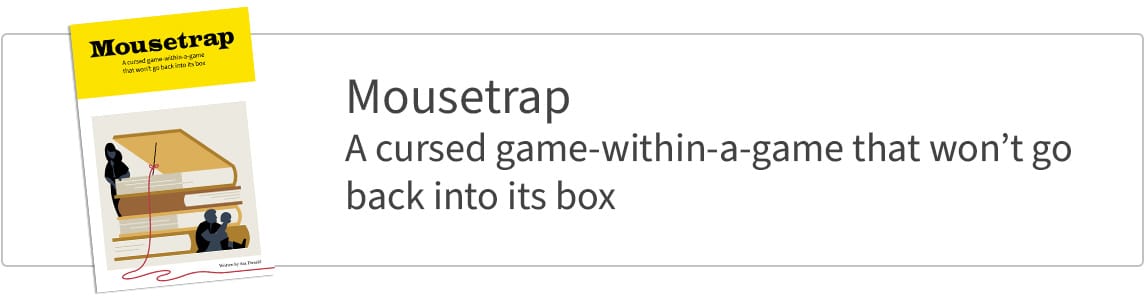
This is the first essay in my series about “metagames.” I wrote it in preparation for publishing Mousetrap: An absurd game-within-a-game about getting trapped inside an RPG and Violent Delights: my chess-based RPG about Shakespeare’s Romeo & Juliet.
I want to talk about metagames — in the broadest sense, games that are about games, games that examine what it means to be a game, and games that draw attention to the fact that they are a game. Although there are already popular metagames in the tabletop RPG mainstream, such as Kieron Gillen’s DIE RPG, and metagames by well-regarded designers, like Dungeon by Jay Dragon and the live-action Game Night by Jason Morningstar, I consider this topic underexplored in tabletop RPGs, both in design and in discussion.
I think it’s a shame.
When you play, read, and design these sort of games, they expand your awareness of the art form and the shapes it can take, what makes it unique, and the culture that surrounds it. Also, I’m just a sicko for weird games.
Metagames, generally
A metagame is a game about games, established by the game's subject matter or content, its formal rules or mechanics, or both. The content may draw attention to the game itself or a component of the game, its conventions, or culture. Or it may offer self-aware characters, characters who directly address the players, or an extradiegetic voice intruding into the diegetic universe. It may even have a game-within-the-game.
Consider the self-referential fiction of Klint Finley’s Logomancy (2021), a system-neutral adventure about a fictional tabletop RPG that drives its players mad — and which is also called Logomancy. This is a tabletop RPG about a tabletop RPG, which quite frequently reminds you that you are playing a tabletop RPG. It also touches on the social elements of these games and their play culture, which are a part of the plot’s Call-of-Cthulu-esque investigation. Logomancy is especially about the game text — hence, its name, which points to the magic of words. In fact, Logomancy comes with a handout that is the embedded game’s actual text.
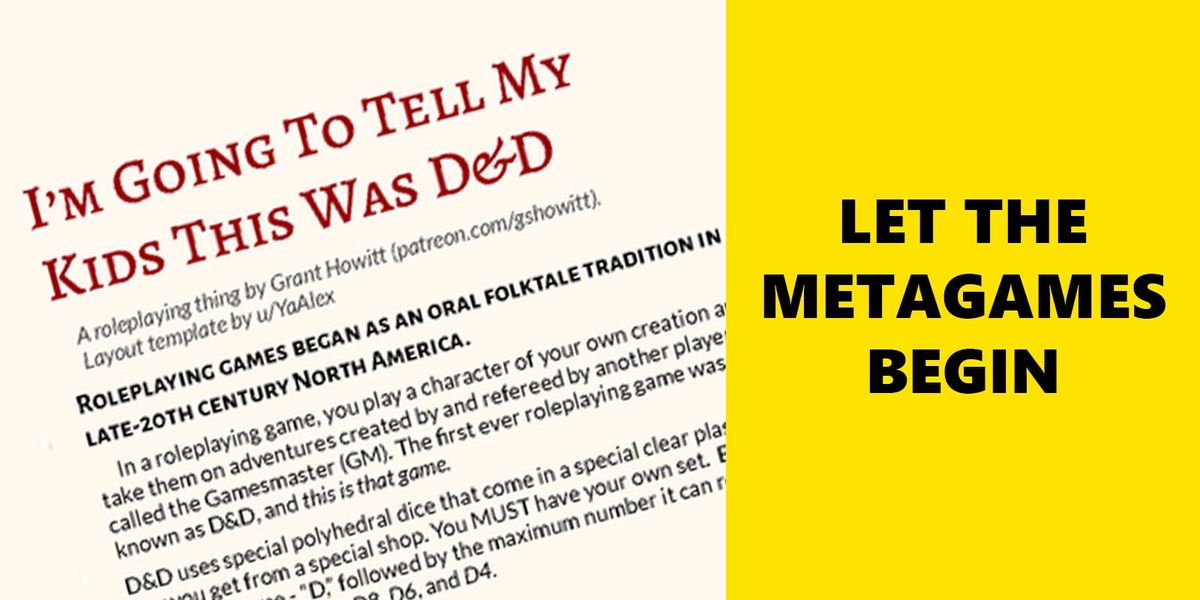
Mechanics and formal rules can also draw attention to the fact that you’re playing a game. Consider Grant Howitt’s I'm Going to Tell My Kids This Was D&D (2025), a one-page RPG whose mechanics intentionally distill those of Dungeons & Dragons 5th Edition into one page, thematizing D&D. One of the six key dice rolls will be familiar:
The D20 is the decider dice. When you attempt to do something difficult, the GM comes up with a number you need to beat or match on the D20 to succeed. (Usually 12; higher if it’s difficult, lower if it’s easy.) Add the relevant statistic to the roll to get your result; if it’s lower, you don’t do the thing.
On a 20, you critically Succeed! (That’s good!)
On a 1, you Critically Fail! (That’s bad!)
D&D is so well known, its mechanics so established, that you may be well aware of the genealogy of this mechanic, even if you have never played D&D. And yet, if you played the game, the absence of D&D’s other rules is bound to be felt. What happens when you critically succeed or critically fail? When do you get advantage — is there advantage in this game?
The game text asserts that this game will “play fucking D&D,” and moreover it insists that “the first ever roleplaying game was known as D&D, and this is that game.” And yet, you are only almost playing D&D. I am reminded of what Lin Codega recently described as "experiential ownership," and I imagine that This Was D&D does in fact play D&D — it is just Howitt's D&D.
And sometimes one’s experience of the game’s rules clash with the game’s content or genre, creating dissonance. This “ludonarrative dissonance” can have the effect of “emersion” rather than immersion, which is to pull you out of your role and reflect on the game or its system. Often, dissonance is a sign of poor design.
But in expressionist games, this dissonance can be the result of an intentional tension “between the narrative of how the characters want to relate to others and the rules enforcing how the characters must relate to others.” And this dissonance is also in some lyric games, which claim they are games yet are questionably playable — games that ask you to play in ways that are impossible, impractical, or (in at least one instance) illegal.
In the tension or clash between these elements, these games draw attention to themselves as games, the game-iness of life, or what a game even is.
Why Metagames?
Or maybe metagames are defined by their effect. Are they games that effectively reveal something about their medium and its cultural significance? I like that, but who determines if this is the case or if a game is "self-indulgent"? I also worry that this perspective may reinforce the narrow view that meta art can occur only after a form is mature.
Metagames can have other, more practical (or silly) effects than this. Metagames create a moment or series of moments in which a player becomes aware of their role as a player or of the artifice of the game’s fiction. This awareness can be disorienting, and the designer can predispose the player to take a certain stance around these moments, maybe curiosity or playfulness. The designer can encourage the player to pause and engage with their experience critically — or simply laugh and move on.
Disorientation is a key part of the experience in Logomancy, which comes with a prop — a game text that drives its players mad. Engaging with this game text creates a Lovecraftian-overwhelm for your character, which Finley describes as “becoming unstuck in time,” seeing all past and all future in one moment. Simultaneously, when the embedded game text reminds you (as a player) that the role in which you may have been immersed is merely a construct, you become “unstuck in [fictional] time” as well. Finley reinforces the game’s fiction using the disorientation of the metagame.
In other metagames, that awareness results in someone becoming aware of the game that they are not playing. In This Was D&D, many of the core rules are based on D&D 5e; however, they are distinctly different — simplified and paired with new dice rules — and we are especially aware of the distinctions from D&D in the rules that intentionally diverge from it, most notably Howitt’s “Birthday Dice.”
When you try to do something interesting, the GM can ask you to roll all seven special dice to see what happens.
The D100 is the birthday dice.
(The D100 is actually two dice - one with the tens, one with the units.) If you roll your current age, set all the other dice to any other result you desire. Congratulations!
Although the game claims to be D&D, you know you are not playing D&D when you roll those birthday dice. You are playing a game that is D&D-like, a version of D&D that celebrates its core rule, homebrew culture, and dice-happy nature but cares little about the rest of its rules.
What can metagames teach us about tabletop RPGs?
Consider how metadrama disrupts the physical space of theatre, where the fourth wall of Western theatre can be pierced by a character who wanders off-stage and into the audience. Or how metafiction can make you question the authority of the written word, when the author interrupts the story to reveal that you have actually been reading a translation.
Similarly, metagames draw attention to formal or conventional qualities of their art form, revealing them, breaking them, distancing us from them. They expand our awareness of them and the culture that surrounds them.
For example, tabletop RPGs can have one player or there can be multiple players. Each player controls their own character, sometimes multiple. Some players may be game masters or take on unique roles as players that help facilitate the game. These roles have different relationships to the fiction, which means that different circumstances can be used to raise awareness of their role or to emphasize the game’s artifice. For example, the disorientation that I discussed in Logomancy reinforces the Lovecraftian themes for player-characters, but what of the game master in their various diegetic and extradiegetic roles?
One distancing effect for game masters can occur around the limits of their authority. As I mentioned, the prop for Logomancy is an actual game text. This prop is also called Logomancy… and it too is playable. The game master can choose to have their players play the game within the game, in which case they become game master for a game of Logomancy where one of the characters is also a game master for a game called Logomancy. How far do their powers (and duties) as game master extend within this game-within-a-game?
Additionally, one of the pieces that a game master must assemble in this module is whether the spells in Logomancy2 may be used to manipulate “reality.” These spells, which come from a secondary game text, lend these players their own authority, which is to say authorial power, which they can wield against the villain, who is Logomancy’s game designer with authorial powers of his own — an NPC played by the game master. These are mirrors — and designers can angle the mirrors to reflect specific roles.
Moreover, tabletop RPGs often have a game text from which we derive rules and perform our fictions. It differs from a script for theatre in that it is rarely an object to be adapted and absorbed by a performer and more often an object for reference during play. Game texts are also communicators of fiction and as such can include metafiction. And game texts can also present a prop or object within the fiction, whose language and design draws attention to the fiction’s artifice.
That’s probably obvious by now in Logomancy, whose handout and prop is itself a game text. And the adventure necessitates that the game text will fall into your character’s hands and that your character will read it, while you operate that character using a very similar text. Simultaneously, this an opportunity for both blur and bleed, when you hold the actual text in your player’s hand and wonder, “Should I read this? Is this dangerous?” Whose thought is this, yours or your character’s?
And when as a player you reference the rules of This Was D&D, you are not only distantly aware of where its decider dice come from but also of the origins for the text’s layout, which is the standard layout for D&D 5e. When you hold the one-page RPG in your hand, you may be reminded of the many rules that this game is lacking, the remainder of the massive tome that is the player’s handbook.
I think that tabletop RPGs are both challenging and exciting to design around in this way. In particular, as these examples may reveal, something that I find especially challenging and exciting is that all tabletop RPGs are metagames in some ways.
Although we can become so immersed in the roles we play that we lose track of our frame of reference or that the fiction takes priority over the rules, we are always actively assembling and refereeing the game as players. We are more frequently aware of our frame of reference, and that awareness is a symptom of a critical difference from other media.
As players we take on a dual role: we are both performers and one another’s audience. Whereas metatheatre tends to be for the audience more so than it is for the performers and stage hands, that’s not the case in tabletop RPGs. This makes meta-RPGs both challenging and exciting to design, from my perspective: when the effect of metagames is to distance and disorient the audience, do you not also disorient the performer?
Essays in This Series
- Essay: Let the Metagames Begin
- Essay: Breaking Fourth Walls and Magic Circles
- Essay: Mini-games and Fragmentation
- Essay: Framing Devices and Games-within-Games
Interviews in This Series
- Interview: Thomas Manuel on Theatre and RPGs
- Interview: Kienna Shaw on Your Magic Circle
- Interview: Emily Allen on The Yellow Curtain and Metagames
- Interview: Cornelia Foote on The Curse of Castle Muldoon