🎤 Thomas Manuel on Theatre and RPGs (plus Metatheatre and Metagames)
An interview with Thomas Manuel on Theatre and RPGs

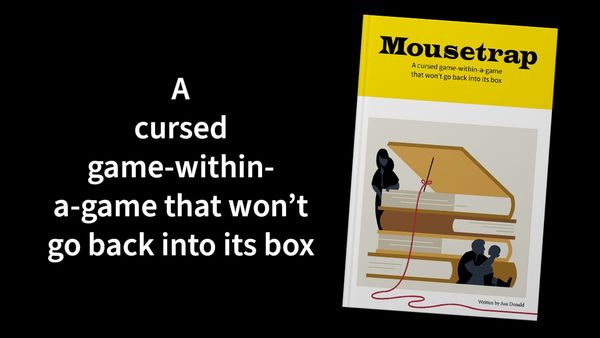
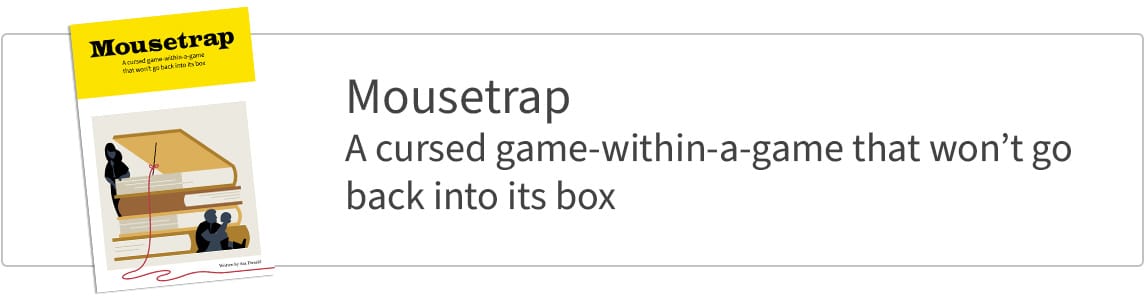
This is the first interview in my series about metagames in tabletop RPGs. I conducted it in preparation for publishing Mousetrap: A cursed game-within-a-game that won't go back into its box.
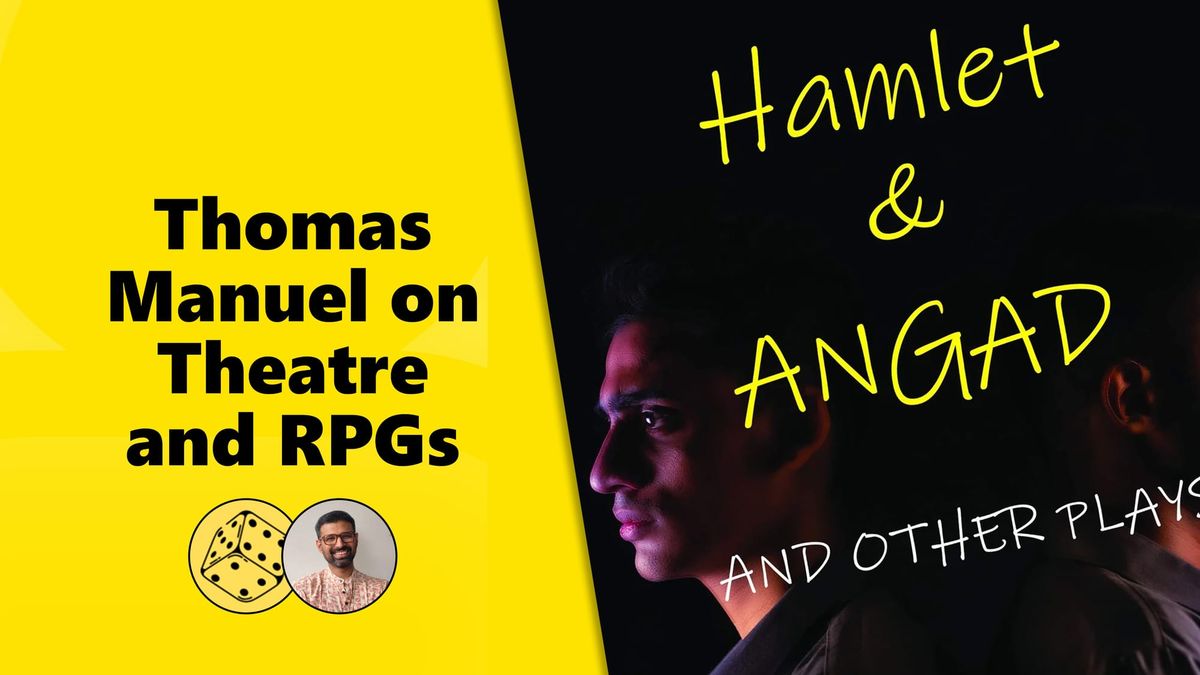
In online communities for tabletop RPGs, Thomas Manuel is a well-known journalist and RPG critic who hosts the Yes Indie’d podcast, curates the Indie RPG newsletter, and writes for Rascal News. Thomas is also an award-winning playwright. His play Hamlet and Angad (2016) won the Hindu Playwright Award, and it is published alongside two of his other plays The Uprising and A Play About Death in a single volume by Dhauli Books.
I asked to interview Thomas because I think tabletop RPGs and theater have an affinity with one another that he can speak to uniquely, and because I wanted to consider the formal distinctions between these two media to introduce design considerations for this series. The result is a discussion in which Thomas probes easy generalizations about theatre, considers for whom these analogies are useful, and speculates on the purpose of metatheatre and metagames.
Thomas, I’d like to begin by asking you about text and performance. In theatre, a play is performed from a text, a script — or adaptations thereof —, and similarly, in tabletop RPGs, gameplay is often assembled from a game text. In your eyes, what insights can we draw from this similarity?
What insights can we draw from comparing scripts and game texts?
Thomas: First off, I know scripts are one of the analogies that people sometimes reach for when talking about game manuals but it's worth saying that like all analogies, they're an abstraction and can't be pushed past a certain point. That's not necessarily a weakness, that's all analogies. They're not the thing, they're only like the thing. The usual problem with the analogy is that game manuals aren't as prescriptive as scripts. They almost never tell you exactly what to say — if they do, it's only for a brief moment. But that said, we can also overestimate how prescriptive scripts are — nobody would say they're like game manuals, but thinking of them like they were might actually be better! And this is the primary weakness of the analogy, which is that since theatre isn't particularly popular anymore, it's not really useful to point at it when making comparisons.
For me, the best way to engage with the analogy is to think of it as a script as one of the directions that a game text can go in. However you imagine a script — something you can just pick up and read, something you interpret, something with characters and sets and a plot — those are all interesting directions for a game text to go in. And it's not new. I'm not sure what were the first voice-y game texts but if you look at any of Mike Pondsmith's early work, it's very theatrical. There's characters with canned dialogue, there's set pieces — it's all there to some extent even though they're often what we think of as "traditional" games.
Asa: And what would you say are the critical distinctions between a script and a game text?
Thomas: I'm struggling to think of something to point out as "critical". There are obviously many. But here's a fun one: Short scripts don't presume more experienced actors! A short script is often easier to approach than a long one. Why are short RPGs sometimes harder?
To phrase that more constructively, I think there's some cool design space for games (like what Jason Morningstar is doing) that are very short in length but rather than creating more and more open space, they have focused scenarios and decision-making.
What are some of the critical differences between an actor and player?
Asa: In theatre, this script is performed by an actor, who assumes the role of a character or who perhaps doubles as multiple characters. And in tabletop RPGs, players assume the role of a character – or multiple characters, depending on the game or if you’re the GM. What are some of the critical differences between an actor and player? And why do they matter?
Thomas: It's a tough question because again, I'm not sure how far to push the analogy. I think if someone told me, I hate when people think playing RPGs is like acting, I'd agree. On the other hand, if someone else said that fundamentally, there isn't much of a difference between acting and playing RPGs, I'd probably also agree. I think part of the problem is that we have this mental picture of what a good actor is, and those qualities don't necessarily make a good player — but at the same time, that's probably not actually what actors think a good actor is. Listening is an essential actor skill, and it's an essential player skill, but nobody says that Leonardo Di Caprio is a good listener, right?
So, maybe the bottom line for me is that this isn't an analogy I would really make to a new player, it would probably be detrimental. But if I was talking in an academic context, I would probably start from asking if there's any difference at all and then go from there.
Asa: I am definitely interested in how far we can push those analogies to find similarities in form. Where they break may tell us something about the difference in form. One question I have is, who is the actor acting for? And who is the player acting for? Does it matter?
Thomas: If you're talking about audience, I'm not sure there's a difference! I've personally been part of shows where there are more people on stage than in the seats and it really felt like the question of audience got really murky. We say that in RPGs that the audience is the players themselves, but if you're bad enough, that can be true of a stage show too.
In his Ultimate RPG Gameplay Guide, James D'amato actually starts the book with a discussion of audience and not in a streaming sense — just as a way of talking about the people at the table and the kinds of stories they want to tell. So yeah, I don't think audience is one of the criteria for how I would distinguish the two mediums.
Asa: Oh, I love that murkiness. Although, maybe there is a primacy of audience that can't be discounted in theatre — and often a spatial component of the theatre audience too? The specter of streaming, I think, also raises a distinction in the audience of an actual play versus actual play.
What are some of the key distinctions between theatre’s “fourth wall” and a magic circle?
Asa: My next question is along similar lines, I think. I know that Tom Stoppard, who just recently passed, is one of your favorite playwrights, and some of his most popular plays, like Rosencrantz and Guildenstern Are Dead, revolve around metatheatre or metadrama, with characters who become self-aware. In The Real Inspector Hound, which is one of my favorites, his characters break the fourth wall and at one point sit down and join in the audience. Theatre has a fourth wall, whereas tabletop RPGs only have a magic circle. What are some of the key distinctions between the two?
Thomas: So the fourth wall comes from, as far as I'm aware, the structure of the proscenium stage because it's shaped like a box. There's an imaginary wall between the actors and the audience — and the audience is seeing through it into the action. It's how a lot of people imagine a "normal" play operates. Norms are their own problem. When I say "tree", you imagine something but I imagine something else. When I say "a play", you imagine something — and it might be costumes, lights, and a fourth wall. But even before I was born, that wasn't necessarily the norm anymore. I've spent most of my time around people doing theatre that didn't necessarily look like a normal play. It might not have had a script, it might not have had costumes or lights or a stage, and it probably didn't have a fourth wall. Often, the plays I liked growing up had a sutradhar (a storyteller) who spoke to the audience directly. Sometimes at the beginning — like Alfred Hitchcock talking to his audience before his movies. But often as a framing device through the whole thing.
Like you said, Tom Stoppard is sort of known for breaking the fourth wall. But for me, when we talk about the meta-ness about Stoppard, it's not just that they occasionally break the fourth wall but it's theatre about theatre in some ways. Like Rosencrantz and Guildenstern builds on the idea that people know Shakespeare well enough in a cultural consciousness sort of way that you can invert it and focus on two minor characters and it'll be interesting. And because Hamlet itself is a play that has a play in it, this one becomes a play about a play that has a play in it. It might not break the fourth wall but it doesn't for one second expect you to forget you're watching a play. It's about you watching the play.
I understand the fourth wall in a way I don't really understand the magical circle for RPGs. Is it even a concept related to audience? It feels like it's about the act of play itself. I have never drawn a line between the world and games in the way the concept seems to suggest. I don't see playing an RPG as entering into a ritual space — with exceptions. (This is assuming we're not saying "actually everything is a ritual", which also means nothing is) Mostly I associate the magic circle with concepts like immersion, which again I don't relate or aspire to. I play online mostly now and so my experience is just so far away from this kind of thing that I don't really know how to even engage with it. What are the new rules that govern the space within the magic circle? I mostly behave the same way as I would outside, following the same norms of courtesy and sociability.
What are the key similarities and distinctions between metatheatre and metagames?
Asa: So far I've asked about formal distinctions between two forms that have seen a lot of comparison, building toward something I'm interested in, which is metatheatre and metagames. You've already raised how Stoppard isn't just known for breaking the fourth wall but also for metatheatre, more generally: theatre about theatre. I'm curious, what are the key similarities and distinctions between metatheatre and metagames for you? Is there anything useful to glean from this comparison?
Thomas: I think the idea is that they should be functionally similar but I don't know if tabletop RPGs are self-critical enough yet. The biggest RPG in the world is a pastiche but that's not the same thing at all. Games might know they're games but that's not the same thing as doing something interesting with that.
There have been RPGs that are metagames, of course. It's a bit harsh but I don't know how many of them work as games. DIE is the closest counter example. I loved the comic but I couldn't make the game work. Kieron Gillen is extremely clever and is someone I admire. I don't doubt they would've run the hell out of that game if they were my GM. But I was my GM and I absolutely failed to do anything interesting with the game. I didn't have the vision. My table didn't have the vision.
To some extent, that's a normal failure point for a trad game, which is why a lot of criticism — and a lot of praise — of those games falls flat. (Obviously not an uncomplicated claim that DIE is a trad game, but in this regard, it is.)
But to get back on topic, DIE's metagame-ness is about how the players put parts of their lives into the game. The game play is about that most powerful aspect of games — how we use them to explore our pasts and futures, our identities, our relationships. It's also about the history of the medium, which we'll see more in the forthcoming metadungeon I'm sure. In that sense, it illuminates games as a medium as well as the role they play in our lives. It's an argument about what games are. Just as with metatheatre, that's the beauty of metagames. That's what they have to offer us.
How have your experiences in theatre shaped how you think about tabletop RPGs?
Asa: Throughout the interview, I’ve appreciated how you resist easy generalizations about what theatre is and how it can relate to tabletop RPGs. In the introduction to the interview, I suggest that tabletop RPGs and theater have an affinity with one another. To conclude the interview, maybe I can ask, do you think your experiences in theatre have shaped how you think about tabletop RPGs — whether as a player, journalist, or game designer?
Thomas: I think it has shaped me. But there's something deeper that drew me to both games and theatre. I worked in theatre as a writer — I specifically loved writing dialogue, conversation is my music. And essentially it is writing that has always been the core of what I think of as "my work", whether it's design or criticism or anything. And, to paraphrase TS Eliot, to be a good critic is easy, you just need to know everything. It's something you fail at but it's very rewarding and fruitful to try. I approach everything like that.
Thank you for taking the time to share your thoughts, Thomas! I really appreciate the opportunity to chat with you about theatre and tabletop RPGs.
I'll link to your podcast, newsletter, and some of your journalism below, and I look forward to hearing about the next great thing that you do!
- Thomas Manuel on Rascal News, see “Mike Pondsmith’s Other Games”
- The Yes Indie’d Podcast, see “Theatre & Games w/ Caro Asercion”
- The Indie RPG Newsletter
Essays in This Series
- Essay: Let the Metagames Begin
- Essay: Breaking Fourth Walls and Magic Circles
- Essay: Mini-games and Fragmentation
- Essay: Framing Devices and Games-within-Games
Interviews in This Series
- Interview: Thomas Manuel on Theatre and RPGs
- Interview: Kienna Shaw on Your Magic Circle
- Interview: Emily Allen on The Yellow Curtain and Metagames
- Interview: Cornelia Foote on The Curse of Castle Muldoon