🎤 Emily Allen on The Yellow Curtain and Metagames
An interview with Emily Allen on The Yellow Curtain

This is the third interview in my series about metagames in tabletop RPGs. This essay is about framing devices and performances-within-performances in The Yellow Curtain by Emily Allen. I conducted it in preparation for publishing Mousetrap: A cursed game-within-a-game that won't go back into its box.
Emily Allen is the designer behind an impressive range of games from OSR and wargame-style adventures to PbtA-inspired or lyric games. Most notably, she is the designer of Black Death Rising, Dungeon Bitches, Gardens of Ynn, and ENNIE award-winning Stygian Library.
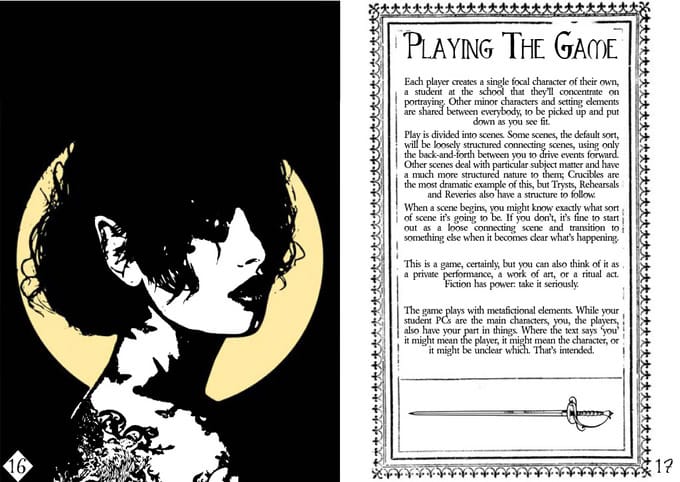
I asked to interview Emily about one of her other works, The Yellow Curtain, an experimental PbtA-inspired storytelling game. In it, a group of theatre students put on a performance of “The Yellow Play.” As they study and rehearse, the line between fiction and reality grows blurry. Just as our students find their experiences of the play bleeding into their lives, so might you, the players. The Yellow Curtain plays with metafiction, inviting you to blur the line between player and character, so I wanted to ask her about the game’s various frames of reference, how she blurs the lines between them, and why.
Emily, in the Drivethrurpg product description, you write that “the game will ask you to consider the way players and their imagined worlds interact.” Why did you want to blur the lines between fiction and reality in this game?
Why did you want to blur the lines between fiction and reality in The Yellow Curtain?
Emily: I don't think there was a single point of inspiration, just lots of little things coming together.
One part of it was watching the anime Review Starlight (RevStar). I'm not sure if you're familiar with it, but a lot of The Yellow Curtains’ elements are drawn from it, and it's a show that's all about theatre. At one point in the concluding movie, there's a moment where a character (who is a sinister talking giraffe, it's that kind of show) turns directly to the camera and explains the themes before exploding. That stuck with me.
In the diegetic events of RevStar, it's all about the way the play that the main characters are rehearsing for bleeds into their lives, and then on top of that it has some stuff to say about the relationship between media and its audience, both in terms of theatre-goers watching a play, and anime fans watching a show.
So that was part of it, I think. A game that starts out as an adaptation of Revstar is going to be about performance, right? So metafiction makes sense as a theme.
And then there's The King In Yellow (TKIY), the other big influence on the game. I have found that there's a certain type of nerd that gets TKIY extremely wrong, who writes of the King as just a Space Tentacle Monster That Drives You Mad. Which misses the point. Within the fiction of TKIY, the play itself is a work of fiction. It's not real. The point of the stories is the way that the play is a sort of memetic virus that tries to escape from the work of fiction it's in, warping people who encounter it to start enacting elements of it. Which is the horror of it, right? It's a story about a work of fiction where the things it depicts escape the fiction and start affecting the world depicted. And then, you — the real life reader — are also reading one such work, and letting those ideas into your mind. That's the horror!
So I had both of these ideas knocking around in my head, the idea of relationships between script, performance, performer and artist, and about ideas and influence that move up and down layers of fictionality. I figured it'd make for an interesting thing to explore, right? At which point if I'm doing it, I might as well go all-in.
This wasn't my first attempt at such things, mind you. I'd played with some meta-adjacent elements in an old experimental game Deep Morphean Transmissions, where memetic viruses affect the way you interact with the game on a meta level. Patrick Stuart did a similar thing with the Dero in Veins of the Earth. A larp I played about ten years ago — Oddyssey — had a strong theme around the power of stories, and elements that highlighted the artifice of the larp. And there had been a horror game I played in at university (A mashup of Pokemon Tabletop Adventures, Lacuna and Mage the Ascension) that went completely off the rails after a couple of player characters realised they were video game PCs rather than real people, and tried to escape to the 'real' world.
So that kind of idea had been floating around for a while, it was just a matter of making a game that focuses entirely on it.
How are bleed and metagaming ways that we interact with our characters or transgress layers of fiction?
Asa: A big part of that focus in The Yellow Curtain is that it is inviting players to blur the lines between themselves and their characters, "to dance on the line between the self-insert and the self" through bleed and metagaming. How are bleed and metagaming ways that we interact with our characters or transgress layers of fiction? And how do you explore that in The Yellow Curtain?
Emily: Well, first up I think that metagaming is basically inevitable, and also a good thing. You're always going to be making decisions on the basis that you're playing a game, and doing that is healthy for the game. There's this pervasive idea you see that metagaming is somehow wrong or cheating, and it pisses me off. Because basically, it's saying — you're familiar with Stances in roleplaying, right? — it's saying that the only valid stance is Actor, and other stances shouldn't be permitted during play. Which is obviously bullshit.
So part of the design was setting up a game that forces you, at times, to play outside of Actor stance. Some of the ways it does this are extremely crude; a character option that makes your PC aware of the game mechanics, or able to hear the table-talk of the game. So even if you're playing exclusively in Actor stance, you're forced to acknowledge the artificiality of the game in character.
I think it's a lot like a Wes Anderson film, right? Everything is set up with framing devices and careful staging to remind you of the artificiality of what you're seeing. It's the same here. I don't want a system that 'gets out of the way' so you can 'just concentrate on the RP', the system is the roleplay, the two are inextricably linked. The fact that your PC is a fictional character can be a plot point in its own right!
If you play it right (and if my design is any good), The Yellow Curtain is a game that's about the act of playing pretend, so those themes are always going to come up. At which point, you might as well use the medium itself to poke at them.
I think one of the key ideas the game's trying to explore is the way that influence moves between layers of fictionality. When the 'real world' intrudes into and affects the fictional world, we call that metagaming. When the fictional world starts affecting the real world, we call that bleed. The two phenomena are reflections of each other, you know?
Why do you feature a play-within-a-roleplaying game as the climactic scene in The Yellow Curtain?
Asa: The climactic scene in this game is when the characters perform “The Yellow Play.” It is a nested performance, a play within a roleplaying game, where players play their player-characters playing their character-characters. Why did you choose this as the climactic scene?
Emily: So the actual answer is that I'm just reusing the plot structure or Revue Starlight. I think it's a natural conclusion to that show's story, so it makes a similar conclusion for the one I'm telling. You spend most of the story struggling for creative control over the art you're making, so it only makes sense for the climax to be the work you finally ended up making, right?
I think in a game that's about intersecting levels of fiction and performance, you want it to end with all the different levels of the fiction collapsing in on a single performance. It gives you a chance to sum up all the themes you've introduced so far, and express them in a single final thesis statement.
Honestly I think more RPG campaigns should conclude with the PCs staring up at their players and saying what the moral of the story is.
What is the power of “play”?
Asa: Throughout The Yellow Curtain, characters contend with one another to manifest “truths” or diegetic facts, and in the climactic scene, the play embodies that thesis statement, “a single great Truth” that “lasts beyond the performance and ripples throughout the world.” It harkens back to early in the game text when you warn that “fiction has power: take it seriously.” What do you see as the power of play in this game, in tabletop RPGs, or otherwise?
Emily: So, I think 'play' is often used in the discourse as, like, this infantilising description of what ttrpgs as a medium do, right? Like you hear people describing the hobby as 'playing with my OCs' or what have you. It's the same pattern you see in people describing the medium as "silly little games", a phrase I've seen pop up a few times on social media that's evidently stuck with me as particularly infuriating.
At the end of the day, I see Tabletop RPGs as part of a broader artform of creative gaming; sitting alongside larp, miniatures gaming, text/pbp RP, journaling games, and others, right? It's the same core activity of exploring fictional spaces through codified rulesets, just through different mediums. But it is, very much, an artform in its own right.
So, if games are an artform, we get the question "why does art matter".
So. Here I am going to sound like a massive pseudo-intellectual, but I think art is hardwired into us. Like to get a bit metaphysical, we don't experience reality directly, we experience reality first filtered through our senses, and then filtered through our internal models of the world, right? How we categorise things, what things mean, how things are connected, these are all things that happen inside our head. Reality is just atoms and void, all that other complex interesting stuff is a product of how our minds interpret and make sense of the world.
And then art is basically an extension of that, right? We have our mental model of the world, where these signs mean this coherent thing. And when we create art, we're reverse engineering it, we take our mental model of something, and work out what signs would produce that mental model if we experienced them, and then put those signs into the world so other people can also experience them and so share our mental model.
By putting these signs into the world for other people to interpret, we spread the ideas inside our heads. The thing we understand about the world becomes something somebody else understands about the world. And that's what art is. It's putting the signifiers of our mental models into the external world to share those mental models with other people.
And sometimes those mental models, those ideas, are good. And sometimes they're bad. But either way, there's a significance to it, right?
So games. Different mediums let you create different signifiers in the world, to communicate different mental models. Drawing is good for visual stuff, music for emotions, and so on and so on. Games let you communicate ideas around choice, interactivity, agency, conflict, power and so on. That's what the medium is, so that's what it communicates well.
When you play a game, you're using its mechanics to create these signifiers on the fly and sharing them with the other players, who perceive and interpret and internalise them. And sometimes what you create and communicate isn't a big deal ("Boblin the Goblin sure is a silly guy!"), and sometimes it's a massive deal, for better or worse ("people deserve a second chance when they do wrong" for the better, or "kill the Othered people and take their stuff" for the worse).
Games matter because they're art and art matters, and art matters because its how we express the fundamental mental models that make up our reality to each other. Right?
So you have a game that makes you think about why you make art and how it affects people, and where the line between fictional and socially constructed and real is, and that's — I think — something that's really exciting to play out and explore, but obviously you gotta be careful with how you handle this stuff because bleed is real and the nature of this sort of game invites bleed.
That's kinda where I'm at, anyway?
What insights can we draw from comparing tabletop RPGs and theatre? And what distinguishes them?
Asa: And The Yellow Curtain is game that is definitely about art. A lot of it is about theatre, specifically, but you also blur the lines between different types of performance. In your glossary, you emphasize that the term “player” is not only “a participant in a game” but also “a synonym for actor.” And you say that this game can sit “in a nebulous space between a private performance, a work of art, or a ritual act.” As my final question, I want to ask, What insights can we draw from comparing tabletop RPGs and theatre? And what distinguishes them?
Emily: The glib answer would be "there's an audience for theatre", but then you have this growing medium of actual play streams, which very much have an audience watching along. So that is perhaps not it.
I think the real distinction generally is that theatre is scripted while roleplaying is procedural. Theatre is just one of the ways to tell a scripted narrative, alongside things like comics, film, novels, radio plays, narrative poetry, and so on. But the point is that it's a thing that you rehearse and refine to produce The Vision as intended by the authors. Whilst roleplaying — and I include larps and wargames and the rest as well as tabletop games — works very differently. You don't know where it will go, you just have these mechanics set up to ensure that your unexpected outcome will be interesting, and the journey to get there will be interesting too, and you just kinda play it out to see where it goes.
It's a lot like sports. A lot of nerds really dismiss sports, but like, I get it. Once you're emotionally invested in a team, and you don't know the outcome, the fact that it's not scripted and you're seeing it all play out live and uncontrolled in front of you is what makes it compelling, right? Same for roleplaying. The excitement is in the process, I think, because you know that what's happening right now matters and will affect the outcome, which hasn't been determined. In that sense, in the same way sports are real, I think roleplaying is real in a way theatre isn't. Not that it isn't fictional, but that it's raw and authentic.
Thanks, Emily! I appreciate your time and your willingness to share your insights! It's been a great opportunity to talk about The Yellow Curtain, which I think more people should read and play, and metagames, which I don't think are discussed enough. I look forward to hearing about the next game that you release!
Essays in This Series
- Essay: Let the Metagames Begin
- Essay: Breaking Fourth Walls and Magic Circles
- Essay: Mini-games and Fragmentation
- Essay: Framing Devices and Games-within-Games
Interviews in This Series
- Interview: Thomas Manuel on Theatre and RPGs
- Interview: Kienna Shaw on Your Magic Circle
- Interview: Emily Allen on The Yellow Curtain and Metagames
- Interview: Cornelia Foote on The Curse of Castle Muldoon