Breaking Fourth Walls and Magic Circles
Games and temporary worlds

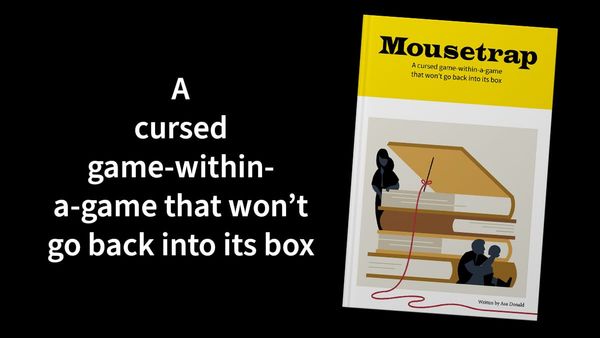
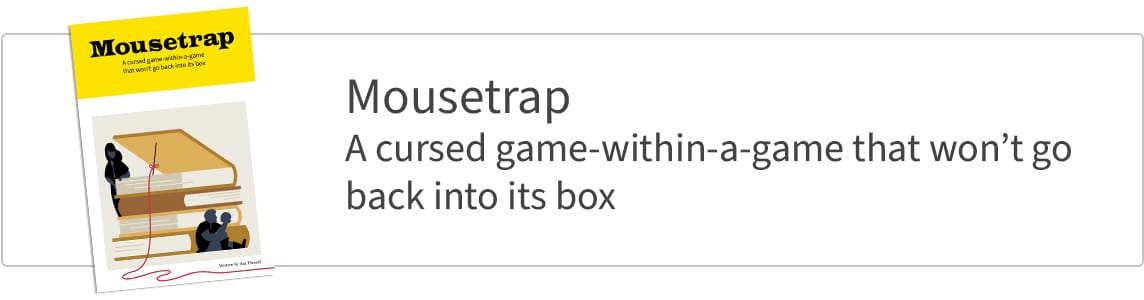
This is the second essay in my series about metagames in tabletop RPGs. This essay is about fourth walls and magic circles. I wrote it in preparation for publishing Mousetrap: A cursed game-within-a-game that won't go back into its box.
In theatre, the fourth wall is the invisible barrier between the performers on stage and the audience of the play. When a character breaks the fourth wall, they typically speak directly to the audience, briefly raising awareness of the fiction or dispelling the fiction entirely. A good example is at the end of A Midsummer Night’s Dream when Puck asks the audience for their applause or at the end of The Tempest when Prospero does the same. In these final scenes, the wall comes down and the magic circle breaks.
As a term derived from western theatre’s spatial layout, the “fourth wall” does not apply to tabletop RPGs, in which the space between performer and audience is not so fixed or clear. “Magic circle” may be the most analogous term, which Johan Huizinga coined to mean “temporary worlds within the ordinary world, dedicated to the performance of an act apart” in 1938.
Huizinga suggests that theatre, as much as games, has a magic circle, and we might envision the fourth wall as a barrier within or around that circle. Our modern emphasis on the term magic circle really comes from Eric Zimmerman (with Frank Lantz in 1999 and Katie Salen in 2003), and Steven Conway orients the fourth wall as part of the magic circle in 2010, arguing that the circle can be not only broken but expanded and contracted.
Personally, I think these temporary worlds are more like an onion than a circle or a wall. I regret that “magic onion” will never catch on as a term. As Shrek and (more recently) the OSR preach: onions have layers. In tabletop RPGs, we can conceive of various frames of reference or layers of reality:
- The external world that informs and distracts our game;
- The immediate conversational context in which we talk about the fiction and interpret rules that are unavailable or invisible to characters;
- The fictional layer(s) in which the reality is narrated to us and within which we play as our characters operating within diegetic rules;
- The embedded fictional layers in which our characters dream up realities or may operate characters of their own.
This distinction between the magic circle and the fourth wall is important in tabletop RPGs. In theatre, for example, the audience observes only the fiction. They rarely see the strings that are pulled behind the stage or before the performance. But in tabletop RPGs, players are pulling those strings and interpreting rules at the same time as observing the fiction.
Moving Between Layers
So, when we speak of breaking the fourth wall or crossing the magic circle, we are talking about transgressing between the diegetic and non-diegetic layers — from the third layer to the second layer of our onion. But there are other transgressions that occur within these layers of reality. For example, a narrator may suddenly be realized as a character within the fiction that they have been telling – what Gérard Genette called metalepsis. There are many fun ways that this can happen in tabletop RPGs. A recent favorite of mine is how “The Narrator” can appear as a monster in Liz Little’s You Will Die In This Place, one who seeks control over the character’s bodies.
 Elizabeth Little
Another example is in Monty Python’s Cocurricular Mediaeval Reenactment Programme, which has layers upon layers of embedded fiction. In this game, you play as medieval characters going on quests — except you are doing it as part of a programme for studio and tv audiences. You primarily operate within the embedded fiction, and the “real” fiction spills into "your" world, sometimes literally:
Outraged history buffs rush the sketch, telescopic pointers and theses swinging. They are non-violent but have a great deal to say about the historical inaccuracy of things. (Prof. Nigel Hampsterplanet’s Beshrewments Table, 137)
At other times, embedded characters point back to the “real” world. Sister Dingo, for example, fancies “having lots of good lines and participating in scenes. She really gives each scene her all and checks with the studio audience every now and then to make sure she’s doing alright.” This game breaks the fourth wall, but it is a fourth wall within the magic circle, transgression from the fourth layer to the third layer.
Breaking the Magic Circle.
As I mentioned, crossing the magic circle is often when the characters seem to be aware of the magic circle, see through it to the real world, or step over the boundary. Each of these are different degrees of “breaking,” and only the most severe degree, I think, captures the forcefulness inherent in that term.
The mildest form is when a character becomes aware that they are a character or that they are in a game. For example, in Savage Worlds, one of the delusions in the Hindrances section reads, “we’re all just characters in a bizarre game.” At the other extreme, characters may directly address a player, verbally or otherwise. In the Munchkin RPG and its Star Munchkin spinoff, there is a “farce” and “farce k’nigit” class that is aware they are in a game and whose abilities interact directly with the GM. In Emily Allen’s The Yellow Curtain, any character can gain the abilities to address the players, hear out-of-character discussion, and understand the game’s mechanics.
These examples are conventional in that the fictional character is the one who initiates the interaction, as you’d expect in fiction, film, and video games. But one of the unique qualities of tabletop RPGs is that the players may be able to initiate this interaction too. Furthermore, they can communicate back to the characters. Another unique quality of tabletop RPGs is that any game can cross the magic circle if its players would like it to; you don’t need rules to facilitate it.
In fact, some would argue that metagaming — using player knowledge and skill instead of a character’s — is an example of crossing the magic circle as a player.
Non-verbal Crossing?
The last element of tabletop RPGs that I’d like to emphasize is that crossing the magic circle does not have to happen through a character’s verbal or non-verbal communication. Tully State Forest by Ravensridge Press is a great example.
Tully State Forest is a scenario for Dread, a GMed game that relies on a Jenga-tower. When you want to do something beyond your character’s normal capabilities or under duress, you pull a block from the tower. A successful pull is a successful task. If the tower falls, your character is removed from the game. In this scenario for Dread, you play as a group of friends on a camping trip in an isolated state forest. A comet passes by and causes a rift in reality, allowing alternate realities to slip into your characters’ fictional world. One of those realities may be the players’...
The characters become trapped within a nexus of parallel realities with doppelgangers and versions of themselves. Odd occurrences happen quickly, but the connection to the players’ reality is paced carefully. In the second act, props are the first thing to draw the player’s attention to the magic circle: a jenga piece, a player’s item (phone, jewelry), an item from the room you’re in.
By act three, the characters learn that to escape this nexus of parallel realities, they need to find “the tower.” While looking for it, they discover a building that resembles the one that the players are currently playing their game in. By this point, “the tower” should have gained new resonance for the players.
When they enter the house, the characters hear music playing. This is the first moment that the magic circle may be pierced, because the scenario uses a music playlist to (1) set ambience and (2) time each act. The music that the characters hear when they enter the building is the same music that the players are listening to at that moment. You can see where this is going.
Crossing, Expanding, Bursting.
However, one of the most interesting things to me is that Tully State Forest positions itself on that boundary between fiction and reality. As a player, you are primed for the characters to cross the magic circle. At this moment of the scenario, you almost expect the characters to walk into the room where you are playing Dread. That is such a cool moment, because you know they cannot and yet you may worry…
When the characters enter the room in the fiction, they cross into the players' reality. But it's not really your reality. Instead, Tully State Forest refers to the players and game master in this scene as non-player characters. Have the player-characters been in an embedded fiction all along? A representation of your reality or potentially a different version of your reality? The magic circle has not been crossed, although the scenario provides the opportunity for characters to speak to the players in a way that can collapse the layers of fiction so that the magic circle may be crossed.
Instead, Tully State Forest expands the magic circle to include items in the players’ reality. In this scene, the GM (NPC) reveals that there are notes taped to the bottom of the players’ chairs, which were going to be clues for the final scene. To get these clues, the real players must check under their chairs, where they will find the notes, in fact. In a remarkable moment of collapsing layers, the magic circle expands into your reality.
That expansion continues when it is revealed that the key for characters to escape this nexus of realities is to knock over the Jenga tower. Players must embody their characters and knock over their tower. The real tower becomes an extension of the fictional world. The act of knocking it over does not cross the magic circle. It goes further. Layers of reality collapse as the magic circle bursts.
The game ends.
If we shadows have offended,
Think but this, and all is mended,
That you have but slumber’d here
While these visions did appear.†
Both, truly.
Essays in This Series
- Essay: Let the Metagames Begin
- Essay: Breaking Fourth Walls and Magic Circles
- Essay: Mini-games and Fragmentation
- Essay: Framing Devices and Games-within-Games
Interviews in This Series
- Interview: Thomas Manuel on Theatre and RPGs
- Interview: Kienna Shaw on Your Magic Circle
- Interview: Emily Allen on The Yellow Curtain and Metagames
- Interview: Cornelia Foote on The Curse of Castle Muldoon