Mini-games and Fragmentation
Mini-games and fragmented stories

This is the third essay in my series about metagames in tabletop RPGs. This essay is about mini-games and fragmented narratives. I wrote it in preparation for publishing Mousetrap: A cursed game-within-a-game that won't go back into its box.
Mini-games
When you think of mini-games, you may think of nested or embedded games that you can play through your characters. In D&D, for example, three-dragon ante is a canonical game nested within The Forgotten Realms with its own set of rules. A deck of three-dragon ante costs 1 gp for your character’s inventory (PHb 5e 154), or $24.99 for your player's personal collection.
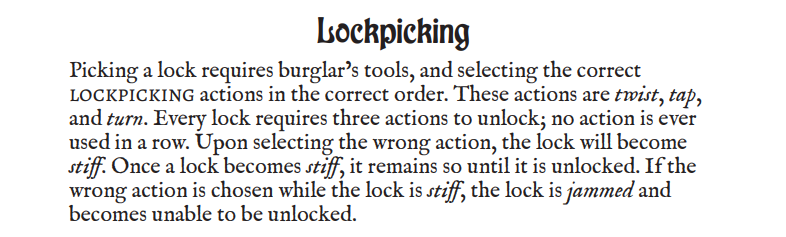
Seemingly distinct from these nested games is another sort of mini-game, integrated into the rules for diegetic tasks, like fishing and brewing potions. Errant, for example, has a mini-game for its lockpicking procedure:
The line between these nested and integrated mini-games can be blurry. Many nested mini-games that characters can play are actually facilitated through non-diegetic rules and procedures. For example, the carnival games of the D&D campaign Wild Beyond the Witchlight often require your player to make skill rolls as part of the mini-game.
In tabletop RPGs, mini-games don’t have to depict something in a game’s narrative. For example, the character creation process could be a mini-game in which you roll to determine details of your character’s life, including whether they suffer a career-ending mishap before the narrative begins... Or maybe encounter creation could be a mini-game for the game master to play solo between sessions and "leveling-up" could be a mini-game for players between sessions.
Other than nested games and gamified procedures, mini-games can include gamified scenes as well, such as the skill challenges of D&D 4e or the chase scenes of Errant and Call of Cthulhu. Some folks refer to combat as a mini-game in D&D. As early as 1979, someone wrote, "Do you realize any [fantasy roleplaying] game is in reality a hierarchy of smaller games? For example, in D&D there is a combat game, a magic game, a guess the magic item game, a role play game, an experience game, a create character game, a find your way out of the maze game, an alignment game, etc." (Alarums and Excursions 51).
I decline to define the boundaries or taxonomies of mini-games, but what I will say is this: Mini-games are pervasive, and tabletop RPGs break into mini-games more than we think. Some games are composed of these fragments.
Mini-game Games
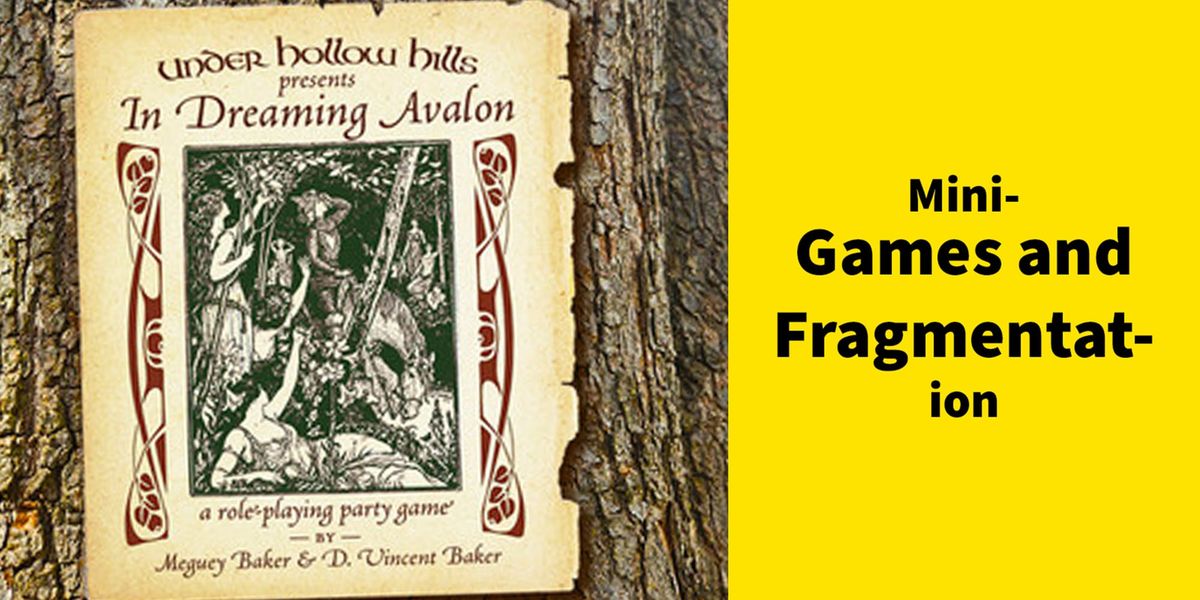
What has me thinking about this subject are the tabletop RPGs that are structured through mini-games, most famously Meguey and D. Vincent Baker’s Mobile Frame Zero: Firebrands, The King is Dead, and In Dreaming Avalon. There are many games inspired by this structure, like Takuma Okada’s popular Stewpot and Rae Nedjadi’s Once More Into the Void. Similarly, Jay Dragon’s Yazeba’s Bed and Breakfast consists of numerous slice-of-life mini-games, and Pidj Sorensen’s Veritable Tales is a roleplaying party game of interconnected mini-games. These are just a handful that excite me.
Most of these mini-games set up discrete scenes, and these scenes connect to form a composite narrative rather than the semi-continuous narrative of some tabletop RPGs. Narrative time is telescoped between scenes, events can happen “off-stage,” and unimportant action can be skipped in the gaps. There are many tabletop RPGs that are structured through discrete scenes like this, but mini-games are distinct.
For example, although Firebrands and Fiasco both break their narrative into discrete scenes, Fiasco is constructed from scenes that players invent whereas Firebrands is constructed from specific types of scenes that characters select on their turns, such as “Stealing Time Together,” “Meeting Sword to Sword,” or “A Free-For-All.” Each of these scene types have pre-defined rules and internal logic that apply to them, such as Stewpot’s “A Funeral,” which disrupts linear time with a prescribed flashback, or Firebrand’s “A Tactical Skirmish,” in which you enable your adversary to spill the blood of your soldiers.
In this way, these mini-games fragment not only the narrative into discrete scenes but also the play experience into discrete games. In fact, in Firebrands, the narrative can fracture into synchronous drama: while some players play a mini-game together, the others can play the solitaire mini-game on their own.
This fragmentation is exciting and challenging to design with. Mini-games resemble an assortment of colored stones: How do players assemble these colored fragments into a mosaic, a “composite” story? Or is narrative coherence the goal, even? The Bakers approach this question from various angles in their Firebrands-style games.
The King Is Dead and In Dreaming Avalon fit into two popular forms. The King Is Dead has a clear, collective arc for a coherent narrative. There is a beginning: the King has died. A middle: Characters vie for the throne while their players collect face cards through the mini-games. And an ending: a final mini-game which determines who ascends to the throne and the fate of the Kingdom. The larger game framework ensures that these mini-games, whichever are selected and in any order, fall into place to create a satisfying mosaic.
In contrast, In Dreaming Avalon is designed in such a way that is satisfying without a narrative arc. Instead, it is an ephemeral dream space, and its mini-games are episodic. As Meg and Vincent Baker say in an interview, “In Dreaming Avalon goes the other way where [structure] matters far less [than The King Is Dead], because all of the episodes are diversions” (23:18). It is “a roleplaying party game” after all, and it ends with characters waking from their dreams.
And then, there is the original Firebrands, which doesn't have a central arc like The King is Dead, and neither is a complete character arc guaranteed. In the same interview, when asked, “How do you move from game to game in a coherent narrative for your character [in Firebrands]?” Vincent Baker replies, “You don’t get to” (18:40). That’s because Firebrands is a game in which you may pursue a character arc but rely on the other players to make it happen through the games they select and the decisions they make. Although every mini-game is satisfying on its own and the game supplies an ending for closure, there’s a chance that your character’s story may not be complete or satisfying by the end.
Firebrands is fantastic. I love its character-driven scenes, and the drama they generate. And yet it leaves me wanting more. I don't know how to put it except that it provides closure but not a conclusion, in a way that is perhaps "traditional" for some tabletop rpgs, which continue from story to story and campaign to campaign. Firebrands itself is designed to be continued or integrated with the Mobile Frame Zero LEGO games: Rapid Attack and Intercept Orbit. The game text suggests you can “alternate playing” these games: “when one game finishes, build on its events to set up the next game” (30).
Briefly, Stewpot and Yazeba’s work so well in part because they are in the “slice-of-life” genre, which is often episodic or presented as vignettes. Even so, Yazeba’s unifies each of its mini-games or “chapters” within a largely pre-written storyline that follows Gertrude, a teenage girl who has run away from home and the found family that she discovers in a magical bed & breakfast.
In Violent Delights, I incorporate the mini-games into a game of chess — whenever you capture a piece, you can play a mini-game to simulate what happened — and the chess game is re-skinned as the masquerade scene in Romeo & Juliet, driving the overarching narrative. Chess provides a framework, and the mini-games zoom in on individual scenes.
Alternating Mini-games
Believe it or not, the most bizarre narrative structure I've seen comes out of an obscure game from 1983, which has recently been reconstructed in a commentary by Dr. Cornelia Foote. The Curse of Castle Muldoon is a fragmentary manuscript of a tabletop RPG from 1983. Written by eccentric designer Houdini Moon, Muldoon consists only of a series of bizarre scenes, without any rules for play — no character creation, no stats, no procedures. All of them have been lost to time. Dr. Foote sought a way to experience the game without having to reconstruct the missing pieces or modify existing content. Her solution was a framework that strings these scenes together through Firebrands-style mini-games.
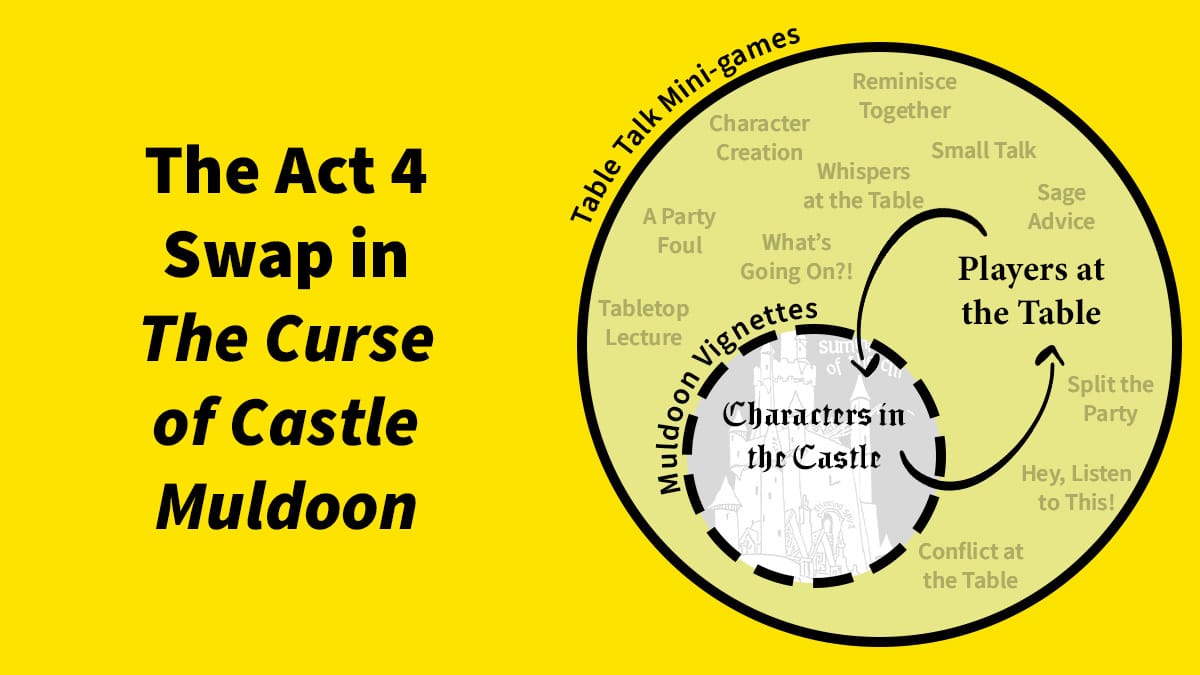
Character creation, dice rolling, metagaming, arguments over rules: to make the play experience as complete as possible without inventing new rules, Dr. Foote recreates these experiences as “table talk” mini-games, which alternate with the original scenes. Whereas the scenes progress through a broad sequence of events — Act 1 through Act 5 — these mini-games depict player relationships at the table, with little narrative progression.
Alternating between mini-games and scenes helps players move between the different layers of reality: that of the table and that of the game played at the table. In between the mini-games and scenes, the unnecessary bits can be glossed over, not just plot points but inconvenient questions about the game’s rules or stats that no longer exist.
Her structure even works with Muldoon’s most peculiar feature: in Act Four, some of Moon’s scenes inexplicably inform you that your character switches bodies with your player. Is this meant to actually happen in play? Surely not... But in this framework, the character of the Muldoon scenes is pulled into the table talk mini-games. And your "player" at the table is suddenly your character in the fiction.
Although the mini-games still have the same internal logic and mechanics when you play them, “you” are asked to engage with them from a new vantage — your character’s perspective. This is welcome, as mini-games can wear out their welcome after being played once or twice with the same character!
And yet, as with Firebrands, The Curse of Castle Muldoon may have closure but no conclusion. Moon has written a postmodern revenge tragedy in that the game seems to end with not only everyone dead but also one or more "players" still trapped inside Muldoon. The story, it seems, is not incomplete, per se, but partial — it leaves you wanting more. For the players among us who crave resolution, Dr. Foote has sprinkled secrets into the footnotes that seem to suggest that such an ending is possible, although you may need to play a second or third time to find it.
Conclusion
The tabletop RPG is a form that is skeptical of single, defined narratives. The narratives that we create rely on the consensus of multiple players, and the authority for composing the story is distributed among these players. The games that I’ve mentioned in this essay fragment the narrative into scenes and they fragment play into different games, constantly changing the rules and internal logic. With each mini-game, authority and authorship is distributed differently.
In games like The King is Dead, the players are responsible for assembling the pre-defined scenes in relation to one another, but the larger game framework organizes these fragments into a satisfying narrative. Other games like In Dreaming Avalon dispel the need for an overarching narrative, although the larger framework still provides closure.
In games like Firebrands and The Curse of Castle Muldoon, players get closure but not a conclusion. When the mosaic reaches completion, its picture may seem partial, like it may be part of something larger. If you want more, you must look outside of the game. In Firebrands, you might integrate the Mobile Frame Zero LEGO games. In The Curse of Castle Muldoon, the blueprint (it seems) is spread across Dr. Foote’s notes.
Essays in This Series
- Essay: Let the Metagames Begin
- Essay: Breaking Fourth Walls and Magic Circles
- Essay: Mini-games and Fragmentation
- Essay: Framing Devices and Games-within-Games
Interviews in This Series
- Interview: Thomas Manuel on Theatre and RPGs
- Interview: Kienna Shaw on Your Magic Circle
- Interview: Emily Allen on The Yellow Curtain and Metagames
- Interview: Cornelia Foote on The Curse of Castle Muldoon