🎤 Cornelia Foote on Metagames, Mini-games, and Muldoon
An interview with the editor of The Curse of Castle Muldoon (1983)

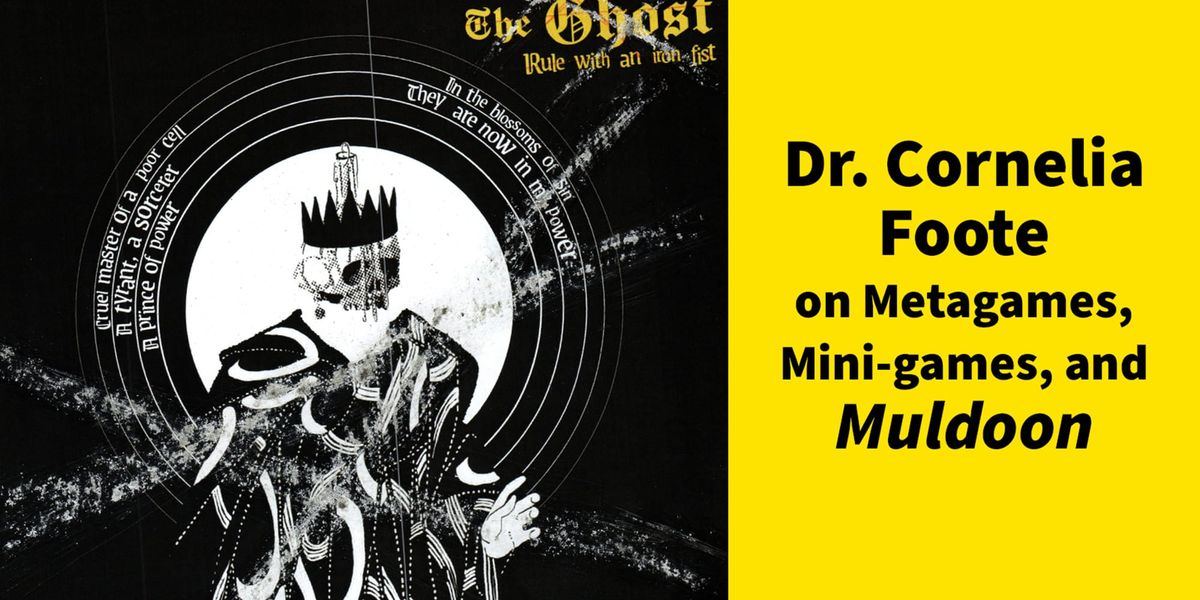
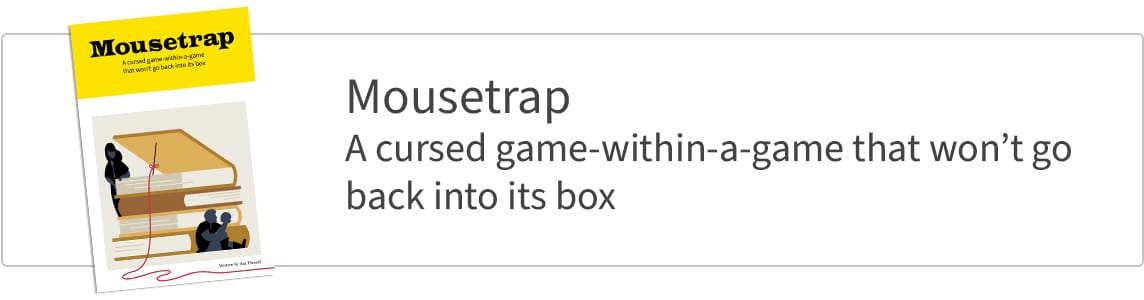
This interview is the last in my series about metagames in tabletop RPGs. I conducted it in preparation for publishing Mousetrap: A cursed game-within-a-game that won't go back into its box.
Dr. Foote kindly agreed to answer an additional question in the attached addendum (11/21/2026), after doubts of her existence were raised on social media.
Cornelia Foote is an assistant professor of English and Modern Languages and editor of The Curse of Castle Muldoon by Houdini Moon, a game inspired by Hamlet, originally written in 1983, and which exists only in fragments. Informed by Moon’s notes and supplemented by the playtesting documents that were preserved upon Moon’s death, Foote has spent the last seven years preserving the game. Foote’s critical commentary is expected to establish Moon as an early innovator in the tabletop RPG art form.
This is the second piece on my blog that features Dr. Foote, who is a personal friend of mine. The first was The GM is Dead, which we co-wrote about Firebrands mini-games. I've also written on Foote's forthcoming commentary in my post on Mini-games and fragmentation.
I invited Dr. Foote to talk about metagames, mini-games, and the purpose of games, as she prepares to publish her first book.
Cornelia, before we jump into discussing metagames, maybe you could give us a little more context. What is The Curse of Castle Muldoon?
What is The Curse of Castle Muldoon?
Cornelia: The Curse of Castle Muldoon is a tabletop RPG from 1983, based loosely on the plot of Hamlet. You take on the role of an attendant lord, lady, or guest who is trying to solve a mystery in a gothic castle. Or you're supposed to, except that only fragments of Castle Muldoon survive now.
The manuscript was written by Houdini Moon, who was a playwright as well as an eccentric, amateur game designer during the late 70s and early 80s. He's largely unknown to all but his contemporaries following a tragic incident that led to his arrest and prematurely ended his career.
I discovered his manuscript in 2019 while performing archival research for a project on “prison Shakespeare” initiatives. And at that point, Castle Muldoon was just a bound pile of pages that I found among his handwritten notes in a box labeled “4 Oct. 1983.” Its basis in Hamlet caught my attention, and although many of the rules were lost or destroyed, the game’s narrative approach seemed ahead of its time. I thought it might be historically significant, and I've spent the better half of the last decade preserving it and writing this commentary.
What is a metagame? And how does that affect Castle Muldoon?
Asa: As you said, The Curse of Castle Muldoon (1983) exists only in fragments. So, to make it playable without modifying its rules or content, you situate it within a mini-games framework that simulates a game night among friends, effectively making Muldoon a game-within-game, a metagame. What is a metagame? And how does that affect Castle Muldoon?
Cornelia: A metagame is a game that effectively reveals something about the form and its cultural significance. Castle Muldoon is a game-within-a-game, but I didn't set out to write a metagame. It's a meta-game purely out of necessity, because this was the only way that I could simulate playing a fragmentary game. I didn't want to “reconstruct” its missing rules or modify Moon’s creation. That felt wrong to me, unethical. I wouldn't be preserving the text. That would be rewriting it, creating the game anew.
Asa: Some of the metacommentary seems intentional. Your mini-games probe at the nature of games and the discourse that surrounds them. One of the games invites discussion on “where the game ends and reality begins.”
Cornelia: That’s how game nights are, in my experience, at least with tabletop RPGs. My playgroup likes to discuss how, in tabletop RPGs, we’re always navigating back and forth between our characters and ourselves. And sometimes that line feels pretty blurry. To some extent, we’re always aware that we’re playing a game, unless we’re completely immersed. And going back and forth between your mental picture and reality invites us to think about games and RPGs and how they work. Maybe that isn’t how you experience game nights, but that’s okay, because the goal here is to simulate a game night in which you play Castle Muldoon, and as strange as it sounds, this would be a very standard experience with this game.
What challenges did you encounter while playtesting Castle Muldoon?
Asa: That’s a good segue into my next question, which is about gameplay. In addition to the peer review process for a book like this, you also had to playtest the framework that you provided, which is certainly a unique experience for an academic. Can you tell me a little bit about your playtest experience with this game? What challenges did you encounter?
Cornelia: I had a lot of trouble writing Firebrands mini-games, each of which are like their own game to playtest but where you also have a high density of language, if you want a game to sit effectively on one spread, and require evocative if not poetic pick lists. So, that was a challenge.
But more than anything else, Castle Muldoon can have a significant emotional toll on a person, even in playtesting, as we discovered. After playing the game myself, I was shocked at how faithfully the framework was able to recreate Muldoon. More shocking yet, I realized that Moon had accomplished something more frighteningly grand than I anticipated, although not without its own equally frightening defects.
Asa: Can you say a little bit more about that? What do you mean by “frightening defects”?
Cornelia: I would say that Castle Muldoon brings characters to life in a way that I haven't experienced before. But to be honest it’s a little tender still and difficult to talk about. I’d like to pass on this question, and you can find out more in the book when it comes out.
Or, in the interim I recommend checking out A. V. Dosmukhamedova's "Independent Agent vs. Rational Being — Character Outside Context." She gets at a similar experience, the reification of characters.
Why did you choose to alternate between Firebrands-style mini-games and the vignettes of Castle Muldoon?
Asa: You mention playtesting your mini-games, which are based on Meguey and Vincent Baker’s Firebrands. Why did you choose to alternate between Firebrands-style mini-games and the vignettes of Castle Muldoon?
Cornelia: Firebrands is the origin of these mini-games, but really I was thinking of The King is Dead when writing these, an appropriately named model for a game based on Hamlet! One of the reasons that I was interested in mini-games is that Houdini Moon was a dramatist, and you can see that in Castle Muldoon, in which the gameplay is divided into scenes called “vignettes.” And these mini-games are very dramatic. They are generic or repeatable scenes, in some way. So, they capture that element well and complement the vignettes, which are mini-games, in their own right!
As you said, in my edition of Castle Muldoon, players alternate between their mini-games simulating game night and the vignettes in their fictional castle. And one of the reasons why this works is because both scenes and mini-games fragment the story, implying what has happened in the cracks or allowing us to imagine it for ourselves in very fruitful ways.
What is the purpose of games?
Asa: People often insist that the point of a game is to have fun, but I don’t think that’s always the case. Castle Muldoon looks like a lot of fun, for example, but I know that you have written it for educational reasons — so that people can experience this historical game as closely as possible to its original state. In your mind, is “fun” the only valid purpose of a game? What are other purposes of games?
Cornelia: That’s really a trick question, because I think we also need to ask, “For whom?” Like, with Castle Muldoon, Moon was really writing it for himself, and it was almost certainly not about having fun. Really, it was about escape and escapism for him, and he was writing it during a challenging time in his life, while he was in prison. Usually, we think of games as offering escapism for players, so it's interesting to consider how games can offer escape for designers as well.
But for players of Castle Muldoon, I think it’s the mirror image. Again, the game is fun, but its purpose for us is something different, a mirror image of Moon’s. The game starts out fun, but instead of distracting us from reality, it shows us how to appreciate it more...
I’ll end by saying that games are often designed with a purpose, but a player may have something else in mind. As an academic, I am not always playing for fun but for research and to appreciate the art form.
ADDENDUM: Cornelia, are you real?
Asa: Thank you for agreeing to answer another question, in light of the recent claims that you aren't real. Obviously, I know you're real, and we co-wrote a blog post earlier this year. But some of my readers have suggested that you are nothing but "a cute little hoax" or "a tasty little [media] stunt" for Mousetrap. It's an awkward question, but I have to ask it... Cornelia, are you real?
Cornelia: What if I said no?! Wouldn't that be awkward for you to include at the end of our interview? I mean, I'm obviously real. It's a funny thing in the 21st century when so many things are Google-able that we assume anything that isn't is a hoax. I'll point out that my dog isn't Google-able, but she's still very real! Of course, I understand the impulse to verify everything in an age of mis- and dis- information, so I don't want to make light of it.
Maybe I can just end by saying, if I were a hoax, you would have had to go to incredible lengths to roleplay as me. At minimum, fake co-writing a blog post, writing about my critical commentary, writing the commentary itself, conducting a fake interview... Not to mention my prior academic publications. All for what? How many hits do you get on this website?
Asa: Around 1400 unique visitors each month, actually.
Cornelia: Yeah, not impressive! I'm just saying, the world we live in, our history already has plenty of stranger-than-fiction stories. You'd have to be a fool to make one up when so many are under your nose.
Thanks, Cornelia.
It's been great to talk about The Curse of Castle Muldoon. I look forward to playing it when it finally releases.
Find out more about Cornelia's work on The Curse of Castle Muldoon in my upcoming Kickstarter:
Essays in This Series
- Essay: Let the Metagames Begin
- Essay: Breaking Fourth Walls and Magic Circles
- Essay: Mini-games and Fragmentation
- Essay: Framing Devices and Games-within-Games
Interviews in This Series